

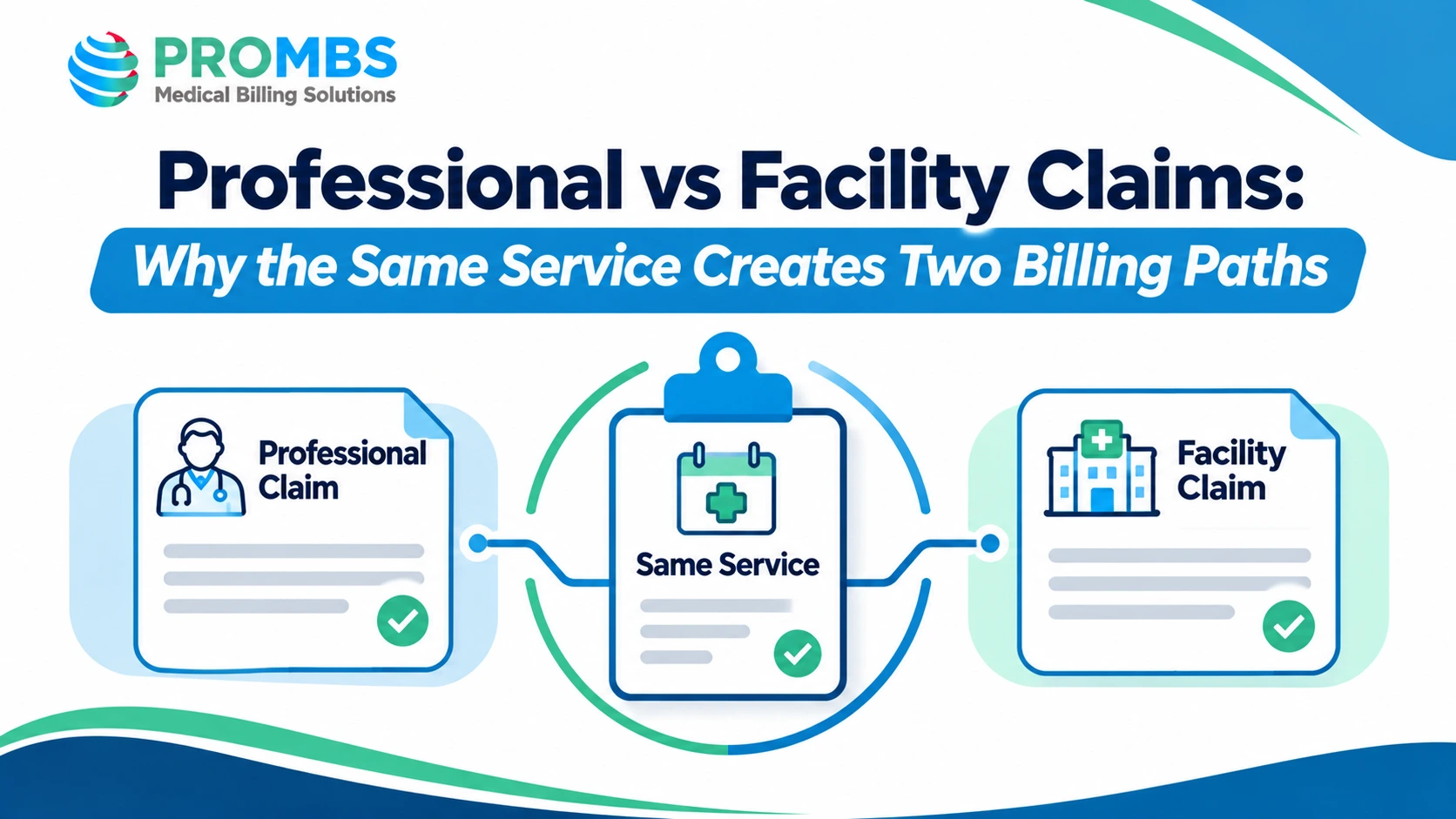
A patient visits the emergency department after experiencing severe abdominal pain. A physician evaluates the patient, orders diagnostic tests, reviews the results, and recommends treatment. The patient receives the necessary care and returns home, believing the hospital visit is complete.
Several weeks later, two insurance claims appear in the patient’s health plan records. One comes from the emergency physician or medical group, while the other comes from the hospital. Both claims relate to the same visit, yet they contain different charges and may be processed under different reimbursement rules.
For patients, this can be confusing. For medical billing teams, it represents an important distinction between the professional services provided by healthcare practitioners and the institutional resources used to deliver care.
Understanding professional vs facility billing helps explain why a single encounter may involve separate claims, different billing entities, distinct coding requirements, and different insurance payment methodologies.
The distinction is particularly important for hospitals, physician groups, outpatient departments, surgical centers, and medical practices operating across multiple care settings. When billing teams fail to identify the correct claim pathway, the result can be inaccurate charges, claim rejections, reimbursement discrepancies, or avoidable administrative work.
This guide explains what professional and facility claims represent, how their billing formats differ, and why one medical encounter may involve more than one legitimate insurance claim.
What Is the Difference Between Professional and Facility Billing?
Professional billing generally covers the services of physicians and other eligible healthcare practitioners, while facility billing covers services and resources furnished by hospitals and other healthcare facilities under applicable payment rules.
The difference lies primarily in what is being billed, which entity is responsible for billing it, and how the insurance payer processes the claim.
When a physician treats a patient inside a hospital, the physician’s professional work and the hospital’s institutional services may represent separate payable components of the encounter.
The physician may provide medical decision making, perform a procedure, or interpret diagnostic findings. Meanwhile, the hospital provides the clinical environment, nursing staff, equipment, supplies, and other resources necessary to furnish the care.
These responsibilities can exist during the same encounter without representing duplicate billing.
However, separate professional and facility charges are not automatically appropriate for every service. The actual billing arrangement depends on the type of provider, location, applicable payer policies, and whether the services qualify for separate reimbursement.
What Does Professional Billing Cover?
Professional billing represents the medical services furnished by physicians and other eligible healthcare practitioners.
These services may include office visits, hospital evaluations, consultations when separately recognized by the payer, procedures, surgeries, diagnostic interpretations, and other covered professional activities.
For example, an orthopedic surgeon who performs a procedure at a hospital may submit a professional claim for the surgical work. That claim represents the surgeon’s covered professional service rather than the hospital’s operating room, nursing staff, or equipment.
Similarly, an emergency physician may bill for evaluating and treating a patient in the emergency department, even though the hospital separately reports its institutional services.
Professional billing is not limited to independent medical practices. Physicians employed by hospitals and other organizations may also provide services that are billed through the professional claim pathway when applicable.
The critical factor is the nature of the service and the applicable billing arrangement, not simply whether the clinician works inside or outside a hospital.
What Does Facility Billing Cover?
Facility billing generally represents services and resources furnished by an institutional healthcare provider.
For a hospital, these resources may include nursing care, operating rooms, recovery areas, diagnostic equipment, medical supplies, and other services reported under the applicable hospital payment methodology.
For example, when a patient undergoes outpatient surgery, the hospital may bill for covered facility services associated with the surgical encounter. These may include operating room resources, recovery services, and other hospital services included or separately reportable under the applicable rules.
The surgeon’s professional work is generally handled separately when it qualifies for professional billing.
An important distinction is that a facility claim does not necessarily produce separate reimbursement for every resource used during treatment. Medicare and commercial insurers may package or bundle certain services into broader payments.
Therefore, the presence of a facility charge does not automatically mean that every listed item qualifies for an independent payment.
Why One Healthcare Encounter Can Involve Two Billing Entities
A medical encounter may involve multiple organizations or professionals with different billing responsibilities.
Consider a patient undergoing an outpatient procedure at a hospital.
The surgeon provides professional care, while the hospital furnishes the institutional resources required for the procedure. The anesthesiology professional may also perform separately billable services.
Depending on the arrangement, these services may generate multiple claims.
The hospital bills for its institutional services, and the physician or authorized billing organization submits the professional claim. An anesthesia provider may submit another professional claim when appropriate.
This does not necessarily mean that the patient received the same service multiple times. Rather, different providers or entities furnished different components of the overall care.
The claims must accurately reflect those responsibilities, and each must satisfy the applicable coding, documentation, and payer requirements.
What Is a Professional Claim in Medical Billing?
A professional claim is a request for reimbursement for covered healthcare services furnished by a physician or another eligible practitioner or supplier through the professional claim submission pathway.
Under Medicare, professional and supplier claims generally use the CMS-1500 paper claim form or the electronic 837P transaction.
The Centers for Medicare & Medicaid Services identifies the 837P as the standard electronic format used by healthcare professionals and suppliers to submit professional claims.
These claims communicate information about the patient, insurance coverage, healthcare provider, services performed, diagnoses, and other details required for payment processing.
Who Submits Professional Claims?
Professional claims are commonly submitted by individual practitioners, physician groups, and authorized organizations billing for professional services.
Examples include family medicine physicians, cardiologists, surgeons, orthopedic specialists, radiologists, anesthesiology professionals, and other eligible practitioners.
A physician does not necessarily submit the claim personally. A medical group, employer, billing department, or authorized billing service may handle claim submission under the applicable billing and enrollment arrangements.
For example, an independent cardiology practice may submit professional claims for office evaluations and covered diagnostic services performed by its providers.
A cardiologist furnishing professional services in a hospital may also have those services billed through the professional pathway, even though the hospital separately bills for its institutional services.
The organization responsible for the professional claim must have the appropriate payer enrollment and billing relationships.
This becomes especially important when physicians work at multiple locations or maintain relationships with more than one medical group.
What Services Are Included in Professional Billing?
Professional claims can represent a broad range of covered medical services.
Evaluation and management services are among the most familiar examples. These include qualifying office visits, hospital visits, and other encounters where eligible practitioners evaluate and manage patient care.
Procedures and surgeries may also generate professional charges. A surgeon performing an operation may report the appropriate surgical service based on the documented procedure and applicable coding rules.
Diagnostic services introduce another distinction. When an eligible diagnostic procedure has separately recognized professional and technical components, the physician’s interpretation may be billed using the appropriate professional component reporting method.
For example, a radiologist may interpret an imaging study performed using hospital equipment. The physician’s interpretation and the hospital’s imaging services may follow different billing arrangements.
However, not every diagnostic service permits component billing, and modifier 26 or TC should only be used when applicable under the relevant coding and payment rules.
These details matter because professional billing involves identifying exactly which service the practitioner furnished rather than assigning charges based solely on the patient’s location.
How CMS-1500 and 837P Claims Work
The CMS-1500 is the standard paper claim form used by eligible noninstitutional healthcare providers and suppliers. Its electronic counterpart, the 837P, is the standard professional electronic claim transaction.
Electronic submission is the normal Medicare claims submission method unless an applicable exception permits paper billing.
The official CMS Medicare Billing: CMS-1500 and 837P guide explains the professional claim format and reporting requirements.
A professional claim commonly includes the following information:
| Claim Information | Purpose |
|---|---|
| Patient and subscriber details | Identifies the patient and applicable insurance coverage |
| Billing provider NPI | Identifies the provider or organization billing for the service |
| Rendering provider NPI | Identifies the practitioner who rendered the service when required |
| Diagnosis codes | Reports the conditions relevant to the billed services |
| CPT or HCPCS codes | Identifies the procedures and services reported |
| Place of service code | Identifies the setting where the service was furnished |
| Modifiers | Provides additional information when required by applicable coding rules |
| Units and charges | Reports the quantity of services and associated billed charges |
One particularly important element is the place of service (POS) code.
Professional claims generally use POS codes to identify where the patient received the service. For example, POS 11 commonly identifies an office, while POS 21 identifies an inpatient hospital and POS 23 identifies a hospital emergency room.
For services paid under the Medicare Physician Fee Schedule, the reported place of service can affect the applicable facility or nonfacility payment rate.
This is a separate concept from a hospital’s facility claim. A professional service may be paid at a facility setting rate without becoming an institutional claim.
Accurate place of service reporting is therefore essential when physicians treat patients across offices, hospitals, and outpatient departments.
What Is a Facility Claim in Medical Billing?
A facility claim generally represents covered healthcare services furnished by an institutional provider under the applicable billing rules.
Hospitals and other qualifying institutional providers typically submit these claims using the CMS-1450 paper form, commonly called the UB-04, or the electronic 837I transaction.
Unlike a professional claim, which primarily identifies covered practitioner or supplier services, an institutional claim reports services furnished by the facility and includes information needed for the relevant institutional payment methodology.
The difference becomes especially important when distinguishing hospital inpatient care from hospital outpatient services.
Which Organizations Submit Institutional Claims?
Institutional claims are commonly submitted by hospitals, skilled nursing facilities, home health agencies, hospices, and other eligible institutional providers.
The specific claim requirements depend on the provider type, coverage program, and services involved.
For hospitals, the billing department must distinguish between inpatient and outpatient encounters because the applicable coding, claim reporting, and reimbursement rules can differ significantly.
For example, a patient formally admitted to a hospital as an inpatient may generate an institutional claim that is processed under inpatient hospital payment rules.
A patient receiving outpatient diagnostic services at the same hospital may generate an institutional outpatient claim instead.
Although both encounters occur within a hospital, their billing classifications and payment methodologies are not necessarily the same.
Not every healthcare facility uses institutional claim transactions. Certain facilities, including Medicare participating ambulatory surgical centers under the ASC payment system, use professional claim formats for their facility services. This important exception will be examined in Part 2.
What Resources Are Represented by Facility Charges?
Hospital facility charges are associated with the institutional services and resources used to provide patient care.
These can include operating rooms, nursing services, recovery areas, diagnostic equipment, supplies, therapeutic services, and other covered hospital resources.
The way those services appear on a claim depends on the care setting and applicable billing rules.
For example, an outpatient hospital visit may involve several charge categories related to the services furnished during the encounter.
However, the insurance payer may package some of those services into a single payment or apply other reimbursement rules that prevent separate payment for every charge.
Inpatient hospital payment often involves a different approach, where the hospital receives payment according to an applicable inpatient classification and payment system rather than simply collecting a separate fee for each routine item.
This distinction explains why facility charge capture, institutional coding, and payment reconciliation require their own review processes.
Hospital billing teams must determine which services should be reported, how they should be classified, and whether the supporting documentation satisfies the payer’s requirements.
How UB-04 and 837I Claims Work
The UB-04, officially Form CMS-1450, is the standard paper claim format for institutional providers. The 837I is the corresponding electronic institutional claim transaction.
The CMS Medicare Billing: CMS-1450 and 837I guide explains the information required for institutional claims and their electronic submission.
A hospital claim includes many elements also found in professional claims, such as patient details, diagnosis information, dates of service, and provider identification.
However, institutional claims use additional information needed to identify the type of facility and services being billed.
Revenue codes are an important example. They identify categories of institutional services or accommodations and support the reporting of hospital charges.
The type of bill code is another important field. It communicates information about the institutional provider, the general type of care, and the claim’s billing frequency or sequence.
Inpatient hospital claims may also require ICD-10-PCS procedure codes for reportable inpatient procedures, while hospital outpatient claims frequently use CPT or HCPCS codes for applicable services.
These requirements differ from the structure of a typical physician professional claim.
A hospital cannot simply convert a professional claim into an institutional claim by changing the form name. The correct billing pathway requires the appropriate entity, codes, supporting documentation, and transaction details.
Professional vs Facility Billing: Key Differences at a Glance
The following comparison summarizes the main differences between typical professional claims and hospital institutional claims.
| Billing Feature | Professional Billing | Hospital Facility Billing |
|---|---|---|
| Primary purpose | Reimbursement for covered practitioner or supplier services | Reimbursement for covered hospital services and resources |
| Typical billing entity | Physician, eligible practitioner, medical group, or authorized organization | Hospital or other eligible institutional provider |
| Paper claim format | CMS-1500 | CMS-1450 / UB-04 |
| Electronic transaction | 837P | 837I |
| Service identification | CPT/HCPCS with applicable modifiers | Revenue codes, applicable CPT/HCPCS, and other institutional coding |
| Diagnosis coding | ICD-10-CM | ICD-10-CM |
| Inpatient procedure coding | Professional procedure reporting uses applicable CPT/HCPCS codes | ICD-10-PCS when required for inpatient institutional reporting |
| Location information | Place of service codes | Institutional provider and type of bill information |
| Medicare payment method | Often Physician Fee Schedule for physician services | IPPS or OPPS for applicable hospital services |
| Typical example | Emergency physician’s evaluation | Hospital emergency department services |
These differences influence more than the appearance of a claim.
They affect charge capture, provider identification, coding reviews, claim edits, reimbursement calculations, and payment reconciliation.
For example, a physician’s professional claim may pass the payer’s validation process while the related hospital claim encounters a separate coding or coverage issue.
The reverse can also occur.
Because each claim follows its own processing requirements, payment of one component does not automatically guarantee payment of every other component associated with the encounter.
For healthcare organizations managing both billing pathways, understanding these differences is essential for identifying where an error occurred and which team is responsible for resolving it.
Does One Medical Service Always Create Two Claims?
No. A healthcare encounter does not automatically generate separate professional and facility claims. Whether multiple claims are appropriate depends on the services provided, billing entities involved, care setting, payer requirements, and applicable payment arrangements.
An independent physician’s office typically submits professional claims for the services furnished by its practitioners. A routine office visit does not automatically create a separate hospital facility claim simply because the practice uses medical equipment or employs clinical support staff.
A hospital emergency department presents a different situation.
The physician may furnish a separately billable professional service while the hospital reports its institutional emergency department services. Depending on the payer and contractual arrangements, both components may generate separate claims.
An outpatient surgery may involve even more billing entities. The surgeon, hospital, and anesthesia professional may each have distinct billing responsibilities.
At the same time, some payment arrangements bundle particular services or do not permit separate reimbursement for specific components.
Therefore, the number of claims should never be determined simply by counting the healthcare professionals who participated in an encounter or the resources used.
Why Separate Claims Are Not Automatically Duplicate Billing
Two claims associated with the same patient, service date, and general episode of care are not necessarily duplicates.
The billing team must determine whether the claims represent distinct payable services or whether an inappropriate overlap has occurred.
For example, the physician’s professional evaluation and the hospital’s emergency department facility services may be separately reportable under their respective payment rules.
However, billing the same covered professional service more than once without an appropriate basis can raise duplicate billing concerns.
A valid distinction requires examining the actual billed services, reporting entities, procedure codes, documentation, and payer requirements.
This is where professional vs facility billing becomes closely connected to charge capture reconciliation.
A complete reconciliation should account for the services furnished and identify which billing entity is responsible for each appropriate charge. It should not assume that every clinical activity requires a separate claim or that every encounter should produce exactly one claim.
Organizations using professional medical billing services should maintain clear visibility into these relationships, particularly when their providers deliver care across independent offices and hospital settings.
Understanding these billing responsibilities is the foundation for accurate claim processing. Once the professional and facility components have been identified, the next question is how the distinctions work during actual medical encounters.
An emergency department visit, an outpatient surgery, a diagnostic imaging service, and a hospital owned clinic can each involve different billing arrangements.
Why Can the Same Patient Encounter Generate Two Claims?
A single medical encounter can involve several services furnished by different healthcare professionals and organizations. Although the patient may receive all those services during one hospital visit, the insurance claims may follow separate billing pathways because each entity has different responsibilities and reimbursement arrangements.
Consider a patient who visits a hospital emergency department with a possible wrist fracture. The emergency physician evaluates the injury, orders an X-ray, reviews the findings, and recommends treatment. Meanwhile, the hospital supplies the examination room, nursing personnel, imaging equipment, and other resources needed to provide care.
The physician’s evaluation and the hospital’s institutional services may be billed separately. If an independent radiologist interprets the imaging study, an additional professional claim may also be appropriate.
Understanding professional vs facility billing requires looking beyond the patient’s appointment or service date. Medical billing teams must identify who furnished each service, which organization has the right to bill for it, and how the applicable payer recognizes the charges.
The following examples demonstrate how those responsibilities differ across common healthcare settings.
Example 1: Professional and Facility Billing in the Emergency Department
Emergency departments provide one of the clearest examples of separate professional and institutional billing.
A patient experiencing severe chest discomfort arrives at a hospital emergency room. The clinical team evaluates the patient, performs diagnostic testing, monitors their condition, and determines whether further treatment or hospital admission is necessary.
The patient receives care in one location, but the physician and hospital may have different billing responsibilities.
What the Emergency Physician Bills
The emergency physician’s professional claim represents the covered medical evaluation and management services personally furnished by the physician or other eligible practitioner.
The physician evaluates the patient’s symptoms, considers possible diagnoses, orders appropriate testing, interprets available clinical information, and establishes a treatment or disposition plan.
For professional emergency department evaluation and management services, CPT codes 99281 through 99285 are used when their respective requirements are satisfied.
The selected professional E/M level must reflect the documented service and applicable coding guidelines. For emergency department E/M services, the current professional coding framework generally relies on medical decision making rather than the amount of time the physician spends with the patient.
The professional claim is typically submitted through the CMS-1500 or electronic 837P pathway.
For services furnished in a hospital emergency room, the professional claim generally reports place of service code 23 when applicable. That code identifies the setting as an emergency department rather than an independent physician office.
The physician’s professional claim does not automatically include the hospital’s separate institutional expenses.
What the Hospital Bills
The hospital’s institutional claim represents the facility services furnished during the emergency department encounter.
These may include nursing services, treatment space, supplies, diagnostic equipment, medications, and other applicable hospital resources. The facility reports services according to its institutional billing rules and the applicable payer requirements.
For Medicare hospital outpatient billing, qualifying Type A emergency department visits generally use CPT codes 99281 through 99285 for facility visit reporting. Certain Type B emergency departments use HCPCS codes G0380 through G0384.
The hospital reports these services through its institutional billing pathway, generally using the UB-04 or electronic 837I format.
Additional diagnostic or therapeutic services may also be reported when appropriate, although Medicare outpatient payment rules may package particular services into the payment for another service.
This means the hospital’s reported charges and the final amount paid by Medicare are not necessarily calculated as independent payments for every resource used.
Why Professional and Facility E/M Levels May Differ
One point that often confuses billing employees is that the physician and hospital may report different E/M levels for the same emergency department encounter.
The physician’s professional level is determined using the applicable professional E/M coding requirements, including the documented medical decision making.
The hospital facility level is based on the facility services and resources furnished under its established, consistently applied coding guidelines and applicable payer rules.
For example, a physician may evaluate a patient whose medical decision making supports a particular professional E/M level. At the same time, the hospital may furnish a different intensity of nursing services, monitoring, and treatment resources.
The two claims can therefore reflect different levels without automatically indicating a coding error.
However, neither claim should be assigned a higher level simply because the other claim uses one. Each must be supported independently.
| Billing Element | Emergency Physician | Hospital Emergency Department |
|---|---|---|
| Billing pathway | Professional claim | Institutional claim |
| Typical format | CMS-1500 / 837P | UB-04 / 837I |
| Primary service | Physician’s medical evaluation and management | Facility resources and emergency department services |
| E/M level basis | Applicable professional E/M requirements | Facility coding guidelines and documented resources |
| Common Medicare POS | 23 | Institutional reporting uses type of bill and other facility information |
| Payment methodology | Commonly Medicare Physician Fee Schedule | Commonly hospital Outpatient Prospective Payment System |
The essential point is that the claims must represent their respective services accurately. A difference in reported levels is not inherently wrong, but unsupported charges or incorrect coding require investigation.
Example 2: Professional and Facility Claims for Outpatient Surgery
Outpatient surgical procedures can involve more than two billing entities because different professionals and facilities contribute to the patient’s treatment.
Consider a patient undergoing an arthroscopic knee procedure at a hospital outpatient surgery department.
The orthopedic surgeon performs the operation, anesthesia professionals provide necessary anesthesia services, and the hospital supplies operating room resources, recovery care, equipment, and other covered services.
Although the patient undergoes one surgical encounter, separate claims may be generated for these different responsibilities.
The Surgeon’s Professional Claim
The orthopedic surgeon generally submits a professional claim for the surgical procedure performed.
The appropriate CPT code depends on the actual procedure, documented findings, and applicable coding rules. The surgeon must report the service accurately and apply any modifiers required by the payer.
The professional claim includes the rendering provider information, relevant diagnoses, procedure codes, and appropriate place of service.
When the procedure is performed in a hospital outpatient department, the physician generally reports the applicable outpatient hospital POS code rather than POS 11 for an independent office.
The surgeon’s professional reimbursement may be determined under the Medicare Physician Fee Schedule or the applicable commercial payer contract.
For Original Medicare, the professional payment may also reflect relevant global surgical payment rules. Routine postoperative services included in the global surgical package are generally not separately payable merely because they occurred on a later date.
The surgeon’s professional claim does not represent the entire cost of operating the hospital surgical department.
The Hospital Outpatient Facility Claim
The hospital submits its institutional claim for the covered facility services associated with the procedure.
These services may involve the operating room, surgical supplies, recovery services, equipment, and other hospital resources used during the encounter.
The hospital reports the appropriate procedure and revenue codes based on its documentation and billing requirements.
Under the Medicare Outpatient Prospective Payment System, many outpatient surgical services are paid according to Ambulatory Payment Classifications, commonly called APCs.
Certain related items and services may be packaged into the payment for the primary procedure, while other services may qualify for separate reimbursement.
The hospital must therefore distinguish between properly reportable charges and services that receive separate payment.
A charge appearing on an institutional claim does not mean Medicare will issue a separate payment for that charge.
Separate Anesthesia and Other Professional Services
Surgical encounters may also involve separately billable anesthesia services.
An anesthesiologist or qualified anesthesia professional may submit a professional claim under the applicable rules, which differ from ordinary physician office E/M billing.
Additional professional services may also be furnished by other practitioners, depending on the patient’s clinical needs and the applicable coverage requirements.
For example, a patient undergoing a surgical procedure may receive a separately reportable consultation or diagnostic interpretation when the service meets the applicable billing rules.
However, the presence of multiple practitioners does not automatically justify multiple independent claims for every activity.
Some professional services are bundled, included in a global payment, or subject to payer restrictions.
The billing team must determine whether each service is independently reportable before submitting charges.
How One Outpatient Surgery May Generate Multiple Claims
| Claim | Billing Entity | Services Represented |
|---|---|---|
| Professional surgical claim | Surgeon or authorized medical group | Covered surgical work |
| Institutional facility claim | Hospital outpatient department | Covered surgical facility services |
| Professional anesthesia claim | Anesthesia professional or authorized group | Covered anesthesia services |
| Additional professional claim, when applicable | Other eligible practitioner | Separately reportable professional services |
This example demonstrates why counting the number of patient encounters is not sufficient for determining the number of insurance claims that should be submitted.
The correct number depends on the services furnished, the billing arrangements, and the applicable payer policies.
Example 3: Professional and Technical Components in Diagnostic Imaging
Diagnostic imaging introduces another important distinction because some procedures have separately recognized professional and technical components.
This structure can exist alongside professional and institutional billing, but the two concepts should not be treated as identical.
For example, a hospital may perform a chest X-ray using its radiology equipment, while a radiologist provides the formal interpretation.
The hospital’s resources and the physician’s interpretation represent different components of the diagnostic service.
What Modifier 26 Represents
Modifier 26 identifies the professional component of an eligible service when the procedure code permits separate professional and technical component billing.
For a diagnostic imaging examination, the professional component typically includes the physician’s interpretation and report.
Consider a radiologist who interprets an imaging study performed at a hospital. When the procedure code permits component billing and the payer’s rules are satisfied, the radiologist may report the appropriate CPT code with modifier 26.
The claim represents the professional interpretation rather than the equipment and technical resources used to obtain the images.
However, modifier 26 is not appropriate for every diagnostic procedure or every physician service.
Some codes already represent professional services only, and others do not permit separate component reporting.
Medical coders should verify the relevant code’s professional and technical component status before applying the modifier.
When Modifier TC Applies
Modifier TC identifies the technical component of certain eligible diagnostic services.
The technical component generally represents resources such as equipment, technical personnel, supplies, and other expenses associated with performing the test.
For example, an independent diagnostic testing facility that furnishes the technical portion of an eligible imaging service may report the applicable procedure code with modifier TC when the billing requirements are met.
However, an important distinction applies when the imaging service is furnished by a hospital.
A hospital’s institutional facility billing does not automatically require modifier TC simply because the hospital furnished the technical resources.
The hospital generally reports applicable services through its institutional claim format and follows the relevant outpatient payment rules.
The use of modifier TC depends on the specific service, claim pathway, and payer requirements rather than the general fact that a facility furnished the equipment.
When Global Billing May Be Appropriate
Global billing generally refers to reporting both the professional and technical components of an eligible diagnostic service together.
This may be appropriate when the billing entity has furnished or is otherwise authorized to bill for both components under the applicable requirements.
For example, an independent medical practice may own diagnostic equipment, employ the necessary technical personnel, and have an eligible physician provide the required interpretation.
If the service qualifies for global billing and all applicable requirements are met, the practice may be able to report the complete diagnostic service without separately identifying its professional and technical components.
This arrangement is different from a hospital furnishing the technical services while an independent radiologist bills the professional interpretation.
| Component | What It Represents | Common Reporting Approach |
|---|---|---|
| Professional | Interpretation and report when separately recognized | Eligible procedure code with modifier 26 |
| Technical | Equipment, technical staff, and applicable resources | Eligible procedure code with modifier TC when permitted |
| Global | Both professional and technical components | Eligible global procedure code without component modifiers, when appropriate |
The CMS Physician Fee Schedule status indicator guidance explains how professional and technical component indicators determine whether modifier 26 or TC may be used.
The practical lesson is that medical billing teams should distinguish component billing from the broader separation between physician claims and hospital institutional claims.
Example 4: Hospital Owned Clinics and Provider Based Billing
Hospital ownership can create additional billing considerations when physician practices operate within or are associated with healthcare systems.
A clinic may appear similar to an independent physician office from the patient’s perspective, but its regulatory and billing status can be different.
Some hospital outpatient departments qualify as provider based departments under Medicare requirements. When the applicable rules are satisfied, the hospital may bill for covered facility services while the practitioner bills separately for professional services.
However, hospital ownership alone does not automatically establish provider based status or authorize a separate facility charge.
Why Some Outpatient Visits Involve Separate Facility Charges
Consider a patient visiting a cardiology clinic that operates as an eligible hospital outpatient department.
The cardiologist evaluates the patient’s condition, reviews current symptoms, and develops a treatment plan. The hospital department also furnishes the setting and institutional resources needed for the visit.
Under the applicable Medicare rules, the physician may submit a professional E/M claim while the hospital reports an outpatient clinic visit using HCPCS code G0463 when the requirements for that service are met.
This is a useful example because the hospital and physician do not necessarily report the same code for the same encounter.
The physician’s professional claim reflects the practitioner’s work under applicable CPT coding rules, while the hospital’s G0463 service reflects the qualifying facility clinic visit.
Off campus provider based departments may also have specific Medicare reporting and payment requirements, including appropriate use of modifiers PO or PN when applicable.
Independent Physician Offices Versus Hospital Outpatient Departments
An independent physician office generally bills for the professional services furnished by its practitioners.
For most office based services under the Medicare Physician Fee Schedule, the nonfacility payment rate reflects practice resources that are typically incurred by the physician or practice, in addition to the practitioner’s professional work.
A hospital outpatient department operates under a different payment structure.
The physician’s professional service is generally paid according to the applicable facility rate, while covered hospital outpatient services may be paid separately through the hospital’s institutional claim.
This difference helps explain why the same type of clinical evaluation may follow different reimbursement structures depending on the recognized care setting.
For billing purposes, the practice must verify the department’s actual provider based status, enrollment information, location, and applicable payment requirements.
How the Setting Can Affect Patient Financial Responsibility
The patient’s financial responsibility may also differ when care is provided in an eligible hospital outpatient department rather than an independent physician office.
Depending on insurance benefits, the patient may have cost sharing associated with both professional and hospital outpatient services.
This can be confusing when the patient expected a single office visit charge.
Medical practices should accurately explain their billing arrangements and comply with applicable notice, transparency, and patient protection requirements.
Billing teams must also distinguish between the hospital outpatient department’s charges and the payment amount ultimately allowed by the insurer.
The presence of separate professional and facility claims does not automatically establish the amount a patient owes. Coverage terms, network status, contracted rates, applicable protections, and payment processing determine the final responsibility.
How Place of Service Codes Affect Professional Claims
Place of service codes help insurance payers identify the setting in which professional healthcare services were furnished.
The Centers for Medicare & Medicaid Services maintains the standard POS code set used for professional claims.
Correct POS reporting matters because the care setting may affect the applicable payment rate, coverage edits, and billing requirements.
For example, a physician performing an eligible service in an independent office may receive a different Medicare payment amount from the amount applicable when the same service is furnished in a hospital outpatient department.
The difference is generally related to how Medicare allocates practice expenses between the physician and facility settings.
Common Place of Service Codes
| POS Code | Setting | Common Billing Situation |
|---|---|---|
| 11 | Office | Independent physician office services |
| 19 | Off Campus Outpatient Hospital | Professional services associated with an off campus hospital outpatient department |
| 21 | Inpatient Hospital | Professional services furnished to hospital inpatients |
| 22 | On Campus Outpatient Hospital | Professional services in an on campus hospital outpatient department |
| 23 | Emergency Room Hospital | Professional services furnished in a hospital emergency department |
| 24 | Ambulatory Surgical Center | Professional services furnished in an ASC |
These definitions are maintained in the official CMS Place of Service Code Set.
The POS code should reflect the applicable Medicare reporting rules for the patient’s recognized setting. In particular, hospital outpatient status can affect the professional billing classification even when the precise physical arrangement requires additional review.
Billing teams should not select POS 11 simply because a physician considers a clinic their office when the patient is actually registered and treated under the hospital’s outpatient billing arrangement.
Likewise, the presence of a physician office within a hospital building does not automatically make it a hospital outpatient department.
The correct code depends on the provider’s actual circumstances and the applicable payer requirements.
Do Ambulatory Surgical Centers Follow the Same Facility Claim Rules?
Ambulatory surgical centers provide an important exception to the assumption that all facility services are billed using institutional claim formats.
Under Original Medicare, participating ASCs generally submit facility claims using the CMS-1500 or electronic 837P format.
This can initially seem inconsistent because the ASC is billing for facility services rather than the surgeon’s professional work.
However, the ASC payment system has its own rules for determining payment for covered surgical procedures and associated facility resources.
Why ASC Facility Claims Use the Professional Claim Format
Medicare treats a participating ASC as a supplier for these billing purposes and requires the applicable professional claim transaction for ASC facility services.
Consequently, an ASC facility claim may use the same electronic transaction format as a physician’s professional claim while representing an entirely different payment responsibility.
The surgeon’s professional services are generally billed separately when appropriate.
For example, a patient undergoes a covered outpatient surgical procedure at a Medicare participating ASC. The surgery center submits its facility claim through the required ASC billing pathway, while the surgeon or authorized medical group submits the professional surgical claim.
Both claims may use 837P, but they are not the same claim and do not represent identical services.
ASC Facility Billing Versus Hospital Outpatient Billing
| Billing Element | Medicare ASC Facility | Hospital Outpatient Department |
|---|---|---|
| Primary service | Covered ASC facility services | Covered hospital outpatient services |
| Typical electronic format | 837P | 837I |
| Common paper format | CMS-1500 when permitted | UB-04 when permitted |
| Payment methodology | ASC Payment System | Hospital OPPS |
| Separate surgeon claim | Generally possible when appropriate | Generally possible when appropriate |
| Key billing consideration | ASC covered procedure and supplier requirements | Institutional coding and OPPS requirements |
The difference between these systems is important for organizations operating surgical facilities or comparing ASC and hospital outpatient reimbursement.
For additional information about surgery center revenue cycle operations, see our guide to ASC billing outsourcing and PROMBS’ ambulatory surgical center billing services.
How Medicare Reimburses Professional and Facility Services Differently
Medicare does not apply one universal payment method to every physician, hospital, or surgical facility claim.
Professional services, inpatient hospital care, outpatient hospital services, and ambulatory surgical center procedures each have distinct reimbursement structures.
Understanding these systems helps billing teams determine whether a payment difference represents an expected result or an issue requiring further investigation.
Physician Fee Schedule Payments
The Medicare Physician Fee Schedule establishes payment rates for covered professional services and certain supplier services.
Medicare calculates these payments using relative value units associated with physician work, practice expense, and malpractice expense, along with applicable conversion factors and geographic adjustments.
For many services, the Physician Fee Schedule distinguishes between facility and nonfacility practice expense values.
A professional service furnished in an eligible facility setting may therefore have a different payment rate from the same service furnished in an independent office.
This does not mean the physician provided less valuable care. It reflects how Medicare accounts for resources furnished by the practitioner and those furnished separately by the facility.
Hospital Outpatient Reimbursement Under OPPS
Medicare commonly reimburses eligible hospital outpatient services through the Outpatient Prospective Payment System.
The system uses Ambulatory Payment Classifications to group services for payment purposes.
Depending on the service, Medicare may provide a separate payment or include certain related resources within the payment for another service.
For instance, a hospital outpatient surgical encounter may involve several reported supplies and services, but the final allowed payment can reflect applicable packaging and comprehensive payment rules.
The hospital’s billing department must understand which charges are reportable and how Medicare determines reimbursement rather than assuming every listed charge receives an independent payment.
Hospital Inpatient Reimbursement Under IPPS
For many acute care hospitals, Medicare inpatient reimbursement is determined under the Inpatient Prospective Payment System.
The system uses Medicare Severity Diagnosis Related Groups, commonly called MS-DRGs, to classify inpatient cases.
Payment generally reflects the assigned classification and applicable adjustments rather than a simple sum of individual room, supply, and procedure charges.
This is different from the physician’s professional claim for services furnished during the inpatient stay.
A physician may submit eligible professional claims for inpatient care, while the hospital receives its applicable institutional payment under IPPS.
The same hospitalization can therefore involve separate reimbursement processes, each requiring accurate documentation and claim reporting.
Ambulatory Surgical Center Payment System
Medicare participating ASCs receive payment under the ASC Payment System for covered procedures and applicable ancillary services.
Payment rates are established according to ASC specific methodologies and Medicare’s covered procedure requirements.
The surgeon’s professional payment generally follows the applicable professional billing rules, while the ASC receives the facility payment for covered services furnished by the surgery center.
The following table summarizes these Medicare payment structures.
| Payment System | Primary Billing Category | General Reimbursement Basis |
|---|---|---|
| Physician Fee Schedule | Professional and certain supplier services | Relative value units, conversion factors, and applicable adjustments |
| Hospital OPPS | Hospital outpatient facility services | APC classifications and applicable packaging rules |
| Hospital IPPS | Eligible acute inpatient hospital services | MS-DRG classifications and applicable adjustments |
| ASC Payment System | Medicare ASC facility services | Covered procedures and ASC payment methodology |
Additional information is available through the official CMS Medicare Payment Systems resource.
These payment structures also explain why the same clinical encounter can produce claims with different allowed amounts, processing times, and reimbursement outcomes.
A physician’s professional claim may be processed successfully while the related hospital claim requires a coding correction or additional documentation. Conversely, the hospital may receive payment while a professional claim remains unresolved because of an enrollment, modifier, or place of service issue.
For healthcare organizations handling multiple claim types, this creates a need for accurate coordination without combining responsibilities that belong to different billing entities.
What Common Errors Occur in Professional vs Facility Billing?
Professional and facility claims follow different reporting requirements, even when they originate from the same patient encounter. Medical billing errors often occur when those distinctions are overlooked during charge entry, coding, or claim submission.
A physician’s professional claim might contain accurate procedure and diagnosis codes but still encounter processing problems because the wrong place of service was reported. Similarly, a hospital claim may contain the correct patient information but fail payer edits because required institutional billing details are missing or inconsistent.
Understanding common errors in professional vs facility billing helps medical practices identify which information needs correction before submitting claims.
Incorrect Claim Format or Billing Entity
One common mistake is selecting a claim format without considering the actual provider or supplier responsible for the service.
Professional claims generally use CMS-1500 or 837P, while hospital institutional claims generally use UB-04 or 837I. However, certain suppliers, including Medicare participating ambulatory surgical centers, submit facility services through the professional claim pathway.
The billing team must therefore verify the provider type, enrollment relationship, and applicable transaction requirements rather than assume that every facility charge belongs on an institutional claim.
An incorrect billing entity can also create problems when an individual physician’s services are submitted using organizational information that does not match the payer’s enrollment records.
Wrong Place of Service Codes
Place of service errors can affect professional claim processing and reimbursement.
For example, a physician providing services in an eligible hospital outpatient department may need to report POS 19 or 22, depending on the department’s actual status and location.
Reporting POS 11 when the applicable setting is an outpatient hospital can produce an inaccurate claim and may affect the Medicare Physician Fee Schedule payment calculation.
Medical practices should confirm where the service was furnished and how the location is recognized under the relevant payer’s rules.
Missing or Inaccurate Provider NPIs
Professional and institutional claims contain provider identification information that helps insurers determine who furnished the service and which organization is requesting payment.
Errors may occur when billing teams use an incorrect individual NPI, omit a required provider identifier, or submit organizational information that does not match the applicable enrollment record.
For example, a physician may provide services through a hospital while the professional claim is submitted by an authorized medical group. The billing system needs to identify the appropriate rendering and billing providers according to the applicable claim requirements.
These relationships should be verified before claim submission, particularly when physicians work at multiple locations or organizations.
Incorrect Use of Modifiers 26 and TC
Modifiers 26 and TC are associated with separately recognized professional and technical components of eligible services.
Modifier 26 generally identifies the professional component, while modifier TC identifies the technical component when permitted by the relevant code and payer rules.
However, these modifiers do not apply universally to every physician service or facility charge.
For instance, a hospital’s institutional charge for diagnostic imaging does not automatically require modifier TC simply because the hospital furnished the imaging equipment.
Billing teams should verify whether the procedure qualifies for component billing and whether the reporting entity is entitled to bill the particular component.
Facility Revenue Code and Procedure Code Mismatches
Institutional claims commonly include revenue codes that identify categories of hospital services and, when required, corresponding CPT or HCPCS procedure information.
An inconsistency between these fields may cause the insurer to question the service being reported or apply an edit.
For example, a hospital outpatient claim may require an appropriate revenue code and procedure code combination for the service furnished.
The billing department should review the relevant institutional coding requirements and payer edits instead of copying professional claim data into the facility claim.
Correct documentation and accurate service classification are essential to both appropriate reporting and reimbursement.
Duplicate or Overlapping Charges
Duplicate billing concerns arise when the same service is reported more than once without an appropriate basis.
However, multiple claims related to one encounter are not automatically duplicates.
The billing team must distinguish separately billable professional and facility services from repeated reporting of an identical service.
A duplicate claim can also result from submitting a second original claim when the first claim has already been accepted for processing.
Before resubmitting an unpaid claim, employees should verify its current status and determine whether a corrected claim, replacement, or another authorized process is appropriate.
Are Professional and Facility Claims Considered Duplicate Billing?
No. Separate professional and facility claims are not automatically duplicate billing when they represent distinct, properly reportable services furnished during the same encounter.
A patient may receive treatment in a hospital, and both the physician and hospital may have legitimate reimbursement responsibilities.
For example, the physician may bill for the professional evaluation while the hospital reports its emergency department facility services. The two claims relate to the same visit but represent different covered services.
Duplicate billing becomes a concern when the same payable service or component is reported more than once without meeting applicable requirements.
| Billing Situation | General Interpretation |
|---|---|
| Emergency physician bills a covered professional E/M service while the hospital bills its appropriate emergency department facility service | Separate claims may be appropriate |
| Surgeon bills a covered surgical service while the hospital bills its covered outpatient facility services | Separate claims may be appropriate |
| Radiologist bills an eligible professional interpretation while the hospital reports its applicable imaging facility services | Separate component billing may be appropriate |
| The same billing provider submits an identical original claim twice without a valid reason | Potential duplicate submission |
| Two entities both bill the global component of the same diagnostic service without entitlement to do so | Potential duplicate or overlapping billing |
| A repeated procedure is performed and separately documented during the same date of service | Requires review of applicable coding, modifier, and payer requirements |
The distinction depends on the services actually furnished, the billing entity, the claim details, and the applicable coverage and payment rules.
CMS guidance on repeat and duplicate services explains that repeated procedures may require specific modifiers or reporting methods to distinguish legitimate additional services from duplicate claims.
The billing team should investigate these situations rather than automatically remove charges based only on matching dates or procedure codes.
How to Prevent Professional and Facility Claim Denials
Reducing avoidable denials requires accurate information before the claim reaches the payer.
Because professional and institutional claims follow different billing requirements, medical practices and healthcare organizations should apply claim reviews appropriate to each pathway.
Verify the Billing Entity and Payer Enrollment Information
Confirm that the rendering practitioner, billing organization, NPI, tax identification information, and applicable payer relationships are correct.
For hospital affiliated physicians, verify whether the professional services are billed by the physician, a medical group, or another authorized entity.
The institutional claim should accurately identify the hospital or applicable facility.
Check the Correct Claim Type and Place of Service
Determine whether the service belongs on a professional or institutional claim under the applicable payer rules.
For professional services, verify the appropriate place of service code. For institutional claims, review the type of bill and other required reporting fields.
This verification is especially important for hospital outpatient departments and ambulatory surgical centers, where the facility’s actual status affects billing requirements.
Review Procedure Codes and Applicable Modifiers
Ensure that CPT, HCPCS, diagnosis, revenue, and inpatient procedure codes are reported appropriately for the claim type.
Modifiers should be used only when the service and payer requirements support them.
For example, modifier 26 should not be added automatically to a physician claim merely because the procedure occurred in a hospital.
The relevant procedure’s component billing rules must support its use.
Confirm Medical Documentation Supports the Services
Both professional and facility claims need documentation that supports the services reported.
A physician’s professional claim may depend on documented medical decision making, procedural work, or interpretation, while the hospital’s claim may require records supporting institutional services and resources.
Documentation should be reviewed according to the specific service and applicable coding standards.
This helps prevent errors caused by unsupported procedure codes, inaccurate E/M levels, or incomplete clinical records.
Apply Payer Specific Edits Before Submission
Claim scrubbing should account for the requirements of the payer and the particular billing pathway.
Professional edits may focus on provider identification, place of service, procedures, and modifiers. Institutional edits may also examine type of bill, revenue codes, and other required facility information.
A reliable review process can identify missing or inconsistent data before it results in a rejection or denial.
When a problem occurs, the team should distinguish a claim rejected before adjudication from a claim denied after processing. Our guide to claim rejections versus denials explains how electronic acknowledgments and remittance responses help identify the appropriate next action.
How Should Medical Practices Reconcile Professional and Facility Claims?
Reconciliation involves verifying that documented healthcare services were reviewed for billing, accurately reported by the responsible entity, and appropriately accounted for through claim processing and payment.
The process becomes more complicated when an encounter involves multiple billing organizations.
For example, a hospital outpatient surgical encounter may involve a professional surgical claim, a hospital institutional claim, and a separate professional anesthesia claim.
Each claim should be evaluated according to its own reporting and reimbursement requirements.
Medical practices should connect the relevant clinical encounter to the services they are responsible for billing. When coordinating with affiliated facilities, they should use available authorized information to identify missing or unresolved components without assuming that every facility charge belongs in the physician practice’s accounts receivable.
Consider an encounter in which the hospital facility claim has been paid but the surgeon’s professional claim remains pending.
The billing specialist should investigate the professional claim independently, reviewing its submission acknowledgment, provider information, codes, applicable payment rules, and current payer status.
The hospital’s successful reimbursement does not establish that the professional claim was processed correctly.
Similarly, an unpaid institutional claim should not automatically be attributed to an error in the physician’s professional billing.
A consistent reconciliation process helps healthcare organizations identify which services are properly billed, which transactions remain unresolved, and which department is responsible for further action.
Why Professional and Facility Claims May Have Different Payment Outcomes
Professional and facility claims may be processed under different reimbursement systems, even when they arise from the same encounter.
Original Medicare commonly reimburses physician services through the Physician Fee Schedule, while covered hospital outpatient services are generally reimbursed through OPPS. Eligible inpatient hospital services commonly follow IPPS, and Medicare ASC facility services follow the ASC payment system.
Commercial insurance companies may also maintain separate contracted reimbursement arrangements for physicians and facilities.
As a result, related claims can have different allowed amounts, patient responsibility calculations, processing timelines, and payment outcomes.
A professional claim may be paid while an associated institutional claim requires additional documentation. The reverse can also occur.
Billing teams should monitor the claim’s actual adjudication status, applicable contract, and remittance information rather than assuming that payment of one component guarantees reimbursement for another.
When an unexpected payment difference appears, the appropriate response is to compare the payer’s determination against the applicable billing and contractual requirements.
Professional vs Facility Billing Checklist for Medical Practices
The following checklist provides a practical framework for reviewing professional and facility claims before and after submission.
| Review Area | What the Billing Team Should Verify |
|---|---|
| Billing responsibility | Identify which individual or organization is entitled to bill for the service |
| Claim format | Confirm the appropriate professional or institutional transaction |
| Provider identification | Verify required NPIs, billing relationships, and payer enrollment |
| Service location | Confirm correct POS reporting or institutional location information |
| Procedure coding | Review CPT, HCPCS, ICD-10, and applicable institutional codes |
| Modifiers | Confirm modifiers are supported by coding and payer requirements |
| Facility reporting | Verify revenue codes, type of bill, and other required institutional data |
| Documentation | Ensure services and reported charges are supported |
| Duplicate review | Identify repeated claims or overlapping components requiring investigation |
| Claim acceptance | Review clearinghouse and payer acknowledgment information |
| Payment reconciliation | Compare adjudication and reimbursement against applicable payer requirements |
| Denial follow up | Assign unresolved issues for timely correction, reconsideration, or appeal |
The checklist should be adapted to the provider type, service setting, and insurance payer. Its purpose is to establish consistent verification rather than apply identical billing rules to every healthcare organization.
Frequently Asked Questions About Professional vs Facility Billing
Can the Same CPT Code Appear on Professional and Facility Claims?
Yes, in certain situations. A professional and institutional claim may contain the same CPT code or related service codes when separate reporting is permitted and each claim represents the appropriate services.
However, code duplication alone does not establish that both charges are payable. The billing entity, service components, and payer rules must be reviewed.
Why Can Patients Receive Separate Hospital and Physician Bills?
Patients may receive separate bills because the physician’s professional services and the hospital’s facility services are billed by different entities or through different payment arrangements.
The final patient responsibility depends on insurance benefits, covered services, contracted rates, and applicable billing protections.
Is a Professional Claim the Same as a Physician Claim?
Professional claims commonly include physician services, but the category is broader.
Other eligible healthcare practitioners and suppliers may also submit claims through the professional billing pathway.
The correct claim format depends on the provider or supplier type and the applicable reporting rules.
Does Facility Billing Always Use UB-04?
No. Hospitals and many other institutional providers generally use UB-04 or electronic 837I claims.
However, Medicare participating ambulatory surgical centers generally submit ASC facility services using CMS-1500 or 837P.
Facility billing and institutional claim formatting are therefore related but not identical concepts.
What Is the Difference Between Facility and Nonfacility Reimbursement?
Under the Medicare Physician Fee Schedule, facility and nonfacility payment rates can differ because Medicare accounts for practice expenses differently across settings.
A physician service furnished in an independent office may receive a different professional payment from the same eligible service furnished in a hospital setting.
This distinction does not mean that the physician’s professional claim becomes a hospital facility claim.
Can Separate Professional and Facility Claims Be Treated as Duplicate Billing?
Not automatically.
Separate claims may be appropriate when the physician and facility furnish distinct covered services.
However, duplicate submissions, overlapping global component charges, or repeated reporting of the same service without a valid basis can create billing concerns.
Does Modifier 26 Always Apply to Professional Services?
No. Modifier 26 applies to the professional component of eligible procedures when separate professional and technical component reporting is permitted.
Many physician services do not qualify for this modifier.
Coders should verify the procedure’s component billing status and applicable payer requirements before using modifier 26.
How Can Practices Reduce Billing Errors Across Both Claim Types?
Practices can reduce avoidable errors by verifying billing responsibilities, using the correct claim format, maintaining accurate provider information, reviewing documentation, and applying appropriate coding and payer edits.
Consistent claim acknowledgment monitoring, payment reconciliation, and denial investigation also help identify recurring problems.
Conclusion: Understand Both Billing Paths to Improve Revenue Accuracy
Professional and facility claims may originate from the same healthcare encounter, but they represent different billing responsibilities and can follow distinct reimbursement processes.
A physician’s professional service, a hospital’s institutional resources, and other separately payable components of treatment must be reported according to the applicable provider, service, and payer requirements.
Understanding these differences helps medical practices avoid incorrect claim formats, inaccurate place of service reporting, inappropriate modifiers, and unnecessary duplicate billing concerns.
It also improves the ability of revenue cycle teams to investigate payment discrepancies without confusing the professional and facility components of care.