

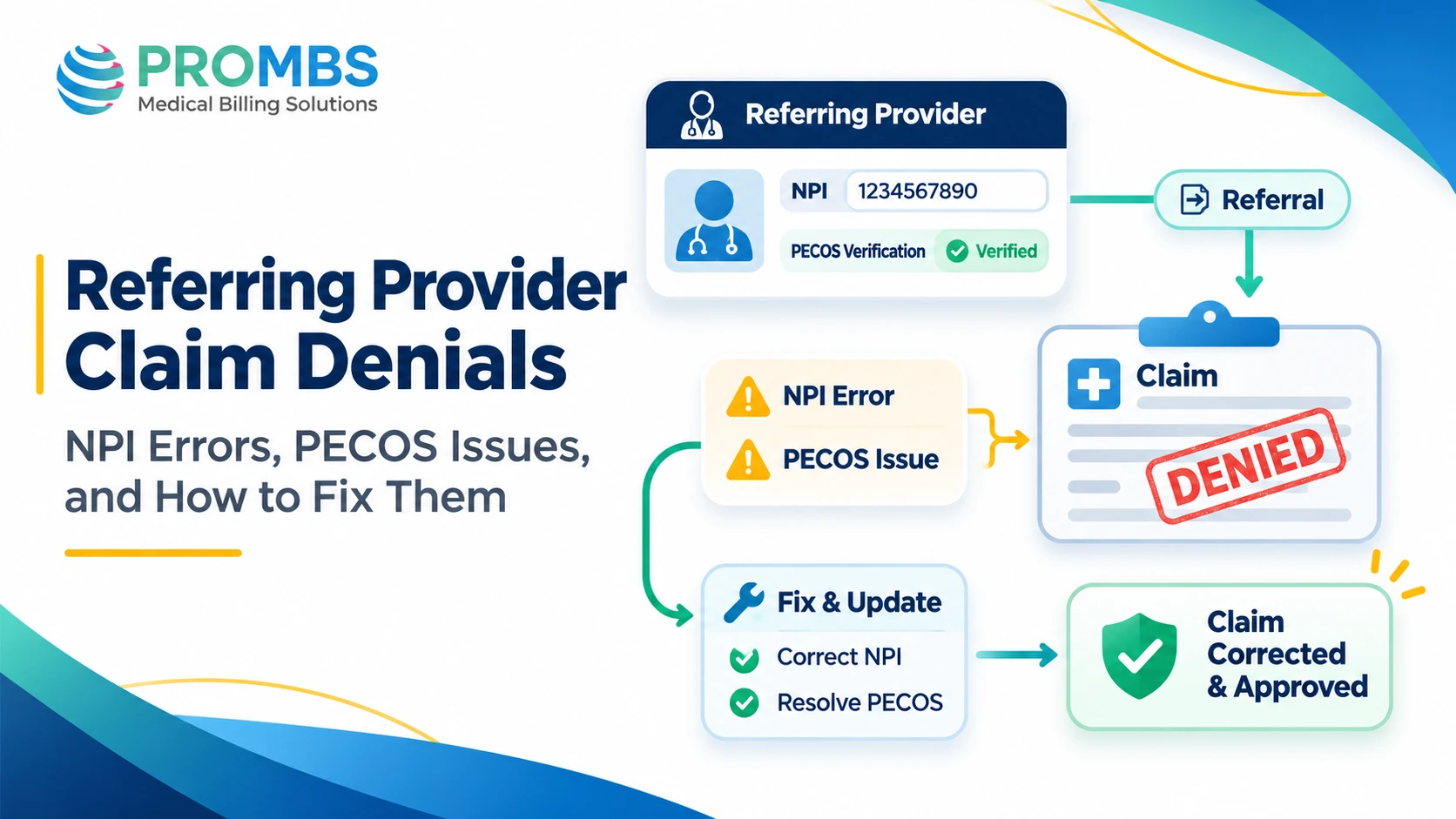
A medical practice submits an insurance claim for a diagnostic service ordered by a physician. The procedure was completed, the patient’s insurance coverage was active, and the claim included the correct CPT code. However, the insurer returns the claim because the ordering physician’s National Provider Identifier (NPI) is missing or does not match the information recognized by the payer.
The problem is not necessarily related to the medical service itself. Instead, the claim lacks accurate information identifying the healthcare professional who ordered or referred the patient for treatment.
This situation is particularly important for diagnostic laboratories, imaging centers, durable medical equipment suppliers, home health providers, and other healthcare organizations that bill for services initiated by another qualified practitioner.
Even when the rendering provider and billing organization are correctly identified, an error involving the referring or ordering practitioner can prevent the claim from being processed or reimbursed.
For medical practices, referring provider claim denials can create avoidable revenue cycle problems because a seemingly minor provider identification error may affect numerous claims.
A laboratory receiving orders from several physicians may repeatedly submit claims with outdated provider information. An imaging center may have the correct referral documentation but transmit an incorrect ordering NPI. A medical equipment supplier may report a valid individual NPI belonging to a practitioner who does not satisfy Medicare’s applicable ordering eligibility requirements.
These problems cannot always be resolved by entering another provider number or submitting the same claim again.
The billing team must determine whether the problem involves missing claim information, an incorrect provider identity, a name mismatch, or an underlying Medicare enrollment and eligibility issue.
Understanding these distinctions is essential for choosing the correct correction, preventing repeat claim failures, and protecting legitimate reimbursement.
What Are Referring Provider Claim Denials?
Referring provider claim denials occur when an insurance payer rejects, returns, or denies a claim because required information about the referring practitioner is missing, invalid, inconsistent, or does not satisfy the applicable payer requirements.
Depending on the service, the disputed information may involve the provider’s individual NPI, name, professional role, Medicare enrollment status, or eligibility to order or refer the particular service.
Although the phrase is commonly used in medical billing, not every referring provider error results in a formal adjudicated denial.
Some claims are rejected by a clearinghouse or returned as unprocessable by Medicare before a normal payment determination is completed.
The distinction affects how the billing team should respond.
Why Referring Provider Information Matters
For services requiring ordering or referring practitioner information, the payer needs to identify the healthcare professional responsible for the relevant clinical order or referral.
For example, a diagnostic imaging provider may perform an examination ordered by a physician who practices at another organization.
The imaging provider submits the claim for the service performed, but the claim may also require information identifying the ordering practitioner.
If that information is missing or fails the payer’s validation requirements, the claim may not be processed successfully.
The purpose of the referring or ordering provider field is therefore different from identifying who performed the service or which organization is billing.
Why These Errors Can Affect Multiple Claims
Many healthcare organizations receive orders and referrals from a network of physicians and other qualified professionals.
If the practice-management system stores incorrect information for one frequently used ordering provider, the same error may be transmitted repeatedly.
For example, a diagnostic laboratory may process 30 orders associated with a referring physician whose NPI was entered incorrectly during initial registration.
If the billing system automatically uses that record, all 30 claims may contain the same incorrect identifier.
The resulting problem may be mistaken for multiple independent denials when the underlying issue is a single inaccurate provider record.
Referring Provider vs. Ordering Provider vs. Rendering Provider
One of the most important steps in understanding referring provider claim denials is distinguishing the professional roles reported on an insurance claim.
A referring physician, ordering practitioner, rendering provider, and billing provider may be different individuals or entities.
These roles communicate different information to the insurance payer.
| Provider Role | Primary Function | Example |
|---|---|---|
| Referring provider | Refers a patient for evaluation or another healthcare service | PCP refers a patient to a specialist |
| Ordering provider | Orders a test, treatment, equipment, or other covered item | Physician orders diagnostic imaging |
| Rendering provider | Furnishes the healthcare service being billed | Radiologist interprets an imaging study |
| Billing provider | Submits the claim and receives payment under the applicable billing arrangement | Imaging practice or medical group |
Although the same practitioner may perform multiple roles, the claim must accurately represent the role applicable to the billed service.
Example: A Diagnostic Imaging Claim
Suppose a primary care physician orders an MRI for a patient.
The patient visits an imaging center, where the examination is performed and interpreted by the appropriate healthcare professionals.
The physician who ordered the study is not necessarily the rendering provider or the organization submitting the claim.
If the payer requires ordering practitioner information, the imaging center must report the correct ordering professional in the appropriate claim fields.
Entering the rendering radiologist’s NPI in place of the actual ordering physician merely to complete a required field would not accurately represent the service.
Why Provider Role Confusion Causes Denials
A billing system may contain several provider profiles for the same encounter.
If employees select the wrong role, the claim may identify a valid NPI but still contain incorrect information.
For example, a claim may report the performing physician as the referring provider even though another qualified professional actually issued the referral.
The billing team should verify the medical order or referral documentation rather than selecting whichever provider is most familiar or already available in the system.
PROMBS explains related identification problems in Rendering Provider Mismatch: Fix NPI and Tax ID Denials.
Referring Provider NPI Requirements in Medical Billing
The National Provider Identifier is a standardized 10-digit identifier used to identify healthcare providers in applicable administrative transactions.
It helps payers recognize the practitioner associated with the reported claim information.
However, possession of a valid NPI does not automatically mean that a practitioner satisfies every payer’s ordering, referring, or enrollment requirements.
Missing Referring Provider NPI
A missing referring provider NPI occurs when a claim requires the identifier but the relevant field is blank.
For example, a laboratory may receive a valid order from a physician but fail to transfer the physician’s NPI into the claim.
The medical order may be clinically appropriate, yet the electronic claim can still fail because the required provider identifier was omitted.
The billing team should retrieve the correct information from the applicable source and determine how the payer permits the claim to be corrected or resubmitted.
Invalid Referring Provider NPI
An invalid NPI may result from a transcription error, incorrect number, or another data problem.
For example, an employee may enter an incorrect digit when creating the ordering provider’s profile.
The transmitted identifier may fail basic NPI validation or identify a different provider from the practitioner documented in the order.
The correct response is to verify the individual practitioner and the official identifier rather than repeatedly attempting alternative numbers.
NPI Belongs to the Wrong Practitioner
A claim may contain a structurally valid NPI that belongs to another healthcare professional.
This can happen when providers have similar names or when the practice uses an outdated record.
For example, a physician group may employ several clinicians with similar last names, and the billing system may select the wrong profile.
The NPI may pass basic format validation but fail the payer’s provider identity checks.
The team must compare the submitted information with the actual ordering or referring documentation and the appropriate authoritative records.
Medicare PECOS and Ordering/Referring Provider Eligibility
For applicable Medicare services, having an active NPI is not sufficient by itself to establish that a practitioner is eligible to order or certify covered items and services.
CMS maintains Medicare enrollment records through the Provider Enrollment, Chain, and Ownership System (PECOS) and makes relevant ordering and certifying eligibility information available through CMS data resources.
A provider may appear in the NPI Registry but fail the specific Medicare eligibility conditions associated with the service.
Medicare’s Core Ordering and Certifying Requirements
According to CMS, practitioners who qualify to order or certify applicable Medicare services generally must meet three requirements:
- Possess an individual NPI.
- Have an appropriate Medicare enrollment status, including approved enrollment or qualifying opt-out status.
- Belong to a professional specialty eligible to order or certify the relevant service.
These requirements are distinct from ordinary NPI enumeration.
For example, a practitioner may have a valid individual NPI but lack the qualifying Medicare enrollment status required for a particular ordering role.
The resulting claim problem cannot necessarily be corrected by changing the spelling of the provider’s name.
Does a Physician Need to Bill Medicare to Order Services?
Not necessarily.
CMS allows certain eligible practitioners to enroll solely for ordering and certifying purposes, and qualifying opt-out practitioners may also satisfy applicable requirements.
This means a physician does not necessarily have to submit their own Medicare claims to be eligible to order certain covered services.
However, the practitioner must still satisfy the relevant Medicare eligibility conditions.
Medical billers should verify actual eligibility rather than assume that every physician who does not bill Medicare is automatically ineligible to order services.
Why a Type 2 NPI Cannot Replace the Individual Ordering NPI
Healthcare organizations may have organizational NPIs, often called Type 2 NPIs.
Individual physicians and other eligible practitioners generally use Type 1 NPIs.
When Medicare requires identification of the individual ordering or referring practitioner, substituting the medical group’s organizational NPI is not an appropriate correction.
The claim must identify the actual qualified professional associated with the order or referral.
Official guidance is available through CMS Ordering & Certifying.
Which Medical Services Require Ordering or Referring Provider Information?
Medicare ordering and referring requirements depend on the type of service, applicable claim instructions, and the professional’s eligibility to order or certify that service.
Billing teams should not assume that every medical claim requires referring provider information.
Similarly, they should not assume that every service is exempt from reporting an ordering practitioner.
Common examples of services with applicable ordering or referring requirements include:
| Healthcare Service | Potential Provider Information Requirement |
|---|---|
| Clinical laboratory services | Appropriate ordering practitioner |
| Diagnostic imaging | Ordering or referring practitioner, as applicable |
| DMEPOS | Eligible ordering practitioner |
| Home health services | Appropriate ordering or certifying practitioner |
| Certain other Medicare services | Referring, ordering, or supervising information under applicable instructions |
The exact requirement depends on the claim type, service, Medicare program, and relevant coverage rules.
Diagnostic Laboratory Claims
Clinical laboratories often perform tests requested by physicians or other qualified practitioners.
The laboratory may have no direct professional relationship with the ordering clinician beyond the submitted order.
However, for applicable Medicare claims, the billing process must accurately identify the ordering practitioner.
If the provider’s NPI is missing or does not satisfy the relevant Medicare checks, the claim can encounter a processing problem even when the laboratory performed the test correctly.
Diagnostic Imaging Claims
Imaging centers may receive orders from multiple practices and specialties.
Because the performing organization and ordering practitioner can be different, correct provider identification is essential.
For example, an imaging claim may contain the correct billing provider and service code but fail because the ordering physician’s name does not match the provider information recognized by Medicare.
The billing team should investigate the ordering practitioner record rather than automatically changing the rendering provider.
Durable Medical Equipment Claims
Durable Medical Equipment, Prosthetics, Orthotics, and Supplies (DMEPOS) claims may require an eligible ordering practitioner.
An individual NPI alone does not guarantee that the practitioner’s specialty and Medicare status satisfy the applicable ordering requirements.
Suppliers should verify the actual practitioner identified on the relevant order and ensure that claim information follows the applicable DMEPOS reporting rules.
Home Health Services
Home health coverage involves specific practitioner ordering, certification, and documentation requirements.
An error involving the professional responsible for the required certification may affect claim processing or coverage.
However, these claims should be evaluated according to the applicable home health billing rules rather than assuming that every situation follows the CMS-1500 professional claim format.
Common Referring Provider Denial Codes
Referring and ordering provider claim errors may be reported through Claim Adjustment Reason Codes (CARCs) and Remittance Advice Remark Codes (RARCs).
The CARC generally explains the adjustment category, while the associated RARC can provide additional details about the specific issue.
One commonly encountered combination involves CARC 16 with a remark code identifying missing or invalid provider information.
| Code | General Meaning | Common Investigation |
|---|---|---|
| CO-16 | Claim lacks required information or contains a submission/billing error | Review the associated remark code |
| N264 | Missing, incomplete, or invalid ordering provider name | Verify ordering practitioner name |
| N265 | Missing, incomplete, or invalid ordering provider primary identifier | Verify ordering practitioner NPI |
| N285 | Missing, incomplete, or invalid referring provider name | Verify referring practitioner name |
| N286 | Missing, incomplete, or invalid referring provider primary identifier | Verify referring practitioner NPI |
The complete payer response and applicable Medicare or commercial payer requirements determine the appropriate resolution.
An adjustment code should not be interpreted independently from the remaining claim information.
CO-16 Referring Provider Denials
CO-16 is a broad billing or information-related adjustment.
It does not independently establish that the referring provider NPI is incorrect.
For example, a claim reporting CO-16 with N286 points toward a referring provider identifier problem.
A claim reporting the same adjustment reason with N264 instead points toward the ordering provider’s name.
The billing team should read all relevant codes and payer remarks before deciding which provider record needs review.
N285: Referring Provider Name Error
RARC N285 concerns missing, incomplete, or invalid referring provider name information.
A claim may contain an NPI that appears valid, but the reported first or last name may not satisfy the payer’s matching requirements.
For applicable Medicare editing, CMS instructions emphasize matching the ordering or referring practitioner’s name with recognized Medicare records.
The billing team should compare the transmitted name with the verified practitioner information and follow the applicable formatting requirements.
N286: Referring Provider Identifier Error
RARC N286 identifies a referring provider primary identifier problem.
A common investigation involves checking whether the correct individual NPI was transmitted.
However, the billing department should also consider whether the claim’s referring provider information was placed in the appropriate field and whether the payer requires that information for the service.
Simply inserting an NPI into an arbitrary claim field may not resolve the problem.
N264 and N265: Ordering Provider Errors
N264 and N265 concern ordering provider name and identifier information, respectively.
These codes are relevant when the service requires identification of the professional who ordered it.
For example, a diagnostic laboratory claim may fail because the ordering physician’s NPI is missing even though the billing laboratory’s NPI is correct.
The investigation should focus on the ordering practitioner information rather than changing an unrelated provider field.
CMS-1500 Box 17 and 17b: Referring and Ordering Provider Information
The CMS-1500 claim form includes fields used to report referring, ordering, or supervising practitioner information when required.
These fields should be completed according to the applicable claim instructions and the actual role of the professional involved.
Box 17: Provider Name and Role
Box 17 identifies the referring, ordering, or supervising professional, as appropriate.
A qualifier indicates the practitioner’s role.
| Qualifier | Provider Role |
|---|---|
| DN | Referring provider |
| DK | Ordering provider |
| DQ | Supervising provider |
For example, a diagnostic test ordered by a qualified physician may require the ordering practitioner to be identified using the appropriate role information.
The billing team should not automatically use DN for every claim merely because Box 17 includes referring provider terminology.
Box 17b: Provider NPI
Box 17b is used to report the NPI of the professional identified in Box 17 when applicable.
The NPI should belong to the actual practitioner associated with the reported role.
An incorrect identifier can prevent the payer from recognizing the provider even if the name is accurate.
Electronic Claims: 837P Provider Loops
For electronic professional claims, relevant provider information is transmitted through the appropriate loops and segments of the X12 837P transaction.
| Electronic Claim Location | Information |
|---|---|
| Loop 2310A | Claim-level referring provider information |
| Loop 2310D | Claim-level supervising provider information |
| Loop 2420E | Service-line ordering provider information, when applicable |
| NM1 segments | Provider identity and associated identifier information |
The appropriate placement depends on the provider’s role, claim circumstances, and applicable transaction requirements.
Billing systems generally generate these electronic segments from the provider information entered into the practice-management platform.
If the underlying field mapping is incorrect, the same problem may affect multiple submitted claims.
CMS provides detailed guidance in its Medicare Billing: CMS-1500 and 837P Provider Details.
Referring Provider Name Mismatches and Medicare Validation
A provider’s NPI may be correct while the claim still fails because the associated name information is inconsistent.
For applicable Medicare ordering and referring edits, CMS provides specific instructions for comparing practitioner names with Medicare records.
These include matching the first letter of the first name and the first four letters of the last name.
CMS also instructs billers to use the applicable first and last names from the recognized ordering and referring records without adding unnecessary professional suffixes.
Example: Incorrect Name Formatting
Suppose the medical order identifies Dr. Michael Anderson.
The billing system stores the provider as “Dr. Mike Anderson, MD,” while the recognized Medicare record identifies the practitioner using the applicable legal name.
Depending on the transmitted data and applicable editing rules, the inconsistency may create a matching problem.
The billing team should verify the authoritative practitioner record and correct the information according to the payer’s instructions.
It should not assume that all informal names, prefixes, and suffixes will be accepted interchangeably.
Why Consistent Provider Records Matter
Practices frequently import referring provider information from EHR records, physician directories, previous orders, and manually entered contact lists.
These sources may contain outdated or inconsistent information.
If the billing system repeatedly selects an incorrect provider profile, the same mismatch can affect many claims.
A reliable referring provider directory should therefore distinguish verified billing identifiers from general contact information.
Referring Provider Claim Rejection vs. Denial
A referring provider error may prevent a claim from being accepted for normal processing, or it may lead to a payer determination after the claim has entered adjudication.
These outcomes should be distinguished before the billing team takes action.
Claim Rejections and Unprocessable Claims
A clearinghouse may reject a claim because a required provider identifier is missing or does not satisfy an electronic submission edit.
Similarly, Medicare may return certain claims as unprocessable when required provider information is missing or invalid.
The billing team should review the applicable acknowledgment or remittance information, identify the specific error, and follow the payer’s permitted resubmission process.
A returned claim should not automatically be handled as though a complete payment determination was issued with ordinary appeal rights.
Adjudicated Claim Denials
A payer may accept a claim but later deny reimbursement because the practitioner does not satisfy an applicable eligibility or coverage condition.
For example, a Medicare-related ordering eligibility issue may require investigation of the practitioner’s enrollment status and eligible specialty.
Correcting the NPI formatting alone will not necessarily resolve such a determination.
The team should verify the payer’s decision and determine which review or appeal procedure applies.
Why Repeated Resubmission Is Not a Solution
Repeatedly submitting an unchanged claim rarely resolves an underlying provider identification problem.
If the payer cannot recognize the individual practitioner or the applicable ordering eligibility requirements are not met, the same issue may continue.
The correct first step is to determine whether the problem originates in the claim data, the referring provider master record, or the payer’s enrollment and eligibility information.
PROMBS discusses related enrollment issues in Provider Enrollment Claim Denials: NPI and Effective Date Errors.
Referring Provider Errors vs. Missing Insurance Referrals
A particularly important distinction is that missing referring practitioner information is not the same as failing to obtain a health plan’s required specialist referral.
For example, a managed care plan may require a primary care physician referral before a patient visits a specialist.
That is an administrative coverage requirement.
A referring provider NPI problem, by contrast, concerns the identity or eligibility of a practitioner reported on a medical claim.
A practice may have a valid administrative referral but submit incorrect referring provider information.
Conversely, the claim may correctly identify the referring physician while the patient’s insurance plan lacks a required referral authorization.
These situations require different investigations.
PROMBS explains this distinction in Referral vs. Prior Authorization: Understanding the Difference.
The billing team should determine exactly what the payer is questioning before contacting the referring physician, changing claim data, or requesting a new administrative referral.
Why Referring Provider Claim Denials Create Revenue Cycle Problems
Referring provider errors can create substantial administrative work when the same incorrect information affects multiple claims.
For example, an imaging center may receive repeated orders from a referring practitioner whose individual NPI was entered incorrectly.
If the billing system uses that record automatically, dozens of claims may fail before the discrepancy is identified.
The staff must then investigate the provider information, determine which claims were affected, and complete the appropriate correction or review process for each account.
Payment Delays Can Increase Insurance A/R
Claims containing incorrect ordering or referring information may remain unresolved until the required data or eligibility issue is addressed.
This can increase apparent outstanding insurance receivables and require additional payer follow-up.
However, the full billed value of every affected claim should not automatically be reported as recoverable revenue.
The actual reimbursement opportunity depends on the covered service, payer rules, contractual allowed amount, filing requirements, and whether the claim can be validly resolved.
One Incorrect Provider Record Can Affect an Entire Claim Population
A referring provider error may originate from a single incorrect NPI or provider name stored in the practice-management system.
Correcting one claim without reviewing the underlying provider record may allow the same problem to continue.
For this reason, investigating referring provider claim denials requires attention to both the affected claim and the source of the information transmitted.
The goal should be to resolve the existing payment problem while identifying whether other claims contain the same discrepancy.
The Foundation of Accurate Referring Provider Billing
Accurate referring provider billing begins with identifying the professional who actually ordered or referred the service and determining whether the payer requires that information on the claim.
The practice must then verify the appropriate individual NPI, provider name, professional role, and any applicable Medicare enrollment or ordering eligibility conditions.
These requirements should not be confused with the provider who rendered the service or the organization submitting the claim.
A valid NPI alone does not guarantee Medicare ordering eligibility, and an approved administrative specialist referral does not automatically establish that the claim contains correct referring practitioner information.
For medical practices, effective prevention of referring provider claim denials depends on recognizing these differences before claims are submitted.
The key principle is that accurate provider identity and applicable ordering eligibility must be established independently. Correctly performing the medical service does not eliminate the requirement to report the appropriate practitioner information when the payer requires it.
How to Fix Referring Provider Claim Denials: A Step-by-Step Guide
Resolving referring provider claim denials requires more than identifying an incorrect National Provider Identifier (NPI). A medical claim may contain a valid provider number but still fail because the reported name does not match Medicare records, the practitioner does not meet applicable ordering requirements, or the billing system has placed the information in the wrong claim field.
These problems are particularly challenging for diagnostic laboratories, imaging centers, durable medical equipment suppliers, and other healthcare organizations that depend on orders or referrals from external practitioners. The billing provider may have performed the service correctly, yet reimbursement remains unresolved because of information associated with a separate healthcare professional.
For example, a diagnostic laboratory may receive a blood test order from a physician whose NPI is valid in the NPI Registry. However, Medicare may not recognize the practitioner as eligible to order the relevant service because the necessary enrollment or specialty requirements are not satisfied.
Repeatedly submitting the same claim will not resolve that underlying eligibility problem.
An effective referring provider claim denials resolution process begins with the payer’s exact response, identifies the affected provider information, and determines whether the problem involves inaccurate claim data or a substantive Medicare ordering eligibility requirement.
The following steps provide a practical framework for investigating and resolving these discrepancies while protecting timely filing deadlines and avoiding unsupported claim corrections.
1. Review the Complete Claim Rejection or Denial
The first step is determining exactly why the claim was not paid.
A claim may be rejected by a clearinghouse before reaching the insurer, returned as unprocessable by Medicare, or processed and denied under an applicable coverage or provider eligibility rule.
Although these situations may appear similar in an accounts receivable report, they do not necessarily follow the same resolution process.
Identify the Relevant CARC and RARC
The billing team should review the Electronic Remittance Advice (ERA), payer rejection report, or applicable claim acknowledgment.
For example, CARC 16 indicates a missing-information or submission-related problem, but it does not identify the specific missing field by itself.
An accompanying Remittance Advice Remark Code (RARC) provides additional information.
| Code Combination | Likely Problem | Initial Investigation |
|---|---|---|
| CO-16 / N264 | Missing or invalid ordering provider name | Verify ordering practitioner name |
| CO-16 / N265 | Missing or invalid ordering provider identifier | Verify individual ordering NPI |
| CO-16 / N285 | Missing or invalid referring provider name | Verify referring practitioner identity |
| CO-16 / N286 | Missing or invalid referring provider identifier | Verify referring provider NPI |
| CO-183 / N574 | Referring or ordering practitioner may not be eligible for the billed service | Investigate applicable Medicare eligibility requirements |
The full remittance should determine the next action because a payer may include additional information relevant to the claim.
For example, an N286 message may require correction of an identifier, while an N574 message can indicate that the practitioner does not satisfy the eligibility conditions for the service.
Treating both problems as ordinary typographical errors could delay resolution.
Determine Whether the Claim Was Adjudicated
An unprocessable claim generally requires an appropriate new submission with corrected information rather than an ordinary Medicare claim appeal.
A claim that received an appealable initial determination may follow a different review process.
The billing team should verify the actual claim status before selecting a transaction type or submitting a redetermination request.
2. Verify the Referring or Ordering Provider’s NPI
Once the payer’s response identifies a provider information problem, the next step is to confirm which practitioner actually ordered or referred the service.
The original clinical order, referral documentation, or other relevant source record should establish the practitioner’s identity.
Employees should not select a different provider simply because that person has an active NPI or appears eligible in Medicare records.
Search the Official NPI Registry
The National NPI Registry allows billing specialists to look up provider identification information.
The team should compare the submitted NPI with the practitioner’s name and available professional details.
For example, an imaging center may discover that the NPI entered into its ordering provider directory belongs to another physician with a similar surname.
The appropriate correction is to verify the actual ordering practitioner and update the claim with that person’s correct identifier.
However, NPI enumeration should not be confused with Medicare enrollment or authorization to order specific services.
Confirm That the NPI Belongs to an Individual
When Medicare requires an individual ordering or certifying practitioner, the provider must be reported using the appropriate individual NPI.
An organizational Type 2 NPI should not replace the Type 1 NPI of the practitioner who actually ordered the service.
For example, if a physician working for a large medical group orders diagnostic imaging, the claim may need that physician’s individual NPI rather than the group’s organizational identifier.
Entering the organizational NPI may produce a provider identification or eligibility problem even when the medical group’s information is otherwise accurate.
3. Verify Medicare Ordering and Certifying Eligibility
If the NPI is accurate but the claim continues to fail, the billing team should determine whether the practitioner satisfies Medicare’s relevant ordering or certifying requirements.
For applicable Medicare services, the practitioner generally must possess an individual NPI, have qualifying Medicare enrollment or opt-out status, and belong to an eligible professional specialty.
An active NPI alone does not establish these conditions.
Check the CMS Ordering and Certifying Files
CMS maintains public Ordering and Certifying Files containing practitioners recognized as eligible under the applicable Medicare enrollment and specialty requirements.
These files can be searched using the practitioner’s NPI or name.
The data is maintained through CMS enrollment records and updated periodically, so billing teams should account for potential timing differences when investigating recent enrollment changes.
A practical verification should establish whether the practitioner appears in the relevant CMS records and whether the information corresponds to the disputed service.
The official starting point is CMS Ordering & Certifying.
Distinguish Enrollment Status From Specialty Eligibility
A practitioner may have a Medicare enrollment record but still be ineligible to order a particular type of service under applicable program rules.
For example, Medicare limits certain ordering or certifying activities according to the practitioner’s specialty and the service involved.
The billing team should therefore investigate both the enrollment status and the specific ordering requirement.
A valid Medicare enrollment record should not automatically be interpreted as unrestricted eligibility to order every covered item or service.
What Happens if the Practitioner Is Missing From Medicare Records?
If the practitioner does not appear in the applicable CMS file, the billing team should verify the information with the practitioner and, when necessary, the Medicare Administrative Contractor (MAC).
The issue may involve an incomplete enrollment, outdated information, a recently approved enrollment not yet reflected in the public file, or another eligibility discrepancy.
The ordering practitioner may need to resolve the enrollment issue directly through the appropriate Medicare process.
The billing provider should not substitute another practitioner’s NPI without documentation establishing that the other professional actually issued the applicable order.
4. Correct Referring Provider Name Mismatches
Some Medicare claims fail even though the submitted NPI belongs to the correct practitioner.
The problem may involve the spelling or formatting of the provider’s name.
For applicable Medicare ordering and referring edits, CMS uses specific name-matching requirements associated with the practitioner’s enrollment record.
Compare the Name With the Recognized Medicare Record
The billing department should verify the practitioner’s first and last name using the appropriate Medicare information.
For example, a provider may be recorded in the practice-management system as “Dr. Robert A. Williams,” while the payer expects the relevant name information without professional titles or additional credentials.
Depending on the transmitted data, this difference may contribute to a matching error.
Medicare’s applicable ordering/referring edits have used the first letter of the first name and the first four letters of the last name as part of name validation.
However, billing teams should follow the current MAC instructions and enter the verified practitioner information accurately rather than relying solely on partial-name matching.
Correct the Source Record
If the discrepancy originates in the practice-management system, the correction should be made to the appropriate provider profile.
Otherwise, the same incorrect name may continue appearing on future claims.
For organizations receiving frequent orders from the same practitioners, correcting master data can prevent repeated billing errors across multiple encounters.
5. Verify CMS-1500 and Electronic Claim Information
After confirming the practitioner’s identity and eligibility, the billing team should review how the information was transmitted.
A claim may contain the correct NPI in the internal record but fail because the billing software did not populate the appropriate electronic field.
For professional claims, CMS-1500 Item 17 and Item 17b are relevant when reporting the applicable referring, ordering, or supervising practitioner.
Electronic 837P claims use designated provider loops and segments according to the practitioner’s role and the claim circumstances.
Check the Provider Role
The claim should accurately distinguish referring, ordering, and supervising practitioners.
For example, an imaging examination ordered by a physician should not automatically identify that physician as the rendering provider.
Similarly, a practitioner who supervised a service should not be reported as its referring physician merely to satisfy a missing-field edit.
The billing department should verify the appropriate role against the original documentation and the payer’s reporting requirements.
Inspect the Actual Claim Transmission
If the practice-management system appears correct but claims continue to fail, the billing team should examine the actual submitted transaction or clearinghouse report.
The problem may involve incorrect field mapping, a missing provider segment, or data that was altered during claim generation.
Correcting the internal provider profile alone may not resolve a technical transmission problem.
The practice should verify that the updated information reaches the intended electronic claim field.
6. Corrected Submission vs. Formal Appeal
One of the most important decisions in resolving referring provider claim denials is choosing the appropriate payer review process.
A claim returned as unprocessable may need a new, complete submission.
An adjudicated denial may require a different procedure depending on the payer’s rules and the issue being disputed.
When a New Claim Submission May Be Appropriate
If a claim was rejected because required ordering provider information was missing, the practice may be able to submit a new claim containing accurate information.
For example, a laboratory claim returned because the ordering practitioner’s NPI was omitted may be corrected using the original order and verified provider record.
The billing team should follow the MAC or payer’s instructions for the specific claim status.
The term corrected claim is not interchangeable with new initial claim, and the appropriate transaction depends on whether the original submission was accepted and adjudicated.
When an Appeal May Be Appropriate
If the insurer issued an appealable denial and the practice has evidence that the original determination was incorrect, a formal appeal may be appropriate.
For example, the payer may determine that an ordering practitioner was ineligible even though the provider had qualifying status applicable to the service date.
The practice should verify the enrollment evidence and relevant payer rules before challenging the determination.
For Original Medicare, the first appeal level is generally a redetermination requested within 120 days of receipt of the initial claim determination, subject to applicable exceptions and requirements.
However, this deadline should not be applied to unprocessable submissions that have no ordinary appeal rights.
Protect Timely Filing Deadlines
Medicare fee-for-service claims generally must be submitted within one calendar year of the date of service, subject to limited exceptions.
A practice should not assume that an earlier rejected submission permanently preserves its filing rights.
When investigating referring provider errors, the billing team should identify the remaining filing period and act promptly.
Commercial insurers may use different claim submission and appeal deadlines.
7. Practical Example: Laboratory Claim With a Missing Ordering NPI
Consider a diagnostic laboratory that performs a covered test ordered by a physician.
The laboratory submits a claim containing the correct patient information, procedure code, and billing provider details.
However, the ordering provider NPI is missing from the transmitted claim.
The Medicare contractor returns the claim with a missing-information message identifying the ordering provider’s primary identifier.
Investigation and Resolution
The billing specialist retrieves the original test order and identifies the practitioner who ordered the service.
The team verifies the individual NPI and checks the applicable Medicare ordering eligibility information.
After confirming the correct practitioner, the billing employee updates the relevant record and prepares the claim for submission through the appropriate procedure.
The practice also reviews whether other laboratory claims were generated from the same incomplete provider profile.
This additional review matters because correcting only one claim may leave other claims exposed to the same error.
8. Practical Example: Imaging Claim With a Provider Name Mismatch
An imaging center performs an MRI ordered by a qualified physician.
The claim contains the correct procedure and individual ordering NPI, but the payer reports that the ordering provider name does not match its records.
The billing system uses an outdated provider profile containing a different surname from the one associated with the recognized Medicare enrollment record.
Investigation and Resolution
The billing department compares the original medical order with the NPI Registry and applicable CMS ordering information.
The team confirms that the correct practitioner issued the order but that the transmitted name is inaccurate.
The provider record is updated, and the affected claim is handled according to the payer’s permitted submission or correction procedure.
The practice then checks other claims linked to the same provider profile to identify additional discrepancies.
The important point is that the underlying medical order may be correct while the transmitted administrative information is not.
9. Practical Example: DMEPOS Claim With an Ineligible Ordering Practitioner
A DMEPOS supplier receives an order for equipment and submits the claim to Medicare.
The ordering practitioner’s NPI is valid, and the name matches the provider’s record.
However, the claim receives an eligibility-related denial indicating that the reported practitioner does not qualify to order the item under the applicable Medicare rules.
Investigation and Resolution
The supplier reviews the original order and verifies the practitioner’s relevant Medicare enrollment and specialty eligibility.
If the practitioner genuinely lacks the required authority or enrollment status, changing the NPI to another professional simply to obtain reimbursement would be inappropriate.
The supplier should determine whether a legitimate correction, qualifying order, or applicable review mechanism is available under the relevant coverage and documentation requirements.
If the payer applied its eligibility determination incorrectly, the supplier may have grounds for further review supported by appropriate records.
The correct outcome depends on the actual service, ordering requirements, and payer determination.
10. Practical Example: Home Health Ordering or Certification Discrepancy
Home health billing can involve provider certification requirements that differ from ordinary outpatient professional claims.
For example, an agency may encounter a problem because the practitioner identified in its certification records does not match the information required under applicable Medicare requirements.
This is not necessarily resolved through the same CMS-1500 fields used for professional diagnostic services.
Investigation and Resolution
The agency should review the clinical certification, practitioner information, relevant enrollment status, and the actual claim instructions for its billing arrangement.
If an identifier was transmitted incorrectly, the agency should determine the appropriate correction procedure.
If the issue involves whether the professional was authorized to certify the service, the agency should evaluate the specific Medicare requirements and available supporting records.
The practice should not assume that every referring provider denial is merely a missing NPI problem.
11. Verify Payment After the Correction or Appeal
Submitting corrected information does not complete the revenue cycle.
The billing department should confirm that the payer received the submission, processed it appropriately, and issued the expected determination.
A claim may pass initial validation but encounter another payment problem involving coverage, coding, enrollment, or documentation.
For example, a laboratory claim that previously failed because of a missing ordering NPI may process successfully after correction but still be subject to patient deductible responsibility.
The final reimbursement should be evaluated against the actual remittance and contractual terms.
Reconcile the Insurance Account
Once the payer completes adjudication, the billing team should post the payment and adjustments accurately.
The account should distinguish legitimate insurance reimbursement, patient responsibility, contractual adjustments, and any unresolved balance.
A claim should not be treated as financially resolved merely because its referring provider error has been corrected.
The objective is to establish the correct final financial outcome and pursue any further action justified by the payer’s determination.
Why Root-Cause Resolution Matters for Referring Provider Claims
Referring and ordering provider errors frequently originate from incorrect information stored in the provider directory rather than independent mistakes on every claim.
For example, a practice may receive repeated denials because one ordering physician’s NPI was entered incorrectly during initial registration.
Correcting individual claims without updating the underlying record allows the same problem to continue.
Similarly, a recurring PECOS eligibility issue cannot necessarily be resolved by modifying a claim field when the actual problem concerns the practitioner’s Medicare enrollment status.
For healthcare organizations, effective resolution of referring provider claim denials requires addressing both the existing unpaid claims and the underlying source of inaccurate provider information.
The financial goal is not simply to resubmit rejected claims. It is to establish accurate provider identity, verify applicable ordering eligibility, and pursue legitimate reimbursement through the correct payer process.
How to Prevent Referring Provider Claim Denials and Improve Reimbursement
Referring provider claim denials can create substantial administrative and financial challenges for healthcare organizations that depend on orders, referrals, and certifications from other practitioners. Although many of these claim problems originate from incorrect provider identifiers or missing information, resolving individual denials does not necessarily prevent the same errors from affecting future submissions.
A diagnostic laboratory may correct an invalid ordering provider NPI on one claim but continue using the same outdated provider record for subsequent tests. An imaging center may successfully resolve a name mismatch while its electronic billing system continues transmitting the information in the wrong claim field. A medical equipment supplier may repeatedly submit claims associated with a practitioner whose Medicare ordering eligibility has not been verified.
These situations demonstrate why effective denial prevention must address the systems and workflows responsible for creating the original claim.
For medical practices, reducing referring provider claim denials requires accurate practitioner information, appropriate Medicare eligibility verification, payer-specific claim validation, and timely communication between clinical and billing teams.
The objective is to submit accurate claims from the beginning, reduce unnecessary administrative corrections, and protect reimbursement that is legitimately payable under the applicable coverage requirements.
1. Maintain an Accurate Referring Provider Directory
A reliable provider directory is one of the most important preventive controls for organizations that routinely receive external orders and referrals.
Medical practices often maintain records for hundreds of physicians and other qualified practitioners. These records may be created through patient registration, clinical documentation, electronic referrals, or manual data entry.
Without consistent verification, the same provider may appear under several names, outdated identifiers, or incomplete profiles.
Verify Essential Provider Information
The directory should maintain accurate information about the individual practitioner and the relevant professional role.
| Provider Information | Purpose |
|---|---|
| Individual NPI | Identifies the practitioner |
| Verified first and last name | Supports payer identity matching |
| Provider type and specialty | Helps evaluate applicable ordering eligibility |
| Practice or organization affiliation | Supports communication and record verification |
| Medicare ordering/certifying eligibility | Supports applicable Medicare claim requirements |
| Verification date | Establishes when information was last reviewed |
| Record status | Identifies active, inactive, or disputed provider information |
The exact fields needed depend on the organization’s services and payer requirements.
For example, a laboratory that receives frequent physician orders may benefit from storing verified ordering practitioner information separately from general physician contact records.
Correct the Source of Recurring Errors
If a provider’s NPI is incorrect in the central directory, correcting one rejected claim will not necessarily prevent future problems.
The billing team should determine whether the incorrect information was entered manually, imported from an external system, or selected through an outdated provider profile.
The source record should then be corrected through an authorized process.
This helps prevent multiple claims from being generated with the same invalid information.
2. Verify Medicare Ordering Eligibility Before Claim Submission
For applicable Medicare services, accurate provider identification must be supported by the required ordering or certifying eligibility.
A practitioner may possess a valid NPI but still fail Medicare’s enrollment or specialty requirements for a particular service.
This means a basic NPI lookup should not be the only verification step when Medicare ordering eligibility is relevant.
Use the Appropriate CMS Records
CMS maintains Ordering and Certifying Files identifying practitioners recognized as eligible under the applicable Medicare requirements.
Billing teams can use these resources to investigate whether the practitioner has qualifying enrollment or opt-out status and an eligible specialty.
However, eligibility should be evaluated for the particular service and date rather than assuming that a provider appearing in an NPI directory can order every Medicare-covered item.
CMS provides access to these resources through its Ordering & Certifying guidance.
Investigate Enrollment Discrepancies
When a practitioner is absent from the relevant eligibility file, the billing department should determine whether the issue involves enrollment, timing of data updates, or an actual eligibility restriction.
The ordering practitioner may need to resolve the enrollment discrepancy through the appropriate Medicare process.
Billing staff should not replace the actual ordering practitioner’s NPI with another provider’s number merely because that alternative identifier appears eligible.
Any claim correction must accurately reflect the professional who issued the relevant order or referral.
3. Use Payer-Specific Claim Scrubbing Rules
Claim-scrubbing systems can identify missing or incorrectly formatted provider information before claims reach the payer.
However, referring and ordering provider requirements are not identical for every insurance company or healthcare service.
A universal edit that requires referring provider information on every professional claim may create unnecessary errors. Conversely, a system that never checks ordering practitioner information may allow incomplete Medicare claims to be submitted.
Validate Required Fields According to the Service
Pre-submission reviews should determine whether the service requires referring, ordering, or supervising practitioner information.
For applicable claims, the system should verify that the relevant identifier and name fields are populated and that the provider role is appropriate.
For example, a diagnostic laboratory claim requiring an ordering practitioner should be reviewed for the correct individual NPI and applicable electronic claim placement.
The system should also distinguish provider identity issues from separate administrative referral or prior authorization requirements.
Review Electronic Claim Mapping
When repeated denials occur despite accurate internal records, the problem may originate in the electronic claim transmission.
The billing team should examine the actual 837 transaction to determine whether the provider information was transmitted correctly.
A properly maintained provider directory cannot prevent denials if the claim generator places the information in an incorrect loop or omits a required segment.
Technical corrections should be verified against subsequent submissions to confirm that the problem has been resolved.
4. Establish a Referring Provider Verification Workflow
Healthcare organizations should assign clear responsibilities for verifying external practitioner information.
The process may involve registration employees, clinical staff, authorization specialists, or medical billers depending on how orders and referrals enter the organization.
The important requirement is that the information used for billing is checked against an appropriate source before the claim is submitted.
Verify New Referring Providers
When a new practitioner begins sending orders or referrals, the practice should establish a verified provider record.
For applicable Medicare services, this may include checking the individual NPI and relevant ordering eligibility.
The directory should identify the actual practitioner rather than relying only on the referring medical group’s organizational information.
Reverify Information When Problems Occur
Practices should establish triggers for reviewing existing records.
For example, a provider-related rejection, reported name change, enrollment discrepancy, or new payer requirement may justify revalidation.
Verification frequency should reflect operational risk and applicable payer rules rather than assuming that every provider must be reviewed at the same fixed interval.
The organization should also preserve evidence supporting corrections when appropriate.
5. Build a Dedicated Referring Provider Denial Work Queue
Medical practices should distinguish provider identification problems from ordinary coding, eligibility, authorization, and medical necessity denials.
A dedicated work queue can help billing teams identify the exact issue and avoid repeatedly resubmitting claims without meaningful corrections.
Classify Denials by Root Cause
| Denial Category | Recommended Investigation |
|---|---|
| Missing referring NPI | Review required claim field and original documentation |
| Invalid provider identifier | Verify the actual individual’s NPI |
| Provider name mismatch | Compare transmitted name with authoritative records |
| Incorrect provider role | Review ordering, referring, or supervising designation |
| Medicare ordering eligibility issue | Check applicable enrollment and specialty requirements |
| Electronic claim mapping problem | Review submitted 837 data and system configuration |
This classification helps identify whether the error affects one claim or an entire group of claims.
For example, 20 laboratory claims containing the same incorrect ordering NPI may be more efficiently investigated as one recurring data problem with multiple affected accounts.
Assign Resolution Responsibility
Each unresolved claim should have an assigned employee, verified reason for nonpayment, and documented next action.
The team should also record filing or appeal deadlines and track whether corrected claims have been accepted.
Accounts should remain under appropriate follow-up until the final payer determination and financial posting have been completed.
6. Protect Insurance A/R and Timely Filing Deadlines
Referring provider claim errors can increase outstanding insurance receivables when claims remain rejected or unprocessed.
However, the full billed charge should not automatically be treated as recoverable revenue.
The practice should evaluate the expected allowed amount, applicable coverage requirements, and whether the identified error can be validly resolved.
Prioritize Claims Approaching Deadlines
An unprocessable Medicare claim generally follows a different resolution process from an appealable denial.
Billing employees should identify the actual claim status and the applicable submission or appeal deadline.
For Medicare fee-for-service, the general initial claim filing limit is one calendar year from the date of service, subject to specified exceptions.
A prior rejected claim should not be assumed to preserve unlimited filing rights.
Timely investigation helps protect legitimate reimbursement opportunities without relying on repeated submissions that do not address the original problem.
Verify Final Payment
After the referring provider issue is resolved, the billing department should confirm that the corrected claim has been processed.
Successful acceptance does not automatically establish that the entire claim is payable.
The final remittance may include contractual adjustments, patient responsibility, or another payer determination.
The practice should reconcile the final result before closing the account.
7. Track Referring Provider Denial Performance
Medical practices need reliable reporting to determine whether their preventive controls are working.
Counting the total number of denied claims may not reveal which providers, services, or billing system configurations are responsible for recurring problems.
A useful performance dashboard should identify the frequency, cause, and resolution of provider-related claim failures.
| Performance Indicator | Suggested Measurement |
|---|---|
| Referring provider error rate | Claims with verified referring provider errors ÷ applicable submitted claims × 100 |
| First-pass claim acceptance | Claims accepted on first submission ÷ initial submissions × 100 |
| Provider information accuracy | Audited applicable claims with correct provider details ÷ audited applicable claims × 100 |
| Medicare ordering eligibility verification | Applicable orders verified before billing ÷ applicable orders reviewed × 100 |
| Average resolution time | Days between identification and final resolution |
| Repeat provider error rate | Claims affected by previously identified provider-data errors ÷ applicable submitted claims × 100 |
| Actual recovered reimbursement | Additional insurance payments received after valid denial resolution |
These KPIs should be calculated using consistent definitions and clearly identified reporting periods.
Example: Measuring Provider-Related Denials
Suppose a diagnostic laboratory submits 600 claims requiring ordering practitioner information during a reporting period.
Of these, 18 experience verified provider identification errors.
The error rate is:
(18 ÷ 600) × 100 = 3%
Further investigation reveals that 12 of the 18 errors originated from two inaccurate provider records in the billing system.
Correcting those records may prevent similar errors on future claims, although the practice should monitor subsequent submissions to verify improvement.
The important finding is not simply that 3% of claims were affected. It is that a substantial share of the errors originated from a small number of identifiable operational problems.
8. Conduct Regular Referring Provider Claim Audits
Periodic audits help detect provider identification errors that may not be visible through routine denial reports.
A claim may be accepted by a clearinghouse despite containing inaccurate information that later causes payer processing problems.
The practice should review a reasonable sample of applicable claims and compare the submitted information with the original order or referral and verified practitioner records.
Review High-Risk Claim Categories
Organizations may prioritize claims associated with external referring practitioners, recently added provider profiles, and previously identified eligibility discrepancies.
For example, a laboratory that recently imported a large physician directory may perform a targeted review of claims generated from the new records.
The audit should also examine whether any system correction has introduced new field-mapping problems.
Confirm Corrective Actions
When an audit identifies a recurring problem, the responsible team should document the cause and the correction.
The practice should then review subsequent claims to determine whether the error continues.
This turns denial management into a preventive process rather than a series of isolated corrections.
How PROMBS Helps Prevent Referring Provider Claim Denials
Referring and ordering provider errors can disrupt reimbursement even when the medical service was correctly performed.
Missing NPIs, inaccurate provider information, Medicare enrollment discrepancies, and electronic claim errors can create repeated rejections and payment delays.
Pro Medical Billing Solutions (PROMBS) supports healthcare practices through claim validation, medical billing, denial investigation, payer follow-up, and accounts receivable management.
Improve Claim Accuracy
PROMBS supports claim review and validation to help identify missing provider information, incorrect identifiers, and other submission discrepancies.
By addressing errors before claims are sent, practices can reduce avoidable rework and improve the consistency of their billing processes.
Investigate Denials and Recover Legitimate Reimbursement
Our denial management workflows help identify why claims were rejected or denied and determine which resolution process is appropriate.
This includes reviewing payer responses, identifying correctable information errors, and supporting legitimate corrections and appeals.
Strengthen A/R Follow-Up
PROMBS supports unresolved insurance account follow-up, claim-status monitoring, and payment reconciliation.
Our goal is to help healthcare providers reduce avoidable reimbursement delays and improve visibility into legitimate outstanding receivables.
Identify Recurring Billing Problems
PROMBS also supports denial trend analysis and revenue cycle reporting.
By identifying repeated errors associated with specific provider records or claim workflows, practices can focus their improvement efforts on the actual causes of payment disruption.
Learn more about PROMBS Denial Management Services and how our team supports accurate claims, payer follow-up, and revenue recovery.
Frequently Asked Questions About Referring Provider Claim Denials
What causes referring provider claim denials?
Referring provider claim denials may occur when required practitioner information is missing, an NPI is invalid, the provider’s name does not match recognized records, or the practitioner does not satisfy applicable Medicare ordering eligibility requirements. The actual cause should be established through the payer’s complete rejection or remittance information.
What does N286 mean in medical billing?
N286 is a remittance advice remark code indicating that the referring provider’s primary identifier is missing, incomplete, or invalid. The billing team should verify the actual referring practitioner, review the submitted NPI, and determine which correction procedure the payer permits.
Can a claim be denied even when the referring provider has a valid NPI?
Yes. For applicable Medicare services, the practitioner may need qualifying enrollment or opt-out status and an eligible specialty in addition to an individual NPI. A valid identifier does not automatically establish eligibility to order or certify every service.
How can medical billers verify a referring provider?
Billing specialists can review the original clinical order, confirm the individual NPI through the official NPI Registry, and examine the relevant CMS Ordering and Certifying Files when Medicare eligibility verification is required. The claim should reflect the actual practitioner and applicable reporting instructions.
Is a missing referring provider NPI always an insurance denial?
No. Some claims are rejected before adjudication or returned as unprocessable. Others may receive an adjudicated denial. The appropriate correction or appeal process depends on the payer’s actual determination.
What is the difference between a referring provider and a rendering provider?
The referring provider directs the patient to another practitioner or service, while the rendering provider furnishes the billed healthcare service. Both roles may require accurate identification, but they serve different purposes in claim processing.
Can Medicare ordering eligibility problems be fixed by changing the NPI?
Only when the original NPI was inaccurate and the correction identifies the practitioner who actually ordered the service. Billing teams must not substitute an unrelated eligible practitioner’s NPI to obtain reimbursement. Actual enrollment or specialty eligibility problems may require a different resolution.
How can practices prevent repeat referring provider denials?
Practices can reduce repeat errors through verified provider directories, appropriate Medicare ordering eligibility checks, payer-specific claim edits, accurate electronic field mapping, and periodic audits. Monitoring recurring error patterns helps identify whether the problem originates from individual claim entry or a broader system configuration.
Final Conclusion: Improve Claim Accuracy and Protect Legitimate Revenue
Referring provider claim denials can create avoidable payment delays, administrative costs, and unresolved insurance receivables.
Although these problems often appear to involve a missing identifier or incorrect provider name, the underlying issue may be more complex. Medicare enrollment status, ordering eligibility, claim field mapping, and inaccurate provider records can all affect whether a claim processes successfully.
Correcting individual claims is necessary when valid information errors occur, but it is not enough to prevent recurring problems.
The strongest revenue cycle strategy is to verify the right practitioner, report the correct information, and identify systemic errors before they affect additional claims.
For healthcare organizations, these controls can reduce preventable rejections, improve claim-processing consistency, and help billing teams spend less time repeating corrections.
They also support more accurate insurance accounts receivable and better prioritization of legitimate reimbursement opportunities.
PROMBS helps healthcare practices strengthen these processes through claim validation, denial management, payer follow-up, and revenue cycle reporting.