

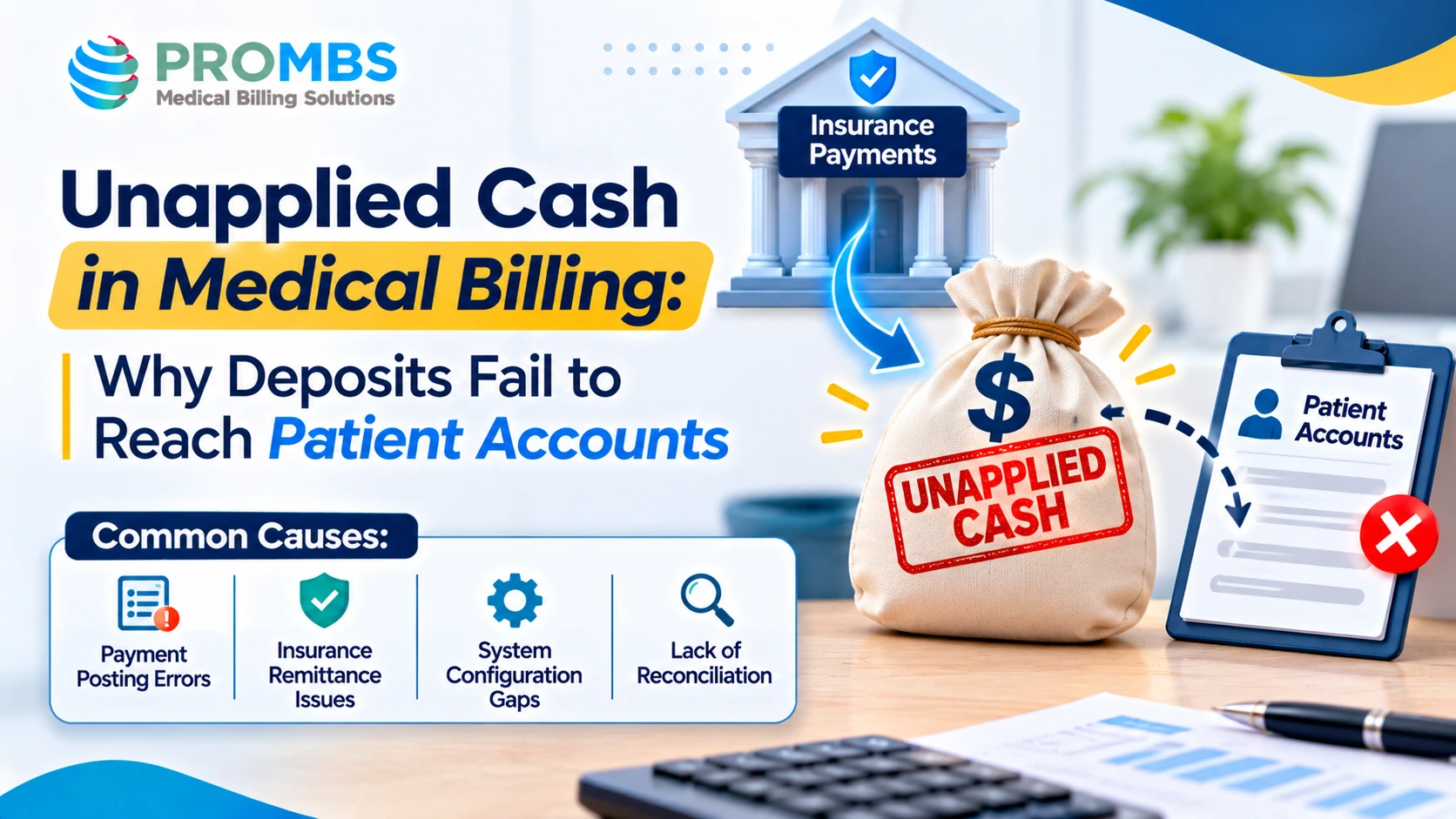
A medical practice receives a $12,000 insurance payment through Electronic Funds Transfer (EFT). The deposit appears in its bank account, confirming that the money has arrived. However, when the billing department reviews the practice-management system, the claims associated with that payment still show outstanding balances.
The practice has received the money, but its financial records do not accurately reflect which claims were paid.
This situation can occur when an Electronic Remittance Advice (ERA) file is missing, a payment cannot be matched to the correct claims, or the billing system fails to allocate the received funds properly. Similar problems arise when patients make advance payments that are not linked to their encounters or when staff members post money to the wrong account.
Although these situations may appear to be ordinary administrative discrepancies, they can create substantial financial confusion.
A claim that has already been paid may remain in insurance accounts receivable. A patient who paid at the front desk may receive another statement for the same amount. A practice manager may believe collections are underperforming even though the funds have already reached the bank.
For healthcare organizations, unapplied cash medical billing is an important revenue cycle issue because receiving a payment and applying that payment accurately are two different financial events.
The problem is not necessarily that revenue has been lost. In many cases, the practice already possesses the cash but has not completed the financial reconciliation necessary to connect it to the correct patient, claim, or service.
Understanding this distinction is essential before taking corrective action. An unmatched deposit may require remittance research, a misapplied payment may need reallocation, and an apparent credit balance may require an entirely different investigation.
This guide explains why unapplied cash occurs, how insurance and patient payments become disconnected from the billing system, and why payment reconciliation is essential to accurate accounts receivable management.
What Is Unapplied Cash in Medical Billing?
Unapplied cash in medical billing refers to money received by a healthcare organization that has not been properly allocated to the patient account, claim, charge, or other financial obligation to which it belongs.
The term is commonly used when a payment is recorded or recognized but cannot yet be assigned to the correct outstanding balance.
For example, a patient may pay $500 before undergoing an outpatient procedure. The payment reaches the practice and is recorded in a general account, but it is not connected to the patient’s specific encounter.
After the insurance company processes the claim, the billing system may continue showing an unpaid patient balance because the previously received $500 was never applied.
The problem is not necessarily a failure to collect payment. It is a failure to accurately associate the payment with its intended financial obligation.
Why Unapplied Cash Occurs
Medical billing involves several transactions that may occur at different times.
The provider performs the service, submits a claim, receives insurance adjudication, collects applicable patient responsibility, and posts the resulting financial activity.
Payments may arrive through insurance EFT deposits, paper checks, patient portals, card transactions, mailed payments, or other collection channels.
Each payment must be matched to the appropriate account and reflected correctly in the billing ledger.
When the necessary identifying information is unavailable, inconsistent, or entered incorrectly, cash may remain unapplied even though it has been received.
Why the Distinction Matters
A healthcare practice should not treat an unapplied payment as though the corresponding claim has never generated any money.
At the same time, receiving a deposit does not automatically establish that every claim associated with the deposit has been fully paid.
The practice must identify the individual transactions, determine their proper financial allocation, and reconcile the records against the actual amount received.
Until that work is complete, outstanding balances and collection reports may not accurately represent the practice’s financial position.
Unapplied Cash vs. Unposted Cash vs. Misapplied Payments
Before investigating unapplied cash, billing teams should distinguish several related payment conditions.
Although these terms are sometimes used differently across practice-management systems, they describe separate financial problems.
| Payment Status | What It Means | Example |
|---|---|---|
| Unposted cash | Payment received but not entered into the applicable billing ledger | EFT reaches the bank, but no posting transaction is recorded |
| Unapplied cash | Payment recorded but not allocated to the correct obligation | Patient payment remains in a general unapplied balance |
| Misapplied payment | Payment assigned to the wrong patient, claim, or encounter | Insurance payment posted to another patient’s claim |
| Unmatched EFT/ERA | Deposit cannot be associated with its remittance information | EFT arrives without an identifiable 835 file |
| Credit balance | Ledger reflects excess payments or adjustments relative to the recorded balance | Patient account shows a negative balance after posting |
These categories can overlap.
For example, an insurance payment may be received but remain unposted because the ERA cannot be located. Once recorded, the payment may remain unapplied until staff determine which claims it belongs to.
Alternatively, a payment may be posted to the wrong patient account, creating an apparent credit on one account while the correct account remains unpaid.
The appropriate resolution depends on identifying which financial event actually occurred.
Unapplied Cash Is Not Automatically an Overpayment
A common misconception is that money remaining in an unapplied account represents excess cash that should be refunded.
That conclusion may be incorrect.
A payment may remain unapplied simply because the practice has not identified the appropriate claim or encounter.
For example, an insurer may have paid the correct amount for several valid claims, but the billing department has not received the corresponding remittance information.
The money may be legitimately owed to the provider, even though it has not yet been allocated.
A refund should not be considered merely because cash remains unmatched.
PROMBS discusses the related distinction between genuine overpayments and false credits in Medical Billing Credit Balance Audits: Finding Duplicate Payments and Refund Risks.
How Insurance Payments Reach Patient Accounts
Understanding the payment flow is essential to identifying where unapplied cash originates.
When an insurer pays a healthcare provider electronically, the payment and its supporting remittance information may arrive through different systems.
The practice may receive the actual funds through its bank while receiving the associated claim-level payment details through an EDI connection, clearinghouse, payer portal, or billing platform.
These records must be associated correctly before the billing department can post the payment to individual claims.
Step 1: The Insurance Company Processes the Claim
After receiving a medical claim, the insurer determines the applicable reimbursement under the patient’s coverage and the provider’s payment arrangement.
The adjudication may include an allowed amount, insurance payment, contractual adjustment, deductible, coinsurance, copayment, denial, or another relevant financial determination.
For example, a physician may bill $1,000 for a service, while the insurer allows $600 and pays $480.
The remaining $120 may represent patient responsibility under the applicable coverage, while the difference between the billed charge and allowed amount may require a contractual adjustment.
These details are necessary for accurate claim posting.
Step 2: The Payer Sends the Payment
The insurer may send the $480 payment through EFT.
The funds reach the provider’s designated bank account, where the deposit becomes part of the practice’s actual cash activity.
However, the bank transaction alone may not provide enough information to identify the correct patient, claim, procedure, or date of service.
A deposit description might identify the payer or payment reference without containing the complete claim-level adjudication.
Step 3: The Payer Sends Remittance Information
The Electronic Remittance Advice, commonly called the ERA, communicates the details needed to understand how the payer processed the claims.
The standard electronic healthcare remittance transaction is the X12 835.
It may contain information about individual claim payments, adjustments, patient responsibility, reversals, and applicable provider-level adjustments.
These details allow the practice to determine how the payment should be reflected in its billing records.
Step 4: The Payment Is Matched and Posted
The billing department or automated posting system associates the deposit with the relevant remittance.
The claim-level payment and adjustments are then entered into the appropriate accounts.
After posting, the claims should reflect the actual adjudication and any remaining legitimate insurance or patient responsibility.
When the deposit and remittance cannot be matched, payment allocation may remain incomplete.
This is one of the central causes of unapplied cash in medical billing.
Why EFT and ERA Reconciliation Is Essential
Electronic Funds Transfer and Electronic Remittance Advice serve different purposes.
The EFT delivers the money.
The ERA explains how the payer processed the claims associated with that payment.
Although the two are related, they should not be treated as interchangeable.
A successful deposit does not establish that the billing system has received or processed the corresponding remittance.
Understanding EFT/ERA Reassociation
The standardized EFT and ERA process uses reassociation information to help providers connect the financial deposit with its remittance details.
For applicable standardized transactions, the X12 835 Trace Number Segment, commonly called the TRN segment, provides identifying information used for payment reassociation.
The related ACH payment addenda can carry corresponding trace information so that the provider can match the electronic funds with the associated ERA.
CMS identifies this matching process as reassociation.
When the relevant identifiers are available and accurately transmitted, a billing system may be able to connect the payment and remittance efficiently.
When the information is missing, unavailable to the receiving system, or inconsistent, staff may need to investigate the transactions manually.
Why a Matching Failure Creates Unapplied Cash
Suppose an insurer issues a $12,000 EFT covering several medical claims.
The practice’s bank confirms receipt of the money, but the billing system cannot locate the corresponding ERA.
Without the remittance details, the billing team may not know how much should be assigned to each claim or whether the payment includes adjustments affecting other accounts.
The entire $12,000 may remain unmatched until the relevant documentation is located.
Simply dividing the deposit among outstanding accounts would not be a valid solution.
The practice must determine the correct allocation using reliable payment and remittance information.
Official technical guidance is available through the CMS EFT and ERA Standards.
Common Causes of Unapplied Cash in Medical Billing
Unapplied payments arise from multiple sources, and the underlying cause determines how the problem should be investigated.
Some originate with missing payer information, while others result from internal posting procedures, patient account discrepancies, or system integration failures.
1. Missing or Delayed Remittance Advice
An insurance payment may reach the bank before the corresponding ERA is available to the billing team.
The remittance could be delayed, inaccessible through the expected connection, or unavailable because of an enrollment or transmission issue.
Without the claim-level explanation, the practice may be unable to allocate the deposit accurately.
The billing department should distinguish this problem from a payer that has not issued payment at all.
2. Incorrect EFT and ERA Matching
A payer may transmit the payment and remittance, but the billing software may fail to associate them.
Possible causes include unavailable reassociation details, incorrect matching configuration, or discrepancies between expected and received identifiers.
For example, the bank deposit may be present in the reconciliation report while the ERA remains in an unmatched posting queue.
The money has arrived, but the system has not connected it to the corresponding financial activity.
3. Payments Without Sufficient Patient Information
Patients sometimes make payments without providing enough information to identify the correct account.
A mailed check may omit the account number, or an electronic payment may include incomplete identifying details.
A family member may also pay on behalf of another individual without identifying the intended patient or encounter.
The practice may receive the funds but hold the transaction as unapplied until the appropriate account can be verified.
4. Advance Patient Payments Not Assigned to an Encounter
A patient may pay an estimated deductible or procedure deposit before insurance processes the claim.
The practice may intentionally record the amount as an unapplied patient deposit until the final responsibility is established.
This can be an appropriate temporary accounting status when supported by the organization’s procedures.
However, the payment must eventually be reconciled and allocated correctly.
If the deposit remains unapplied after the final patient balance is determined, the account may incorrectly continue showing an outstanding amount.
5. Incorrect Patient or Claim Matching
A posting employee or automated system may assign a payment to the wrong patient, claim number, or date of service.
For example, two patients may have similar identifying information or the same insurer and treatment date.
An incorrect match can cause one account to show an artificial credit while another remains unpaid.
The practice may mistakenly pursue the unpaid account even though the associated payment was received.
Correcting this issue requires identifying the actual payment destination rather than assuming additional funds are necessary.
6. Bulk Payments Covering Multiple Claims
Insurance companies frequently issue payments that cover several claims in a single remittance.
A $20,000 deposit may include payments for numerous patients, different dates of service, and various adjustments.
The practice cannot accurately apply that amount by matching the deposit to one open invoice.
It must use the claim-level remittance information and any applicable provider-level adjustments to reconcile the complete transaction.
Bulk payments can become difficult to allocate when the relevant remittance information is incomplete or the posting system cannot import it correctly.
7. Payment Posting System Errors
Automated payment posting can improve efficiency, but configuration or data-processing issues may prevent transactions from reaching the correct accounts.
A system may reject certain claim lines, fail to recognize a claim identifier, or leave an ERA in an exception queue.
An employee may also record the deposit manually while assuming that the automatic posting process will complete the account allocation.
If the expected posting never occurs, the cash and ledger remain disconnected.
8. Incomplete Reversals and Reprocessed Claims
Insurance companies may reverse and reprocess claims after an eligibility correction, coding change, or another adjudication update.
If the practice posts the replacement transaction without reconciling the original activity, payment records may become inconsistent.
For example, a payer may reverse an earlier $700 reimbursement and issue a corrected $620 payment.
The billing team must reflect the actual reversal and replacement activity rather than treating both amounts as independent new collections.
Incomplete processing can create false credits, apparent unpaid balances, or unresolved payment exceptions.
Practical Example: Insurance Cash Received but Claims Still Open
Consider a medical practice that receives a $12,000 EFT deposit from a commercial insurer.
The payment covers 15 previously submitted claims.
The bank confirms that the funds were deposited, but the billing system has not associated the payment with the correct ERA.
The financial records show:
| Financial Record | Amount |
|---|---|
| Actual EFT received | $12,000 |
| Payment allocated to claims | $0 |
| Unmatched payment | $12,000 |
| Claim balances awaiting posting | $12,000 |
For simplicity, assume the payment consists entirely of claim-level reimbursement without additional provider-level adjustments.
The practice has received $12,000, but the individual claim accounts have not been updated.
An employee reviewing the A/R report may believe the claims remain unpaid.
Another employee reviewing the bank statement can see that the payment has already arrived.
Both records are reporting different aspects of the same transaction.
What This Means Financially
The practice should not pursue the insurer for another $12,000 simply because the claims remain open internally.
Instead, the team must establish which claims were covered by the deposit and ensure the payment and applicable adjustments are posted accurately.
Once the claim-level payments are allocated, the related insurance balances can be updated according to the adjudication.
This distinction prevents duplicate payer follow-up and inaccurate collection reporting.
Practical Example: A Patient Paid but Still Receives a Statement
Suppose a patient pays $500 toward an estimated deductible before receiving an outpatient procedure.
The front desk records the payment, but the transaction remains in a general unapplied deposit account.
After the insurer processes the claim, the final patient responsibility is $450.
The billing system generates a patient statement for $450 without applying the earlier payment.
The patient receives a bill despite having already paid more than the final amount due.
What the Account Should Reflect
The correct reconciliation is:
| Financial Component | Amount |
|---|---|
| Patient payment received | $500 |
| Final patient responsibility | $450 |
| Remaining patient balance | $0 |
| Excess patient payment | $50 |
The original $500 should be reconciled against the valid $450 responsibility.
The remaining $50 must be handled under the applicable refund or authorized credit procedures.
It should not be treated as additional income or ignored because the original payment was held in an unapplied account.
Why This Creates Patient Billing Problems
Without proper reconciliation, the practice may send payment reminders for an amount the patient has already covered.
The patient may contact the billing department, dispute the balance, or make another payment because the statement appears legitimate.
If the duplicate collection is not identified, the practice may eventually have an overpayment requiring resolution.
A simple account allocation problem can therefore develop into a patient billing dispute and a credit balance issue.
Provider-Level Adjustments Can Complicate Deposit Reconciliation
Not every difference between claim-level payments and an EFT deposit is caused by unapplied cash.
An ERA may include provider-level adjustments, often represented through the PLB segment, that affect the payment total without corresponding directly to an individual claim payment.
These adjustments may include payer recoveries, offsets, or other transactions recognized at the provider level.
Example: Payer Recoupment Included in an EFT
Suppose an ERA reports $7,200 in current claim-level payments.
The payer also offsets $400 related to an earlier overpayment.
The resulting EFT deposit is:
$7,200 − $400 = $6,800
The practice receives $6,800, even though the current claims reflect $7,200 in payment activity.
The $400 difference is not automatically missing cash.
It may represent a legitimate provider-level offset requiring reconciliation with the original overpayment or recovery record.
The billing department should avoid forcing the $400 difference onto an unrelated patient account simply to balance the deposit.
Proper reconciliation requires understanding both the claim-level payment information and the provider-level adjustments affecting the net amount received.
How Unapplied Cash Distorts Accounts Receivable
One of the most significant consequences of unapplied cash is inaccurate A/R reporting.
A medical practice may have received payments that have not been allocated to the relevant claims.
If the billing system continues showing those claims as unpaid, the insurance A/R balance may be overstated.
Similarly, a patient payment that has not been applied can cause the patient ledger to show an amount still due when the practice has already collected sufficient funds.
False Outstanding Insurance Balances
An insurer may have paid a claim, but the transaction remains unposted or unmatched.
The practice’s follow-up team may continue contacting the payer because the claim appears in an aging report.
These unnecessary follow-ups consume administrative resources and can create confusion when payer representatives confirm that the claim has already been paid.
The billing issue is not a lack of insurance payment. It is an incomplete internal reconciliation.
Incorrect Patient Statements
Unapplied patient deposits can result in statements that fail to reflect money previously received.
A patient may be asked to pay the same amount twice, particularly when registration payments and billing ledger transactions are maintained in separate systems.
Accurate posting is necessary to prevent these discrepancies.
Misleading Collection Performance
A practice may report a strong total cash collection figure because deposits are arriving in the bank.
At the same time, its claim-level collection performance may appear weak because payments remain unmatched.
Conversely, incorrectly posted transactions can make individual accounts appear fully paid even when the corresponding cash was not actually received.
These discrepancies can distort collection performance, payer reporting, and outstanding balance analysis.
Why Unapplied Cash Should Not Be Cleared Through Arbitrary Adjustments
When a practice identifies a large unapplied cash balance, employees may feel pressure to reduce the amount quickly.
However, clearing an unapplied balance without determining where the payment belongs can create additional financial errors.
For example, applying an unidentified $1,000 deposit to an unrelated outstanding claim may make that account appear paid.
The correct account remains unpaid, while the practice’s records no longer accurately explain the transaction.
Similarly, writing off an outstanding balance because the practice has received unmatched cash does not prove that the payment belongs to that claim.
Reconciliation Must Reflect Actual Transactions
A financial correction should be supported by the underlying deposit, remittance, patient payment, or other reliable documentation.
The billing team must determine whether the money belongs to an insurance claim, patient encounter, prior balance, or another financial obligation.
Where the ownership or intended allocation remains uncertain, the amount should be maintained and investigated under the appropriate accounting procedures.
Unapplied cash is not automatically collectible income, refundable overpayment, or a valid adjustment to unrelated claims.
How Unapplied Cash Affects Revenue Cycle Management
Unapplied cash can affect several stages of the revenue cycle simultaneously.
The payment posting team may be unable to complete a batch. The A/R team may pursue claims that have already been paid. The patient billing department may issue statements that do not account for previous collections.
Management may also receive financial reports that do not reconcile with actual bank activity.
These consequences become more significant when the same posting problem affects recurring payments from a major insurer or multiple practice locations.
The Operational Cost of Repeated Investigation
A single unmatched payment may require relatively limited research.
However, recurring mismatches can consume substantial staff time because employees must repeatedly review remittance records, claim histories, posting transactions, and bank information.
If the same issue continues, the practice may invest additional resources in follow-up without correcting the underlying problem.
The financial objective should therefore be to identify the source of the discrepancy rather than merely reduce the number of items in an unapplied cash queue.
Payment Accuracy Protects Legitimate Revenue
Unapplied cash does not necessarily represent revenue that has not reached the organization.
In many cases, it represents revenue that has not been accurately recognized within the patient or claim accounting workflow.
Resolving the mismatch helps the practice distinguish genuine unpaid claims from payments that require posting.
This improves the reliability of insurance follow-up, patient collections, and financial reporting.
Why Unapplied Cash Requires a Different Approach From Denial Management
An unpaid balance on a medical claim can have several causes.
The insurer may have denied the service, processed it with patient responsibility, issued payment that has not been posted, or made a payment that was allocated to the wrong account.
These situations should not enter the same resolution workflow without investigation.
A denied claim may require correction or appeal.
A valid deductible balance may require patient billing after the proper adjudication and reconciliation.
An unapplied payment requires the practice to identify the received money and assign it correctly.
When these categories are confused, employees can waste time appealing claims already paid or requesting payment from patients who have previously settled their balances.
PROMBS discusses related financial classification issues in Patient vs. Insurance A/R: Differences and Collection Strategies.
The most reliable approach is to determine whether the expected cash has actually been received before deciding which recovery or follow-up procedure is appropriate.
The Financial Importance of Accurate Unapplied Cash Management
Unapplied cash should be evaluated as a financial reconciliation problem, not automatically as missing revenue.
A provider may have received the funds but failed to update its internal records. Another provider may have recorded the payment but assigned it to an incorrect encounter.
A third practice may have an apparent payment discrepancy caused by a legitimate payer offset rather than an actual shortage.
Although these situations may produce similar outstanding account balances, they require different resolutions.
For healthcare practices, accurate unapplied cash medical billing helps establish which claims have genuinely been paid, which patient balances remain collectible, and which financial transactions require further investigation.
It also prevents improperly allocated funds from creating duplicate collections, false credit balances, or misleading A/R figures.
The central principle is that cash receipt and payment allocation must be reconciled. A deposit does not complete the revenue cycle until the related financial activity is accurately reflected in the appropriate accounts.
How to Find, Reconcile, and Resolve Unapplied Cash in Medical Billing
Identifying unapplied cash is only the beginning of the reconciliation process. The more important task is determining why a payment has not reached the correct patient account and establishing which financial transaction must be corrected.
A medical practice may receive an insurance deposit that cannot be matched to its Electronic Remittance Advice (ERA). Another practice may discover that patient payments collected through its front desk are recorded in a general deposit account rather than being applied to individual encounters. In more complicated situations, payer recoupments, duplicate transactions, and corrected claims can create differences between bank deposits and posted reimbursement.
These problems require more than manually transferring money between accounts. Every correction should reflect an identifiable payment, the underlying claim or obligation, and the final financial responsibility established through insurance adjudication.
For healthcare providers, resolving unapplied cash medical billing discrepancies requires a structured investigation that connects bank activity, remittance information, payment posting records, and patient account histories.
The following workflow explains how to identify the source of unmatched funds, select the correct resolution, and ensure that financial records accurately reflect the payments received.
1. Identify and Classify Unapplied Cash Transactions
The investigation should begin by identifying every payment or deposit that has not been reconciled with its expected accounting records.
Common sources include unmatched insurance EFT deposits, unapplied patient payments, unposted checks, unresolved payment batches, and transactions assigned to incorrect accounts.
These items may appear in separate reports depending on the practice-management system and accounting software.
Review the Relevant Financial Reports
A medical billing team should review the unapplied cash report alongside payment posting exceptions, bank deposit records, patient credit balances, and insurance accounts receivable.
For example, an unapplied cash report may identify a $2,400 insurance payment awaiting allocation. The corresponding deposit may already appear in the bank statement, while the related claims remain open.
This combination suggests a payment matching or posting problem rather than a payer that has failed to issue reimbursement.
However, an amount should not be classified as unapplied solely because the bank and billing totals differ. Posting delays, payment processing fees, payer offsets, and transactions recorded in different periods may also explain discrepancies.
Assign a Clear Investigation Status
Each unresolved item should be classified according to its actual condition.
A payment may be awaiting its ERA, require patient identification, contain an incorrect posting reference, or need review of a payer recovery.
The investigation record should identify the payment amount, receipt date, payer or payment source, available reference numbers, assigned employee, and next action.
This prevents multiple employees from investigating the same transaction without understanding what work has already been completed.
2. Reconcile Bank Deposits With Recorded Cash Receipts
The next step is determining whether the expected money actually reached the practice.
Billing employees should compare bank deposit information with the corresponding payment records in the practice-management system and accounting ledger.
This distinction is important because the billing system may contain a payment entry even when the corresponding financial transaction has not settled.
Match the Deposit to Its Payment Source
A bank deposit should be reviewed using available information such as the payer name, deposit date, amount, EFT trace, check reference, or payment processor identification.
For example, the bank may show an $8,500 insurance deposit, while the billing system contains an unmatched payment batch for the same amount.
The matching amount provides useful evidence, but it does not independently establish that the records belong together.
The team should compare additional references before completing the allocation.
Account for Settlement Differences
Not every bank deposit equals the total of individual patient payments processed on the same day.
For example, a payment processor may settle $1,000 in card transactions while deducting $25 in processing fees, resulting in a net deposit of $975.
The $25 difference is not automatically unapplied patient cash.
It may represent a processing expense that must be reflected in the accounting reconciliation.
The billing team should preserve the individual patient payments at their appropriate amounts and coordinate the fee treatment with the accounting department.
This prevents financial discrepancies from being incorrectly resolved through changes to patient balances.
3. Locate the Corresponding EFT and ERA Records
When an insurance EFT deposit cannot be allocated, the team should determine whether the corresponding ERA is available.
The ERA communicates how the insurer adjudicated the claims associated with the payment.
It may include claim-level reimbursement, contractual adjustments, patient responsibility, and provider-level financial activity.
The standard electronic healthcare remittance transaction is the X12 835.
Review the Reassociation Information
For applicable standardized EFT and ERA transactions, the TRN segment helps connect the payment with its remittance.
The team should review the trace information available through the bank, payer, clearinghouse, and ERA.
The payment amount and relevant dates can provide additional evidence.
In the 835 transaction, the BPR segment communicates payment information, while the TRN segment provides reassociation details.
A matching TRN is particularly useful because payment amounts alone may not uniquely identify a deposit.
What Happens When the ERA Is Missing?
If an EFT deposit has been received but the ERA cannot be located, the practice should investigate the payer’s remittance delivery channel.
The problem may involve incorrect electronic enrollment information, a clearinghouse transmission issue, or an ERA delivered through a different system.
The billing team may need to retrieve the remittance from the payer portal or request an appropriate copy through the payer’s established process.
The deposit should not be allocated to outstanding claims based solely on approximate amounts.
The official CMS Health Care Payment and Remittance Advice guidance explains how electronic remittance information supports payment posting.
4. Reconcile Bulk Insurance Payments and Provider-Level Adjustments
An insurer may send one EFT deposit containing reimbursement for several claims.
The ERA can also include provider-level adjustments that affect the net payment amount without corresponding directly to a new claim-level payment.
These adjustments may involve recoveries, offsets, or other financial transactions.
Example: A Bulk Payment With an Offset
Suppose a payer processes three claims and reports the following reimbursement:
| Payment Component | Amount |
|---|---|
| Claim A payment | $2,500 |
| Claim B payment | $1,800 |
| Claim C payment | $700 |
| Total current claim payments | $5,000 |
| Provider-level recovery offset | −$300 |
| Net EFT deposit | $4,700 |
The practice receives $4,700 in its bank account.
However, the ERA identifies $5,000 in current claim-level payments and a $300 recovery adjustment related to an earlier transaction.
The $300 difference should not automatically be treated as missing cash.
The billing team should verify the recovery, reconcile it with the appropriate prior account or recovery record, and account for the net deposit correctly.
Why the PLB Segment Matters
The provider-level balance adjustment segment, commonly called PLB, can contain transactions affecting the total payment independently of current claim-level reimbursement.
A posting process that ignores these adjustments may incorrectly report a payment shortage.
Alternatively, an employee may attempt to force the deposit and claim payments to match by assigning the difference to an unrelated patient account.
Neither approach establishes an accurate financial record.
The correct resolution requires interpreting the entire remittance, including the relevant provider-level adjustments.
5. Match Payments to the Correct Claims and Service Lines
Once the ERA has been identified, the practice should reconcile the payment with the corresponding claim records.
The review should compare available payer claim identifiers, patient information, dates of service, procedures, payments, and adjustment details.
The amount paid should not be considered in isolation.
Two patients may have claims with identical reimbursement amounts, particularly when the services involve common office visits or standardized procedures.
Review Claim-Level Adjudication
A remittance may show an insurance payment along with contractual adjustments and patient cost-sharing.
For example, assume a claim has an original charge of $900, an allowed amount of $600, an insurer payment of $480, and patient responsibility of $120.
Under the simplified adjudication, the billing system should reflect the $480 insurance payment, the applicable $300 contractual adjustment, and the $120 patient responsibility.
Posting only the $480 without recording the other required financial transactions may leave the claim balance inaccurate.
Confirm That the Payment Was Not Already Posted
Before applying an unmatched payment, the team should inspect the account’s existing transaction history.
An ERA may have been processed automatically while a separate employee also entered the payment manually.
Posting the payment again could create a false credit balance.
The investigation should establish whether the funds were received once or multiple times and whether the billing system contains corresponding duplicate entries.
6. Resolve Unapplied Patient Payments
Patient payments require a related but distinct investigation because they may not have an insurance remittance identifying the intended claim.
The billing team should review receipts, transaction identifiers, appointment records, payment portal information, and the account ledger.
A payment may belong to a particular encounter, an existing patient balance, or an advance deposit awaiting final insurance adjudication.
Example: A Patient Deposit Applied to the Wrong Encounter
A patient pays $600 before a scheduled outpatient procedure.
The front desk records the amount as an advance deposit.
After insurance processes the procedure, the final patient responsibility is $520.
However, the original payment remains associated with an earlier appointment that has no outstanding balance.
The correct reconciliation requires reviewing the payment record, confirming its intended purpose, and applying it to the appropriate obligation.
After the $520 responsibility is satisfied, the remaining $80 must be evaluated as a potential patient credit.
The practice should follow its applicable procedures for refunds or other authorized handling of the credit.
Avoid Premature Allocation
A patient deposit may legitimately remain unapplied temporarily when the final amount owed has not been established.
For example, a patient may pay an estimated deductible before treatment.
The practice should preserve the payment and reconcile it after the insurer determines the final responsibility.
The existence of an unapplied deposit during this period does not necessarily mean the original payment was mishandled.
The problem arises when the funds remain unresolved after the necessary information is available or are assigned to an incorrect obligation.
7. Correct Payments Posted to the Wrong Patient Account
Misapplied payments can create two simultaneous billing errors.
One account may show an artificial credit because it received money that belongs elsewhere.
The correct account may continue showing an unpaid balance even though the practice already received the funds.
Example: Incorrect Patient Allocation
Suppose an insurer pays $900 for Patient A, but the payment is mistakenly posted to Patient B.
Patient A’s claim still shows $900 outstanding.
Patient B’s account may show a $900 excess payment, assuming no corresponding balance was due.
The practice has not received an additional $900 simply because Patient B’s account shows a credit.
The money was received once but allocated incorrectly.
Correct the Posting Without Creating a Duplicate
The billing department should verify the intended claim using the original remittance and payment references.
The incorrect posting should then be reversed or transferred through the practice-management system’s approved correction procedure.
The corrected allocation should preserve an audit trail identifying the original transaction and the reason for the change.
The team should not post a second $900 payment to Patient A while leaving the original transaction on Patient B’s account.
That would create inaccurate financial records and could lead to an unnecessary refund.
8. Investigate Duplicate Payments and False Credits
A patient account with a negative balance does not automatically establish that the practice received excess money.
The account may contain duplicate posting transactions associated with only one actual deposit.
Example: One Deposit Posted Twice
A payer issues a single $1,200 EFT.
The payment is imported and posted automatically, but an employee later records the same $1,200 manually.
The billing ledger now reflects $2,400 in payment entries, while the bank confirms receipt of only $1,200.
The additional $1,200 is a duplicate internal posting, not an actual second payment from the insurer.
The practice should correct the duplicate transaction rather than issue a $1,200 refund.
Verify Actual Cash Before Refunding
If the bank confirms that two separate payments were received, the investigation may involve a genuine duplicate payment.
However, the team should still review whether one transaction represents a replacement payment, reversal, or another valid financial event.
The key question is whether the practice received more money than it was entitled to retain after the relevant adjudication.
For more information, see PROMBS’s Medical Billing Credit Balance Audit.
9. Reconcile Reversals, Reprocessed Claims, and Recoupments
Insurance claim payments may change after their initial adjudication.
A payer may reverse an earlier payment, reprocess a claim, or recover part of a previously issued reimbursement.
These transactions can cause financial discrepancies when the billing system does not reflect the complete sequence.
Example: A Reprocessed Insurance Claim
Suppose an insurer originally pays $950 for a claim.
After reviewing the claim, the payer reverses that payment and replaces it with a corrected payment of $850.
The billing system must reflect the original $950, the corresponding reversal, and the corrected $850 reimbursement.
If the reversal is missing, the account may appear to have received both payments.
If the replacement is missing, it may show an outstanding balance despite additional money being received.
The team should reconcile the complete payer transaction history before deciding whether any amount remains unpaid or should be refunded.
Confirm Whether a Recovery Already Occurred
A payer may recover an overpayment by reducing a later EFT deposit instead of requesting a separate refund.
If the practice has already experienced that offset, it must avoid refunding the same amount again.
The payment posting and accounting teams should verify the recovery against the appropriate remittance and underlying claim history.
This prevents duplicate financial adjustments and unnecessary cash outflows.
10. Determine the Correct Resolution for Each Unapplied Payment
The investigation should result in a documented resolution based on the actual financial issue.
Not every unapplied payment should be transferred, refunded, or written off.
| Investigation Finding | Appropriate Resolution |
|---|---|
| EFT received, ERA missing | Retrieve remittance and establish the correct match |
| Payment recorded but not allocated | Identify and apply to the correct obligation |
| Payment posted to the wrong patient | Correct the allocation with an audit trail |
| Single payment posted twice | Reverse the duplicate internal entry |
| Patient deposit exceeds final responsibility | Reconcile and handle the verified credit appropriately |
| Net EFT reduced by payer recoupment | Reconcile provider-level recovery and corresponding records |
| Payment reversed and reissued | Reconstruct the complete adjudication and posting sequence |
| Ownership of payment remains uncertain | Continue documented research under controlled procedures |
The accounting and billing teams should also distinguish between transactions requiring ledger corrections and circumstances involving actual movement of funds.
A posting correction may change which account receives credit without requiring any new bank payment.
A genuine overpayment refund, by contrast, involves returning funds to the party legally entitled to them.
11. Maintain a Controlled Unapplied Cash Work Queue
Unresolved payments should remain visible until an appropriate final disposition is documented.
The work queue should identify the amount, payment source, aging, reason for exception, supporting records, assigned employee, and next follow-up action.
For example, a $15,000 insurer deposit awaiting an ERA may require a different investigation from a $75 patient payment lacking an encounter reference.
Both issues matter, but the financial significance and required research may differ.
Prioritize Without Ignoring Smaller Balances
Practices may prioritize large payments, older unresolved transactions, and discrepancies affecting multiple claims.
However, small balances should not remain indefinitely unresolved simply because they receive less attention.
Multiple small unapplied patient payments can accumulate and create widespread statement inaccuracies.
Aging and dollar value should support investigation priorities while appropriate controls remain in place for every unresolved item.
Document the Resolution
When a transaction is resolved, the employee should record the evidence supporting the decision, the correction performed, and the resulting balance.
For example, if a missing ERA was retrieved and a deposit posted across 12 claims, the record should identify the matched payment and relevant posting batch.
This provides accountability and helps the team investigate recurring discrepancies.
12. Verify the Final Account Balances Before Closing the Case
Resolving an unapplied cash item requires more than removing it from an exception report.
The practice should confirm that the correction is reflected in the relevant financial records.
For insurance payments, the claim ledger should show the appropriate payment, adjustments, and remaining responsibility.
For patient payments, the account should reflect all previous collections and any verified credit.
The team should also confirm that the bank, general ledger, and practice-management payment records reconcile at the relevant levels.
Avoid False Resolution Through Write-Offs
A billing employee should not eliminate an outstanding claim balance through an unsupported adjustment simply because the practice has received an unmatched deposit.
Doing so may make the A/R report look cleaner while leaving the actual payment unidentified.
Similarly, transferring cash between unrelated accounts without evidence may hide one discrepancy and create another.
A resolution should be supported by the original financial transaction and the applicable claim or patient obligation.
Confirm Whether Collection Activity Should Stop
If a previously unpaid claim is found to have been paid, the related insurance follow-up should be updated.
If a patient’s earlier payment is located and applied, any incorrect outstanding statement or collection reminder should be corrected through the appropriate workflow.
This is particularly important when unapplied cash has caused duplicate collection attempts.
Accurate payment posting protects the reliability of both insurance A/R and patient A/R.
Why Accurate Unapplied Cash Reconciliation Protects Revenue
Unapplied cash often represents money already received by the practice but not accurately reflected in its billing records.
Correcting these discrepancies does not necessarily generate additional cash. Instead, it establishes which claims have actually been paid, which balances remain legitimately collectible, and which transactions require further action.
This distinction matters because an inflated A/R report can cause billing employees to pursue accounts that are already settled, while incorrectly posted payments can conceal genuine reimbursement shortages.
A disciplined reconciliation process connects bank deposits, EFT and ERA information, payment posting records, and patient account balances.
For medical practices, effective unapplied cash medical billing management improves financial accuracy, reduces duplicate collection activity, and supports more reliable revenue cycle reporting.
The objective is not simply to clear unapplied cash from a report. It is to establish where every payment belongs and ensure that the corresponding financial records reflect the actual transaction.
Unapplied cash can create financial discrepancies even when a medical practice receives payments on time. An insurance company may deposit reimbursement into the provider’s bank account while the related claims remain outstanding in the billing system. Similarly, a patient may pay a legitimate balance, but the payment may remain unassigned to the appropriate encounter.
These problems affect more than accounting accuracy. They can distort accounts receivable, trigger unnecessary insurance follow-up, generate incorrect patient statements, and make it difficult for practice managers to understand actual collection performance.
The long-term solution requires more than investigating individual unmatched deposits. Healthcare organizations need dependable processes for identifying payments, reconciling bank activity, monitoring posting exceptions, and verifying that every financial transaction reaches the correct account.
For medical practices, effective unapplied cash medical billing management means maintaining a clear connection between the money received and the claims or patient obligations to which that money belongs.
A strong prevention strategy should combine daily reconciliation, appropriate automation, financial oversight, and measurable accountability.
1. Establish Daily Cash and Payment Posting Reconciliation
One of the most important safeguards against unapplied cash is reconciling payment activity regularly rather than allowing unmatched deposits to accumulate.
The billing department should compare actual receipts against transactions recorded in the practice-management system and identify payments that have not been allocated.
This process should include electronic insurance payments, paper checks, patient portal transactions, and payments collected during registration or checkout.
Reconcile Cash at Multiple Levels
A medical practice should distinguish between three financial records:
- Bank activity: Confirms funds actually received or disbursed.
- Accounting ledger: Records the organization’s financial transactions.
- Patient and claim ledger: Shows how payments and adjustments affect individual receivables.
These records should reconcile according to their respective accounting purposes.
For example, a practice may receive an $18,000 insurance EFT that appears correctly in the bank and general ledger but remains unmatched to its corresponding claims.
The bank and accounting records may agree, yet the insurance A/R report still shows the claims as unpaid.
Daily reconciliation should identify this difference before the claims enter unnecessary payer follow-up.
Investigate Unexplained Differences Promptly
A difference should not automatically be classified as missing revenue.
It may result from an unmatched ERA, payer recoupment, payment processing fee, reversal, or transaction recorded in a different period.
The responsible employee should document the reason for the discrepancy and assign the appropriate investigation.
Delaying this review can make the original payment more difficult to trace, especially when subsequent transactions affect the same accounts.
2. Automate EFT and ERA Matching With Appropriate Controls
Electronic payment posting can reduce manual work when the billing system correctly associates insurance deposits with their remittance information.
For applicable standardized electronic payments, the EFT and ERA reassociation information helps connect the funds with the claims described in the X12 835 transaction.
However, automation should not assume that two transactions belong together simply because their amounts are identical.
Use Reliable Matching Information
Automated matching should use available payer information, reassociation trace details, payment references, and other relevant transaction data.
When the system cannot establish an appropriate match, the payment should enter an exception workflow rather than be allocated to an unrelated account.
For example, two separate insurance deposits may each total $5,000. Matching only by amount could cause the wrong remittance to be associated with a deposit.
Appropriate identifiers and verification rules reduce this risk.
Preserve Manual Review for Exceptions
Not every payment can be posted automatically.
Unidentified patient payments, missing ERAs, provider-level adjustments, and corrected claim transactions may require investigation.
Automation should make these exceptions visible while preserving the original payment information.
The goal is to improve posting accuracy without sacrificing the audit trail needed to explain how each transaction was processed.
3. Create an Unapplied Cash Aging Report
An unapplied cash report should identify more than the total unresolved amount.
It should help management understand how long payments have remained unmatched, why they remain unresolved, and which employee is responsible for the next action.
For example, a payment awaiting an ERA for two days may require routine monitoring. A payment that has remained unidentified for more than a month may require additional investigation or escalation.
Suggested Internal Aging Categories
| Unapplied Cash Age | Suggested Action |
|---|---|
| 0–2 days | Verify payment receipt and expected posting |
| 3–7 days | Investigate missing information and matching exceptions |
| 8–30 days | Escalate unresolved transactions and review supporting records |
| More than 30 days | Conduct a focused investigation and management review |
These intervals are suggested operational controls, not regulatory deadlines.
The appropriate timeframe should depend on payment volume, payer behavior, internal accounting procedures, and any applicable legal requirements.
Prioritize by Risk and Financial Impact
An unresolved $25,000 insurer deposit may affect numerous claims and require prompt attention.
However, small unapplied patient payments should not be ignored because they can result in incorrect statements, duplicate collections, and credit balance problems.
A useful work queue considers the payment amount, age, number of affected accounts, and potential financial or compliance risks.
4. Maintain Clear Payment Posting Accountability
Unapplied cash problems can persist when responsibilities are divided between multiple departments without a clear owner.
For example, the accounting department may confirm that a deposit was received while the billing department assumes that someone else has completed the corresponding posting.
Both teams may believe the transaction has been resolved, even though the patient accounts remain unchanged.
Assign Responsibility for Exceptions
Every unresolved payment should have an assigned employee, investigation status, and documented next action.
The team should know who is responsible for obtaining missing remittances, reviewing payment allocation errors, and confirming that corrections are reflected in the account balances.
Organizations should also maintain appropriate approval controls for adjustments, refunds, and transfers.
Where practical, separate responsibility for initiating sensitive financial corrections from responsibility for approving them.
These controls reduce the risk of unsupported adjustments and help preserve reliable transaction records.
5. Prevent Duplicate Patient Collections and False Credit Balances
Unapplied patient payments can create financial problems when the billing system generates statements without recognizing money previously collected.
For example, a patient may pay $400 before an outpatient procedure. After insurance adjudication establishes a final responsibility of $350, the payment should be reconciled against that amount.
If the original payment remains unapplied, the system may issue an inaccurate $350 statement.
The practice could then collect money twice for the same obligation.
Reconcile Payments Before Statements Are Issued
Before generating final patient statements, billing teams should verify that relevant advance payments, copayments, and other existing collections have been applied.
The same review should account for secondary insurance and applicable adjustments.
An apparent credit balance should also be investigated before any refund is issued.
A negative ledger balance may reflect a genuine overpayment, but it may also result from duplicate posting or an incorrectly allocated transaction.
Practices must distinguish these situations rather than treating every credit as refundable cash.
PROMBS discusses this issue in Medical Billing Credit Balance Audits.
6. Monitor Unapplied Cash Performance With Financial KPIs
A medical practice should measure how effectively received payments are allocated and how quickly unresolved transactions are investigated.
These measures should distinguish cash receipt from payment posting and should not count accounting adjustments as new collections.
| Performance Indicator | Suggested Measurement |
|---|---|
| Cash application rate | Value of received funds correctly allocated ÷ comparable received funds × 100 |
| Unapplied cash balance | Total value of received payments awaiting valid allocation |
| Unapplied cash aging | Unresolved amounts grouped by days outstanding |
| EFT/ERA matching rate | Successfully matched eligible electronic payments ÷ total eligible electronic payments × 100 |
| Average resolution time | Average days from exception identification to final resolution |
| Posting correction rate | Payment transactions requiring corrections ÷ comparable posted transactions × 100 |
| Bank-to-ledger reconciliation differences | Unexplained differences after accounting for documented timing and adjustments |
These are practical management measures. Practices should define their reporting periods and denominators consistently to make comparisons meaningful.
Example: Calculating the Cash Application Rate
Suppose a medical practice receives $200,000 in payments during a defined reporting period.
Of that amount, $194,000 has been correctly allocated to the applicable accounts, while $6,000 remains unmatched.
The calculation is:
Cash Application Rate = ($194,000 ÷ $200,000) × 100 = 97%
The remaining 3%, or $6,000, requires investigation.
This does not automatically mean the practice is missing $6,000 in revenue. The funds may already have been received but not properly allocated.
The practice should determine which transactions remain unresolved and why.
Avoid Misleading Financial Performance Claims
Clearing an unapplied payment from the exception queue does not automatically increase cash collections.
For example, allocating a previously received $6,000 deposit may improve claim-level A/R accuracy, but it does not create another $6,000 of cash.
Management should report actual collections separately from payment allocation improvements.
This distinction is essential for accurate revenue cycle analysis.
7. Conduct Monthly Unapplied Cash Audits
Daily reconciliation helps identify current discrepancies, while monthly audits can reveal recurring problems that require broader operational changes.
A monthly review should examine unresolved payment aging, repeated EFT/ERA matching failures, frequent manual posting corrections, and duplicate payment activity.
The objective is to identify why discrepancies occur rather than simply report their total value.
Identify Recurring Root Causes
For example, a practice may discover that most unmatched EFT payments originate from a single insurance payer.
Further investigation may show that the corresponding remittances are being delivered to an outdated clearinghouse enrollment.
Correcting the enrollment information may prevent future payments from entering the exception queue.
Similarly, repeated unapplied patient deposits may indicate that the registration and billing systems are not transferring transaction details reliably.
The practice should address the underlying configuration or workflow problem rather than repeatedly correcting individual accounts.
Verify That Corrections Actually Worked
After implementing a change, management should review subsequent transactions to determine whether the issue has been resolved.
A new software integration should be evaluated against actual payment records, not assumed successful simply because the system reports no error.
This helps prevent recurring discrepancies from accumulating unnoticed.
8. Protect Patient Information and Maintain an Audit Trail
Payment reconciliation involves sensitive financial and patient information.
Healthcare organizations should limit access to authorized personnel and use appropriate safeguards when reviewing payment records, patient identifiers, remittance files, and account histories.
Employees should avoid transferring protected information through insecure channels merely to investigate a deposit.
Maintain Transaction-Level Documentation
A payment correction should preserve the original transaction, supporting evidence, employee action, and final allocation.
For example, if a $900 insurance payment was initially posted to the wrong claim, the record should show how the error was identified and corrected.
The practice should avoid deleting transactions or entering unsupported adjustments that make the original payment difficult to trace.
Proper documentation supports financial accountability, accurate reporting, and review of potential payment errors.
9. Handle Genuine Overpayments Separately
A legitimate overpayment requires different treatment from an unidentified or incorrectly posted payment.
For example, if the practice receives two actual payments for the same obligation and is not entitled to retain both, it may have a genuine overpayment.
By contrast, one deposit entered twice in the billing system is a posting error rather than evidence of receiving additional funds.
The practice should establish whether an overpayment exists before deciding how it must be returned or otherwise resolved.
For Medicare payments, identified overpayments can trigger specific reporting and repayment obligations. The applicable requirements and deadlines should be assessed according to the program and circumstances.
Unapplied cash should not be automatically refunded simply to eliminate an unresolved balance.
Unapplied Cash Prevention Checklist
Before closing the daily or monthly payment posting process, medical practices should verify the following:
- Actual bank receipts have been compared with recorded payment transactions.
- Applicable EFT deposits have been matched with their corresponding ERAs.
- Claim-level payments and adjustments have been posted accurately.
- Provider-level adjustments and recoupments have been reconciled.
- Patient deposits have been connected to the correct accounts when responsibility is established.
- Duplicate payment postings and potential credit balances have been reviewed.
- Unresolved payments have assigned owners and documented follow-up actions.
- Corrected claim and patient balances reflect the underlying financial transactions.
These controls should be adapted to the practice’s accounting system, payer relationships, and transaction volume.
How PROMBS Helps Medical Practices Resolve Unapplied Cash
Unapplied cash can reduce the reliability of financial reporting, inflate apparent accounts receivable, and create unnecessary billing work.
Healthcare providers need accurate payment posting and reconciliation to understand which claims have been paid and which balances remain legitimately outstanding.
Pro Medical Billing Solutions (PROMBS) supports medical practices through insurance and patient payment posting, ERA/EOB reconciliation, A/R follow-up, and broader revenue cycle management services.
Accurate Insurance and Patient Payment Posting
PROMBS supports the accurate recording of insurance and patient payments, helping practices maintain reliable account balances.
This includes reviewing remittance information and identifying payment discrepancies that may affect outstanding receivables.
EFT and ERA Reconciliation Support
Our payment posting workflows support the reconciliation of electronic payments and remittances so that claim-level reimbursement and adjustments are recorded accurately.
When discrepancies occur, appropriate investigation helps distinguish missing payment information from actual reimbursement problems.
A/R Management and Financial Reporting
PROMBS supports insurance follow-up, accounts receivable management, and revenue cycle reporting.
Accurate payment allocation helps practices avoid pursuing claims that have already been paid while maintaining better visibility into genuinely unresolved reimbursement.
Learn more about PROMBS Revenue Cycle Management Services and how our team supports payment accuracy and financial operations.
Frequently Asked Questions About Unapplied Cash in Medical Billing
What is unapplied cash in medical billing?
Unapplied cash refers to money received by a healthcare organization that has not been properly allocated to the appropriate claim, patient account, or financial obligation. It may result from missing remittances, incorrect payment references, advance patient deposits, or posting discrepancies.
Is unapplied cash the same as missing revenue?
No. Unapplied cash often represents money the practice has already received but has not accurately allocated. The issue may distort financial records and outstanding balances without representing an actual shortage of cash.
How do medical billers resolve unapplied cash?
Medical billers investigate the original payment, identify the correct remittance or patient transaction, verify the intended obligation, and complete an appropriate posting correction. The final account balance should be reconciled against the actual funds and supporting records.
What is the difference between unapplied cash and a credit balance?
Unapplied cash is money awaiting proper allocation, while a credit balance generally indicates that recorded payments and adjustments exceed the relevant account balance. A credit may represent a genuine overpayment or an accounting error, so the two conditions should be investigated separately.
Why do EFT payments remain unapplied?
An EFT may remain unmatched when the corresponding ERA is missing, delayed, or not properly associated with the deposit. Incorrect reassociation information, system configuration issues, and posting exceptions can also prevent payment allocation.
Can unapplied cash affect patient collections?
Yes. If a patient’s earlier payment is not properly applied, the billing system may continue showing an outstanding balance. This can generate incorrect statements, unnecessary reminders, or duplicate collection attempts.
How often should medical practices reconcile payments?
Daily reconciliation is a useful operational approach for many practices because it helps identify discrepancies close to the original transaction date. Monthly audits can then examine recurring errors and the aging of unresolved items.
Does resolving unapplied cash increase revenue?
Resolving unapplied cash improves payment accuracy and may help identify genuinely unpaid claims. However, applying money already received does not create new cash revenue. The primary financial benefits include more accurate A/R, fewer duplicate follow-ups, and stronger collection reporting.
Final Conclusion: Turn Unmatched Payments Into Accurate Financial Records
Unapplied cash is not merely a bookkeeping inconvenience. It can prevent medical practices from understanding their actual financial position even when payments have already reached the bank.
When insurance deposits are not matched to claims, accounts receivable may appear higher than the amount genuinely outstanding. When patient deposits remain unapplied, patients may receive inaccurate statements. When duplicate entries or payer adjustments are not reconciled, the financial records may misrepresent collections and reimbursement.
The solution is a coordinated payment posting and reconciliation process that verifies each transaction from receipt through final account allocation.
Accurate unapplied cash management does not create money that has already been collected. It protects the integrity of that money by ensuring every received payment is reflected in the correct financial record.
For healthcare organizations, reliable unapplied cash medical billing controls support accurate receivables, reduce unnecessary administrative work, and improve financial visibility.
PROMBS helps medical practices strengthen these essential revenue cycle functions through payment posting, ERA/EOB reconciliation, insurance follow-up, and accounts receivable management.