

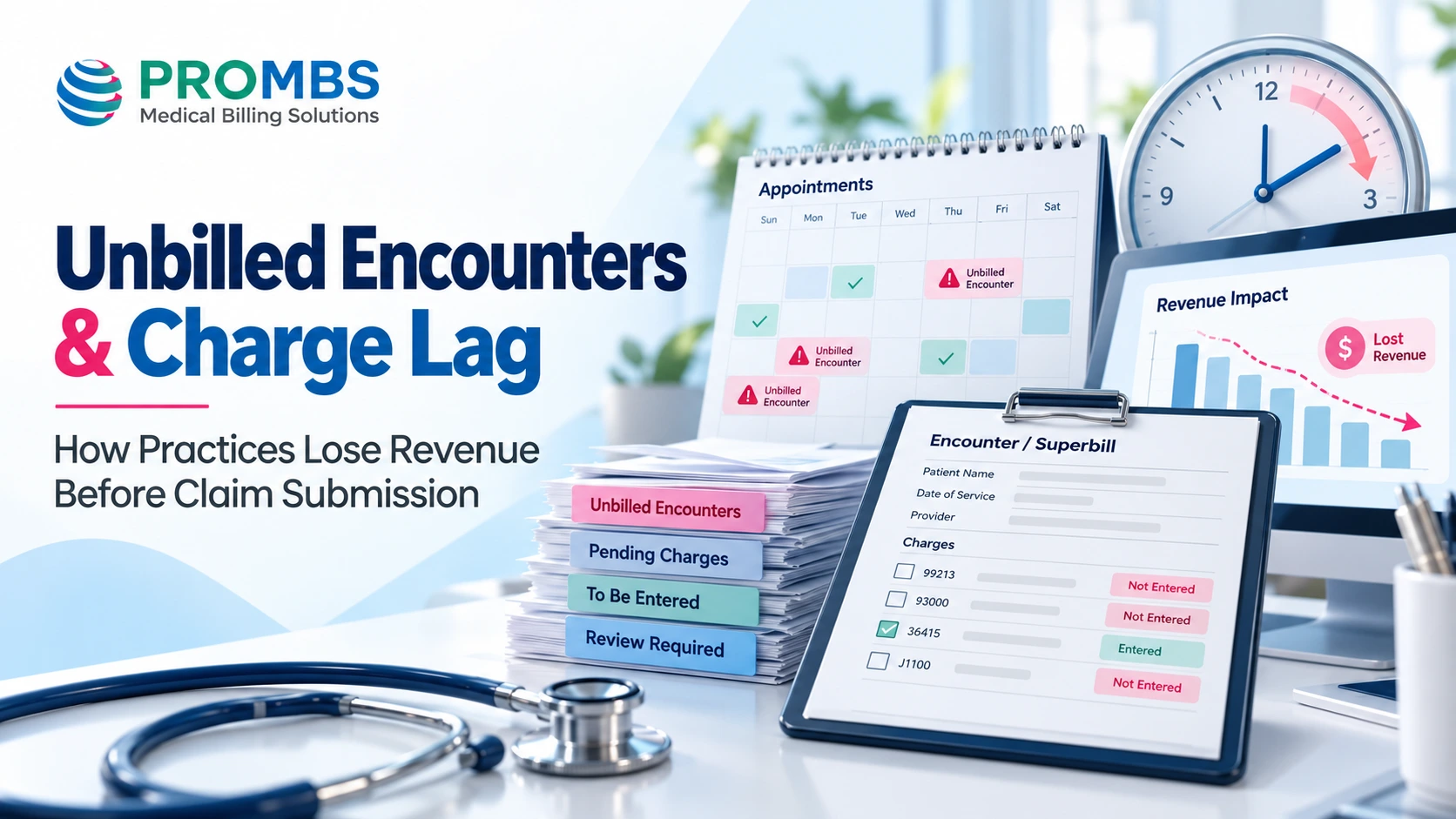
A medical practice can see patients every day, maintain a busy appointment schedule, and still miss revenue from services it has already provided. Sometimes, the problem has nothing to do with insurance denials or low reimbursement rates. The claim was simply never submitted.
This happens when completed patient visits remain unbilled because of missing charges, unfinished documentation, or delays between clinical and billing teams.
These unbilled encounters can go unnoticed for weeks, especially when practices focus on submitted claims and outstanding payments rather than checking whether every eligible visit entered the billing process.
Understanding where these gaps begin is essential for protecting practice revenue. The earlier an unbilled visit is identified, the easier it generally becomes to review the documentation, correct the issue, and submit an accurate claim within the applicable deadline.
What Are Unbilled Encounters in Medical Billing?
Unbilled encounters are completed patient visits or services that have not progressed through the billing process to claim submission. They may be waiting for clinical documentation, coding, charge entry, or another required billing action.
For example, a physician sees a patient for a follow-up appointment. The visit is recorded in the electronic health record (EHR), but the clinical note remains unfinished. As a result, the encounter stays in a pending work queue rather than moving forward for claim preparation.
The patient received care, but the practice has not yet submitted a claim for that service.
This does not automatically mean the practice has lost money. However, it does mean that a potentially billable service requires attention before the delay creates further problems.
Unbilled encounters can appear in different stages of the workflow:
- Completed visits with unsigned or incomplete clinical notes.
- Documented procedures with charges that have not been entered.
- Encounters waiting for coding or billing review.
- Charges entered in the system but not converted into submitted claims.
- Visits delayed because of unresolved insurance or patient information.
Not every completed encounter should generate a separate claim. Some services may be bundled, nonbillable, or included in another payment arrangement. The purpose of reviewing unbilled encounters is to identify legitimate billing opportunities, not to create unsupported charges.
A structured medical billing and coding audit can help practices distinguish routine billing holds from missing charges and other revenue-related problems.
What Is Charge Lag and How Does It Affect Revenue?
Charge lag is the time between the date a healthcare service is provided and the date its charges are entered into the billing system.
It measures how quickly completed patient care moves into the financial side of the practice.
For example, suppose a patient receives treatment on Monday, but the charges are not entered until Thursday. The practice has a three-day charge lag for that encounter, measured in elapsed calendar days.
If the charges are entered on Thursday but the claim is not submitted until Friday, the practice also has a separate delay between charge entry and claim submission.
These two delays should not be confused:
- Charge lag: Time from the date of service to charge entry.
- Claim submission lag: Time from charge entry to claim submission.
Both affect how quickly a medical practice can begin collecting payment, but they occur at different points in the billing process.
The Healthcare Financial Management Association (HFMA) identifies accurate charge capture as an essential part of revenue cycle management because healthcare services must be recorded correctly before claims can be processed.
Why Does a Longer Charge Lag Matter?
A delay of one or two days may be manageable within a practice’s established workflow. However, recurring delays across multiple providers or locations can create a larger problem.
When charges remain pending, claims cannot move through the normal billing process. This postpones payer processing and delays the opportunity to receive payment.
Longer delays can also make billing errors harder to resolve. Staff may need to revisit older patient records, clarify missing documentation, or investigate why an encounter never reached the billing team.
Practices that monitor charge lag and other revenue cycle KPIs can identify these problems earlier instead of discovering them after monthly collections decline.
Why Do Completed Patient Visits Remain Unbilled?
Unbilled patient encounters rarely happen because of one isolated mistake. They usually develop when responsibilities are unclear, clinical documentation is delayed, or information fails to move correctly between systems.
Understanding the root causes helps practices identify where revenue is getting stuck.
1. Incomplete or Unsigned Clinical Documentation
Clinical documentation is one of the most common reasons an encounter remains on hold.
A physician may complete a patient appointment but leave the note unfinished while attending to other patients. If the billing workflow requires finalized documentation before coding or charge release, the encounter cannot move forward.
This becomes particularly problematic when providers have large patient volumes or when no one regularly reviews outstanding documentation.
The billing team may know that the patient was seen but still lack sufficient information to determine which services can be billed.
A practical solution begins with identifying outstanding notes and assigning clear responsibility for completing them.
2. Missed Charges During Charge Capture
A service can be documented correctly and still remain unbilled if its charge is never entered.
This can happen when a practice provides multiple services during the same appointment, such as an office visit and a separately billable procedure.
If the procedure is documented but never added to the appropriate charge workflow, its potential reimbursement may be overlooked.
These mistakes are sometimes called missed charge capture.
They are especially important in practices that perform frequent procedures, diagnostic services, or treatments involving several billing components.
Accurate charge capture requires comparing documented services with the charges actually recorded, while confirming that each service qualifies for separate billing.
3. EHR and Practice Management System Problems
Many medical practices use an EHR to document patient care and a practice management system to handle billing.
When these systems do not communicate correctly, a completed encounter may fail to reach the billing queue.
For example, the clinical record may show that a service was performed, but an interface error prevents the corresponding charge information from transferring.
Without regular reconciliation, the billing team may never realize that the encounter is missing.
Technology can improve billing efficiency, but automated processes still require monitoring. Practices should have a way to identify failed transfers, unresolved interface errors, and encounters that do not appear in expected billing reports.
4. Staffing Delays and Unclear Workflow Responsibilities
Even well-designed billing systems can develop backlogs when staff responsibilities are not clearly assigned.
A provider may assume the coding department is reviewing an encounter, while the coding department is waiting for documentation. Meanwhile, the billing team assumes the claim is being prepared.
These handoff problems become more common during staff turnover, rapid practice growth, or billing company transitions.
The underlying issue is often not a lack of effort. It is the absence of a clear process showing who owns each pending encounter and when action is required.
A reliable workflow should make unresolved visits visible and assign responsibility for moving them forward.
5. Unresolved Coding or Insurance Information
Some encounters remain unbilled because staff are waiting for diagnosis clarification, payer information, or an eligibility review.
These issues may require investigation before a compliant claim can be prepared.
However, waiting for information should not mean leaving an encounter indefinitely in an unmonitored queue.
Practices need a process for identifying what information is missing, who must obtain it, and whether the encounter is approaching a filing deadline.
How Unbilled Encounters Affect Medical Practice Cash Flow
Unbilled encounters create a different financial problem from unpaid claims.
When a claim has been submitted, the practice can usually track it through its billing and accounts receivable reports. But when a visit has never become a submitted claim, the expected payment may not appear in those reports at all.
This makes the revenue gap harder to recognize.
Consider a practice that identifies 12 potentially billable encounters each month, with an estimated allowable reimbursement of $125 per encounter.
That represents $1,500 in potential monthly reimbursement, or $18,000 across a year if the same pattern continues.
These figures are illustrative, not guaranteed losses or recoverable revenue. Actual payment depends on coverage, coding, documentation, contractual reimbursement, and whether each encounter can still be billed.
Nevertheless, the example demonstrates why relatively small workflow problems deserve attention.
Delayed Claims Can Become Permanent Revenue Losses
The longer an encounter remains unbilled, the greater the risk that the practice will run into a payer’s timely filing deadline.
For Medicare fee-for-service claims, the Centers for Medicare & Medicaid Services (CMS) generally requires claims to be submitted within one calendar year after the date of service, subject to limited exceptions.
Commercial insurance plans and Medicaid programs may have different filing requirements.
If a practice discovers an old encounter after the applicable deadline, it may be unable to collect payment even when the original service was properly documented.
This is why unbilled encounters should be reviewed well before filing deadlines become urgent.
Unbilled Revenue May Not Appear in Standard A/R Reports
A common mistake is assuming that an accounts receivable report provides a complete picture of everything the practice is owed.
Traditional A/R reporting generally focuses on recorded charges and outstanding balances. An encounter that has never produced a charge may be missing from that view.
A practice could therefore have reasonable A/R performance while still overlooking billable services that never entered its financial workflow.
The broader issue is revenue leakage in healthcare, where earned or potentially collectible revenue is delayed or missed because of gaps in the revenue cycle.
To understand the full picture, practices need to compare completed patient encounters with recorded charges and submitted claims.
This comparison helps reveal whether revenue is being delayed before submission rather than lost later through denials or unpaid balances.
How to Identify Unbilled Encounters in Your Practice
The most effective way to identify unbilled encounters is to compare completed patient visits with recorded charges and submitted claims. A busy schedule alone does not reveal whether every billable service has moved through the revenue cycle.
Practices should begin by reviewing their EHR’s completed encounter report alongside billing records for the same dates of service.
A review of unbilled encounters should answer three questions:
- Was the patient visit or service completed?
- Was the appropriate charge recorded?
- Did the charge result in a submitted claim or another valid billing outcome?
If the answer to any question is unclear, the encounter needs further investigation.
The review should include office visits, telehealth appointments, procedures, and services performed outside the main practice location. It should also account for completed encounters that do not require separate claims, including services bundled into another payment or handled through a different billing arrangement.
Review Pending and Incomplete Encounters Daily
Most EHR and practice management systems offer reports showing encounters waiting for documentation, coding, or charge entry.
These reports become useful when someone regularly reviews them and follows up on unresolved items.
For example, a medical practice may have 60 completed encounters in one day. After reconciliation, the billing team discovers:
- 51 encounters matched to submitted claims.
- 4 encounters correctly included in other billing arrangements.
- 3 encounters waiting for documentation.
- 2 encounters with missing charges.
The last five encounters require attention, although their underlying problems are different.
This type of review helps practices identify billing gaps while the services are still recent and supporting information is easier to obtain.
Common Charge Capture and Documentation Problems
Finding missing encounters is only the first step. Practices also need to understand why charges failed to reach billing.
Missing Procedure Charges
Sometimes, a provider documents multiple services during one appointment, but only some of the charges reach the billing system.
For example, a physician may perform an evaluation and a minor procedure during the same visit. Depending on documentation, payer policies, and applicable coding rules, separate billing may be appropriate.
If the procedure charge is missing, the billing team should verify the clinical record and determine whether the service qualifies for separate reimbursement.
The goal is accurate charge capture, not automatically billing every documented activity as an additional service.
Documentation Holds That Remain Unresolved
An encounter may remain pending because the clinical note lacks information needed for coding or claim submission.
Rather than allowing these cases to accumulate, practices should establish a process for notifying providers when documentation requires completion or clarification.
The Centers for Medicare & Medicaid Services emphasizes that medical documentation must support the services and codes reported on a claim.
Billing staff should not guess missing clinical details or select unsupported codes simply to release a delayed claim.
EHR Integration and Charge Transfer Failures
Automated billing workflows can reduce manual work, but they can also hide problems when system interfaces fail.
A completed encounter may appear correctly in the EHR without creating the expected charge in the practice management system.
Routine interface monitoring should flag rejected transfers, unmatched records, and incomplete transactions.
When the same error affects several encounters, correcting the underlying system problem is more effective than repairing each record individually.
How to Reconcile Patient Encounters With Submitted Claims
Encounter-to-claim reconciliation is the process of verifying that each completed, billable service has been captured, reviewed, and moved to an appropriate billing outcome.
A reliable reconciliation process follows the encounter from the clinical record through charge entry and claim submission.
The billing team should compare each stage rather than assuming that a completed visit automatically generated a claim.
| Workflow stage | What should be verified |
|---|---|
| Completed encounter | Patient, provider, date of service, and actual services performed |
| Clinical documentation | Required information is complete and supports coding |
| Charge entry | Appropriate charges and units are accurately recorded |
| Claim submission | The claim was transmitted and its acceptance status checked |
| Exceptions | Missing, bundled, nonbillable, or pending services are documented |
Reconciliation does not always mean matching one encounter to one claim. Some encounters may produce multiple billable services, while others may not require a separate claim.
For this reason, each completed encounter should have a clear billing status.
For example, when an EHR shows a completed patient visit but the billing system has no corresponding charge, staff should investigate whether the service was missed, included in another charge, or legitimately nonbillable.
This process is especially important for practices with multiple providers or locations, where missing encounters can become difficult to identify through ordinary claim reports.
The Medical Group Management Association (MGMA) recommends regularly reconciling services and orders against charges to identify gaps in the charge capture process.
Practical Steps to Reduce Charge Lag
Reducing charge lag requires a workflow that helps clinical and billing teams resolve problems before encounters become old.
Establish Clear Documentation Turnaround Expectations
Providers should understand when clinical documentation is expected to be completed and how outstanding records will be monitored.
Practices can establish internal turnaround targets based on service complexity, staffing, and payer requirements.
For example, an organization may aim to review routine documentation holds within one business day. More complicated cases may require additional time.
The important point is to make delays visible rather than allowing them to remain unresolved.
Assign Ownership to Every Pending Encounter
Unbilled encounters should not remain in shared work queues without a responsible staff member.
Each pending record should identify the problem, the person responsible, and the next action required.
Documentation questions should reach the appropriate clinical team. Coding questions should go to qualified coding staff. System errors should be directed to the relevant technical support team.
Clear ownership reduces repeated follow-ups and prevents encounters from becoming stuck between departments.
Use Automated Alerts Without Removing Human Review
Billing systems can be configured to highlight encounters that remain pending beyond a defined period.
For example, an alert may identify visits completed three days earlier that still lack charges.
However, automated alerts cannot determine whether every service is separately billable. Staff must still review the clinical documentation and applicable billing rules.
Automation is most valuable when it helps employees prioritize actual problems rather than generating large numbers of unnecessary notifications.
Review the Entire Revenue Cycle, Not Just Charge Entry
Reducing the time required to enter charges is helpful, but it does not guarantee faster payment.
A charge may be entered promptly and still remain in an unsubmitted claim queue because of coding errors, missing insurance information, or unresolved claim edits.
Practices should therefore monitor both charge entry and claim submission.
A structured revenue cycle management process helps connect these activities so that improvements in one area do not simply move delays elsewhere.
Key Metrics for Tracking Unbilled Encounters
Practices cannot improve a billing problem consistently without measuring it.
Instead of relying only on total charges and collections, administrators should monitor the movement of encounters from the date of service to claim submission.
The following measurements are particularly useful.
1. Charge Lag
Charge lag measures the number of days between the date of service and charge entry.
A practice can monitor both average and median charge lag to understand whether delays are routine or concentrated in a smaller group of older encounters.
For example, a practice with an average charge lag of four days should investigate which providers, locations, or services contribute most to that delay.
2. Unbilled Encounter Count and Aging
This metric shows how many completed encounters have not reached a final billing disposition.
The report should separate recent visits from older pending encounters and identify why each item remains unresolved.
Tracking aging by provider, location, and hold reason helps billing managers focus on problems that require immediate action.
3. Encounter Reconciliation Rate
This measurement shows the percentage of completed encounters that have been matched to an appropriate billing outcome.
A practice can calculate it as:
Encounter Reconciliation Rate = (Completed Encounters With a Verified Billing Outcome ÷ Total Completed Encounters Reviewed) × 100
Valid outcomes may include submitted claims, completed self-pay billing, bundled services, or documented nonbillable encounters.
This measurement should not be confused with the clean claim rate, which evaluates claim quality after the billing process has progressed further.
4. Date-of-Service-to-Claim Submission Lag
This metric tracks the time between delivering care and submitting the claim.
It helps practices identify whether delays continue after charges have already been entered.
For example, a practice may reduce charge lag from four days to two days but still take another five days to submit claims.
In that situation, improving charge entry alone will not solve the entire problem.
These measurements should be reviewed alongside broader revenue cycle KPIs to understand how early billing delays affect overall financial performance.
Turning Billing Reports Into Preventive Action
A report showing unbilled encounters is only useful when the practice acts on the information.
Billing managers should review repeated hold reasons, investigate unusual delays, and determine whether the problem involves staff capacity, documentation habits, system configuration, or coding requirements.
For example, if one provider consistently has more pending encounters than others, the practice should examine the workflow before assuming individual performance is the problem.
The cause might be a documentation template issue, a different service mix, or an ineffective handoff process.
Regular reconciliation makes it easier to separate isolated mistakes from recurring operational weaknesses.
However, some encounters remain unresolved long enough to create timely filing risks or require a more detailed revenue recovery review.
How to Recover Revenue From Unbilled Encounters
Finding missing encounters is important, but identifying them does not automatically mean the practice can recover payment. Each encounter must be reviewed to determine whether the service was billable, whether the documentation supports a claim, and whether the payer’s filing deadline is still open.
A systematic review of unbilled encounters allows practices to separate recoverable charges from records that require further investigation or cannot legitimately be billed.
The recovery process should begin with older encounters and those approaching filing deadlines.
Verify That the Service Was Never Billed
Before creating a claim, the billing team should confirm that the service has not already been submitted through another billing account, location, or system.
This is particularly important for practices that have changed billing software, merged locations, or transitioned between billing companies.
Submitting a duplicate claim can create additional rework, payment complications, and compliance concerns.
Review Documentation and Coding Accuracy
Once an encounter is confirmed as unbilled, the next step is reviewing the clinical documentation.
The billing team should verify the service date, provider information, diagnosis codes, procedures, and payer requirements.
If information is missing, the appropriate clinical staff should review the record. Any late documentation must accurately reflect the services originally provided and follow applicable documentation requirements.
Charges should never be created or changed simply to increase reimbursement without supporting evidence.
Prioritize Claims That Can Still Be Submitted
Not every missing charge has the same recovery potential.
For example, an encounter from two weeks ago may require routine correction, while an encounter from several months earlier may need urgent attention because of its filing deadline.
Billing teams should prioritize encounters according to:
- Time remaining before the payer’s filing deadline.
- Availability and completeness of clinical documentation.
- Potential reimbursement and claim complexity.
- Whether the claim can be submitted compliantly.
Once a valid claim is submitted, staff should confirm its acceptance and monitor its progress through payment.
How Charge Lag Creates Timely Filing Risks
One of the biggest financial risks associated with charge lag is discovering a completed patient encounter after the payer’s claim submission deadline has passed.
For Original Medicare, claims generally must be filed within 12 months, or one calendar year, after the date of service. The Centers for Medicare & Medicaid Services recognizes limited exceptions to this requirement.
Commercial insurance and Medicaid filing limits vary according to the applicable payer rules, contracts, and programs.
A practice should never assume that every insurer follows Medicare’s deadline.
Can an Old Unbilled Claim Still Be Submitted?
The answer depends on the payer, the date of service, and the circumstances surrounding the delay.
If the filing deadline remains open, a properly supported claim may still be submitted.
If the deadline has passed, the billing team must determine whether a specific exception or other permitted process applies.
Importantly, a claim that was never submitted is different from a claim that was submitted and subsequently denied.
For Medicare, a denial solely for failing to meet the original timely filing requirement is generally not an appealable initial determination. A routine appeal cannot be assumed to restore the missed filing opportunity.
This distinction matters because practices sometimes spend unnecessary time preparing appeals when the problem actually began before claim submission.
The best protection is identifying missing encounters early, maintaining accurate submission records, and monitoring payer deadlines before they expire.
What Should an Unbilled Encounter Audit Include?
An unbilled encounter audit examines whether completed, potentially billable services have moved correctly from clinical documentation to charge entry and claim submission.
Unlike a traditional review of unpaid claims, this audit focuses on services that may never have entered accounts receivable.
An effective audit should examine five areas.
1. Completed Encounters and Missing Charges
Compare appointment schedules, completed EHR encounters, procedure records, and billing reports.
Identify services without a corresponding charge or another documented billing outcome.
2. Documentation and Coding Holds
Review encounters waiting for unsigned notes, diagnosis clarification, procedural details, or coding review.
Determine whether these delays are isolated or repeatedly associated with particular workflows.
3. Charge Lag and Claim Submission Delays
Measure how long encounters take to move from the date of service to charge entry and then to claim submission.
Separate documentation delays from coding, billing, and technical problems so the practice can address the correct cause.
4. Potential Revenue and Filing Deadlines
Estimate the allowable reimbursement associated with potentially billable missing services.
Separate amounts that remain eligible for submission from those requiring further review. Potential revenue should not be counted as recovered revenue until payment is actually received.
5. Recurring Workflow Problems
Investigate whether missing charges result from EHR interfaces, staffing shortages, unclear responsibilities, or incomplete reconciliation processes.
The final audit report should identify both the financial exposure and the operational changes required to prevent similar problems.
A targeted audit is more useful than a long list of missing records when it clearly explains what caused each issue and who is responsible for resolving it.
How to Prevent Unbilled Encounters From Recurring
Recovering older charges can improve collections, but long-term improvement depends on preventing new billing gaps.
Practices should establish a consistent process for reviewing completed visits, documenting exceptions, and confirming claim submission.
A practical prevention plan includes daily exception reviews, clearly assigned work queues, automated aging alerts, and periodic reconciliation between clinical and billing systems.
Management should also review recurring hold reasons rather than focusing exclusively on the total number of pending encounters.
For example, if missing charges repeatedly originate from one EHR interface, training billing staff to process the resulting backlog will not solve the underlying technical problem.
Similarly, if providers regularly experience documentation delays, the practice may need to improve templates, communication, or workload distribution.
The objective is to build a workflow in which every completed encounter reaches a documented outcome and unresolved items are identified before they threaten reimbursement.
How Pro Medical Billing Solutions Helps Prevent Revenue Leakage
Many medical practices have capable clinical and administrative teams but lack the time or reporting systems needed to investigate every billing exception.
Pro Medical Billing Solutions (PROMBS) helps healthcare practices identify weaknesses in charge capture, medical coding, claim submission, and revenue cycle workflows.
Through its medical billing and coding audit services, PROMBS can help practices examine missing charges, documentation problems, and billing inconsistencies that contribute to delayed revenue.
Its broader revenue cycle management services address charge entry, claim processing, reporting, and follow-up.
For practices dealing with unresolved claims that have already been submitted, PROMBS also provides denial management services to investigate payer responses and identify appropriate corrective actions.
The goal is not simply to submit claims faster. It is to help practices create a more reliable process from the completion of patient care through reimbursement.
Frequently Asked Questions About Unbilled Encounters
What is an unbilled encounter in medical billing?
An unbilled encounter is a completed patient visit or healthcare service that has not reached claim submission or another appropriate billing outcome. It may be waiting for documentation, coding, charge entry, or billing review.
What is the difference between charge lag and unbilled encounters?
Charge lag measures the time between providing a service and entering its charges into the billing system.
Unbilled encounters are completed services that remain outside the finalized billing process. A practice can have a short charge lag but still experience unbilled encounters if entered charges become stuck before claim submission.
How can medical practices find missing patient charges?
Practices can compare completed patient encounters in their EHR with charge entry records, claim submission reports, and documented billing exceptions.
Regular encounter-to-claim reconciliation helps identify missing charges that might not appear in traditional A/R reports.
Can unbilled encounters cause revenue loss?
Yes. Unbilled encounters can delay collections and create financial losses when eligible claims are overlooked or filing deadlines expire.
However, not every unbilled encounter represents collectible revenue. The service must be separately billable, properly documented, and eligible for payment under the applicable rules.
How often should a practice review unbilled encounters?
Daily exception reviews are a useful operational practice, particularly for clinics with high patient volumes.
A more detailed weekly or monthly reconciliation can help management identify recurring problems, monitor charge lag, and evaluate the effectiveness of corrective actions.
The appropriate frequency depends on the practice’s size, service mix, and billing workflow.
Find and Recover Revenue Before It Is Lost
Medical practices often devote considerable attention to denied claims and overdue insurance payments. However, some revenue problems begin much earlier, when completed patient visits never reach claim submission.
Identifying these gaps requires more than reviewing collections. Practices need visibility into documentation holds, missing charges, billing exceptions, and the time it takes for an encounter to become a submitted claim.
By reviewing these issues regularly, practices can reduce preventable delays, protect filing opportunities, and strengthen their overall revenue cycle.