

Choosing between Orthopedic Billing Companies is less about the boldest collection claim and more about fit.
A solo sports medicine office needs something different from a ten-surgeon group with spine, joint replacement, therapy, imaging, and an ASC. The first may prioritize eligibility, injection coding, claim follow-up, and patient billing. The second needs surgical coding depth, global-period controls, authorization tracking, location-level reporting, and reliable backup coverage.
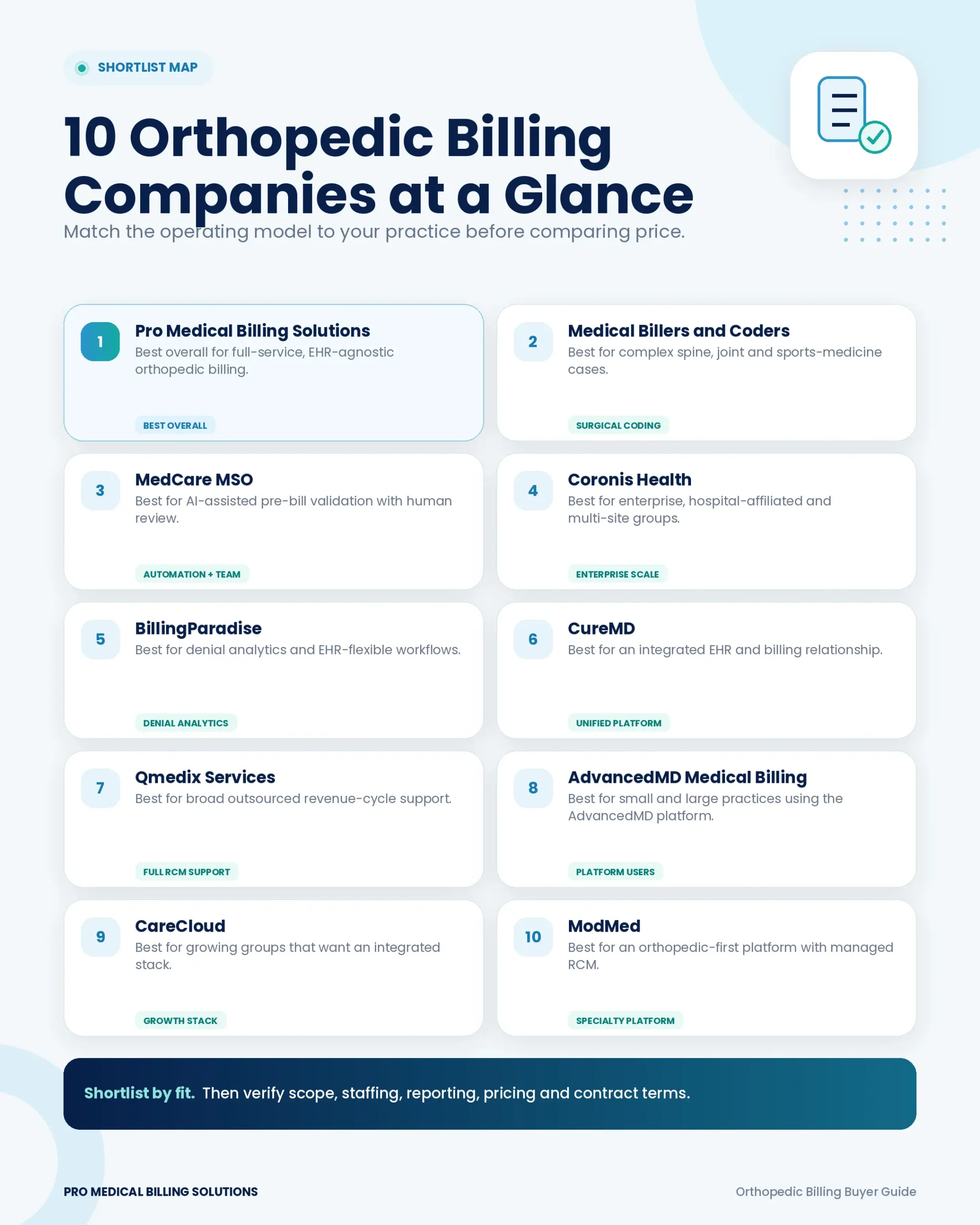
Pro Medical Billing Solutions is our best overall choice for broad support, EHR flexibility, orthopedic workflow coverage, and public starting pricing. Medical Billers and Coders suits surgery-heavy groups, MedCare MSO combines service with automation, and Coronis Health is aligned with enterprise scale.
No ranking can replace due diligence. Public performance claims are often based on selected clients or company-wide results. Use this guide to build a shortlist, then ask each finalist to prove its numbers using the same definitions and a comparable orthopedic client.
If you first need a practical explanation of the specialty’s revenue workflow, read this orthopedic medical billing guide.
The 10 Best Orthopedic Billing Companies at a Glance
| Company | Best Fit | Operating Model | Main Strength | Pricing Visibility | Point to Verify |
|---|---|---|---|---|---|
| Pro Medical Billing Solutions | Solo surgeons, growing groups, multi-location practices, and ASCs | Full-service, EHR-agnostic RCM | Broad orthopedic workflow coverage with transparent starting pricing | Starts at 2.49% of collections | Confirm the final rate and exact scope for your volume |
| Medical Billers and Coders | Spine, joint, sports medicine, and multi-surgeon groups | Specialty-focused full-service RCM | Detailed public focus on complex orthopedic procedures | Custom quote | Validate self-reported outcomes with similar client references |
| MedCare MSO | Practices and ASCs seeking billing support plus automation | RCM services and technology | Pre-bill validation, authorization support, and reporting | Custom quote | Ask which automation tools and human reviews are included |
| Coronis Health | Large, multi-site, or hospital-affiliated orthopedic organizations | Enterprise RCM | Scale, integrations, financial analysis, and broad RCM coverage | Custom quote | Confirm the service structure and attention level for your practice size |
| BillingParadise | Groups prioritizing denial control and analytics | Full-service RCM with proprietary tools | EHR flexibility, dashboards, and orthopedic denial workflows | Custom quote | Put KPI definitions and service levels in the agreement |
| CureMD | Practices wanting billing, EHR, and practice management together | Integrated platform and RCM | One-vendor clinical and financial workflow | Custom quote | Price migration, implementation, and data portability |
| Qmedix Services | Independent practices and groups wanting broad outsourced support | Full-service RCM | Coding, underpayment work, credentialing, ASC support, and patient billing | Custom quote | Confirm the included service package and supporting evidence |
| AdvancedMD Medical Billing | Practices, small or large, planning to use AdvancedMD Medical Billing services | Expert-led managed billing and complete RCM services | Tight software integration and flexible in-house or outsourced workflows | Typically about 4% to 8% of collections | Clarify the fit if you intend to keep a third-party system |
| CareCloud | Growing groups seeking an integrated operational and financial stack | Platform-led RCM | Orthopedic templates, automated billing rules, and scalable software | Custom quote | Separate the software features from staffed RCM responsibilities |
| ModMed | Orthopedic groups replacing both clinical and billing systems | Orthopedic-first platform with RCM services | Specialty-built documentation, coding prompts, analytics, and billing support | Custom quote | Evaluate the total migration effort and ecosystem fit |
Why Orthopedic Billing Requires More Than General Claim Submission
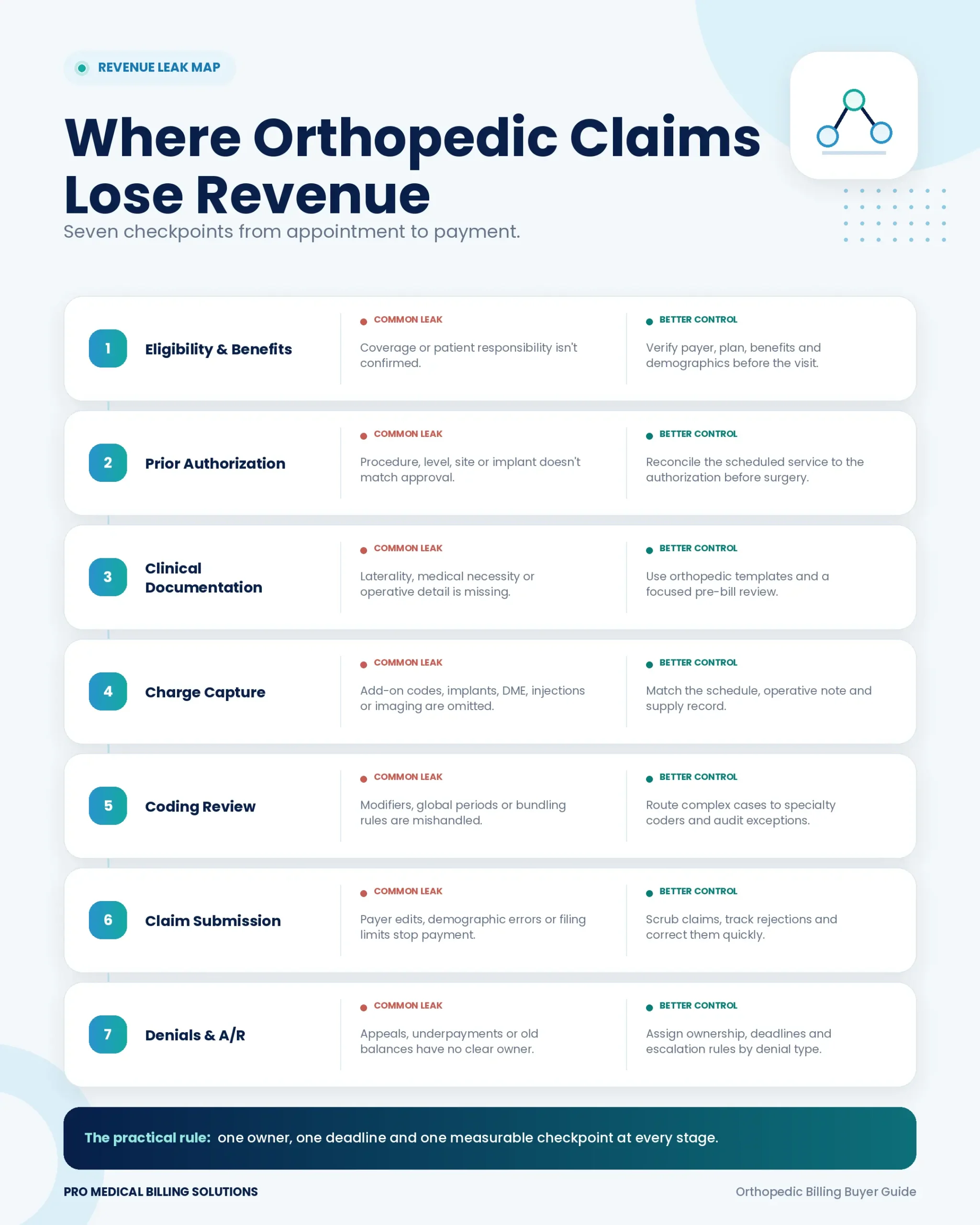
Orthopedic claims cross office visits, injections, imaging, fracture care, DME, surgery, rehabilitation, and sometimes workers’ compensation or personal injury.
Picture a patient who is seen for a new shoulder problem, receives imaging, completes conservative treatment, and later undergoes arthroscopic repair. The billing workflow must connect medical necessity, authorization, the operative report, code bundling, laterality, modifiers, and postoperative care. A vendor that only receives charges and sends claims is joining the story too late.
Global surgery rules add another layer. Medicare uses 0-day, 10-day, and 90-day postoperative periods, and separately payable care depends on the service, timing, documentation, and modifier. The CMS Global Surgery booklet explains which services are included and how modifiers such as 24, 25, 57, 58, 78, and 79 apply.
Multiple-procedure cases also require disciplined edit review. The CMS National Correct Coding Initiative policy manual is the starting point for Medicare bundling policy, though commercial payer rules can differ.
That is why good orthopedic billing services begin before submission. They catch missing authorization details, incomplete operative documentation, laterality conflicts, modifier problems, and charge gaps while the issue can still be corrected.
Free Orthopedic Billing Review
See whether authorization gaps, coding errors, denials, aging A/R, or underpayments are weakening cash flow before you change vendors.
Request a Free Billing and Coding AuditHow We Evaluated These Companies
We gave the most weight to the factors that affect orthopedic revenue in daily practice:
- Evidence of orthopedic coding and surgical workflow knowledge
- Coverage across eligibility, authorization, coding, claims, payments, denials, A/R, and reporting
- Ability to work with existing EHR and practice-management systems
- Reporting that can be filtered by payer, provider, location, and denial reason
- Support for solo practices, groups, ASCs, or enterprise organizations
- Pricing and contract transparency
- Clear public information that a buyer can verify
This is a fit-based editorial comparison built from current public information. It is not a hands-on audit of each company’s client accounts. When a vendor publishes a collection rate or denial result, treat it as a claim to investigate, not a guaranteed outcome.
Top 10 Orthopedic Medical Billing Companies
1. Pro Medical Billing Solutions | Best Overall
Pro Medical Billing Solutions combines orthopedic-specific billing with a broad, EHR-agnostic service model. Its published scope covers charge capture, coding, claims, payment posting, denial appeals, A/R, patient billing support, authorization, and reporting.
| Evaluation Point | Orthopedic Billing Review |
|---|---|
| Ideal Practice Type | Independent surgeons, multi-physician groups, growing practices, and multi-location organizations |
| Revenue Cycle Coverage | Charge capture, coding, claims, payment posting, denial appeals, A/R follow-up, patient billing, authorization, and reporting |
| Orthopedic Capability | Arthroscopy, joint replacement, fracture care, trauma, reconstructive procedures, and office-based services |
| Technology Approach | EHR-agnostic support that allows practices to continue using their existing software |
| Standout Value | End-to-end orthopedic billing support with transparent starting pricing |
| Reporting Experience | Performance dashboards, implementation planning, A/R visibility, and ongoing revenue-cycle reviews |
| Pricing Visibility | Public starting rate of 2.49% of collections |
| Buyer Check | Confirm which front-end services are included and request a sample dashboard, implementation plan, and comparable orthopedic references |
2. Medical Billers and Coders | Best for Complex Surgical Case Mixes
Medical Billers and Coders publishes detailed information about specialty-specific orthopedic medical billing, including joint replacement, spine surgery, sports medicine, fracture care, add-on code capture, global periods, authorization, and procedure-level reporting.
| Evaluation Point | Orthopedic Billing Review |
|---|---|
| Ideal Practice Type | Multi-surgeon groups, spine practices, joint replacement centers, and procedure-heavy organizations |
| Revenue Cycle Coverage | Coding, authorization, claims, denial management, old A/R recovery, credentialing, and reporting |
| Orthopedic Capability | Spine surgery, sports medicine, fracture care, joint replacement, add-on codes, implants, and global periods |
| Technology Approach | Procedure-level reporting supported by RCM dashboards and surgical billing workflows |
| Standout Value | Detailed public focus on complex orthopedic procedures and surgical coding requirements |
| Reporting Experience | Procedure-level reporting, denial tracking, A/R monitoring, and performance dashboards |
| Pricing Visibility | Custom quote required |
| Buyer Check | Ask how published performance figures are calculated and whether they reflect comparable orthopedic practices |
3. MedCare MSO | Best for AI-Assisted Pre-Bill Validation
MedCare MSO blends managed RCM with automation and analytics. Its orthopedic offering covers laterality checks, global periods, complex procedures, authorization, appeals, A/R, credentialing, integrations, and real-time reporting. Its rule engine and AI-assisted validation aim to catch problems before submission.
| Evaluation Point | Orthopedic Billing Review |
|---|---|
| Ideal Practice Type | ASCs, surgical practices, growing groups, and organizations with higher claim volumes |
| Revenue Cycle Coverage | Coding, authorization, claims, appeals, A/R, credentialing, integrations, and reporting |
| Orthopedic Capability | Laterality validation, global-period management, surgical coding, complex procedures, and authorization control |
| Technology Approach | AI-assisted validation, automated work queues, rule-based claim checks, and real-time analytics |
| Standout Value | Combines an outsourced billing team with technology-assisted pre-submission controls |
| Reporting Experience | Real-time visibility into claims, denials, payments, A/R, and workflow exceptions |
| Pricing Visibility | Custom proposal based on practice requirements |
| Buyer Check | Request a live orthopedic claim demonstration and confirm which decisions receive human review |
4. Coronis Health | Best for Enterprise and Multi-Location Groups
Coronis Health is built for scale. Its orthopedic RCM offering includes billing, certified coding, audits, denial management, A/R, financial reporting, patient access, automation, and system integration.Coronis Health is built for scale. Its orthopedic RCM offering includes billing, certified coding, audits, denial management, A/R, financial reporting, patient access, automation, and system integration.
| Evaluation Point | Orthopedic Billing Review |
|---|---|
| Ideal Practice Type | Large orthopedic groups, hospital-affiliated departments, and multi-location organizations |
| Revenue Cycle Coverage | Billing, certified coding, audits, denial management, A/R, patient access, integrations, and financial reporting |
| Orthopedic Capability | Scalable RCM support across providers, locations, payers, and orthopedic service lines |
| Technology Approach | Enterprise automation, system integration, financial analytics, and standardized workflows |
| Standout Value | Large-scale operational capacity with centralized reporting and backup resources |
| Reporting Experience | Reporting by surgeon, location, payer, service line, and overall financial performance |
| Pricing Visibility | Custom enterprise quote |
| Buyer Check | Confirm who manages the account after implementation and how much direct support the practice receives |
5. BillingParadise | Best for Denial Analytics and EHR Flexibility
BillingParadise combines outsourced RCM with claim scrubbing, denial management, A/R workflows, eligibility automation, and revenue analytics. Its orthopedic materials address authorizations, spine and joint coding, implants, DME, global-period modifiers, and common EHRs.
| Evaluation Point | Orthopedic Billing Review |
|---|---|
| Ideal Practice Type | Established multi-provider practices needing stronger denial and A/R oversight |
| Revenue Cycle Coverage | Eligibility, coding, claim scrubbing, denial management, A/R workflows, authorization, and analytics |
| Orthopedic Capability | Spine and joint coding, implants, DME, global-period modifiers, and surgical authorization workflows |
| Technology Approach | EHR-agnostic workflows supported by claim scrubbing, denial tools, and revenue analytics |
| Standout Value | Detailed work queues and denial reporting without requiring an EHR replacement |
| Reporting Experience | Denial trends, claim status, A/R aging, payer performance, and workflow reporting |
| Pricing Visibility | Custom quote required |
| Buyer Check | Define denial ownership, appeal turnaround, low-balance follow-up, reporting frequency, and escalation rules |
6. CureMD | Best for Integrated EHR and Billing
CureMD competes through a broader healthcare platform. Practices can combine EHR, practice management, billing, eligibility, authorization alerts, payment posting, denials, patient statements, credentialing, and reporting through one vendor.
| Evaluation Point | Orthopedic Billing Review |
|---|---|
| Ideal Practice Type | Practices seeking one vendor for clinical, operational, and financial workflows |
| Revenue Cycle Coverage | Billing, eligibility, authorization alerts, payment posting, denials, patient statements, credentialing, and reporting |
| Orthopedic Capability | Specialty coding, surgical billing, authorization support, claim follow-up, and compliance oversight |
| Technology Approach | Integrated EHR, practice management, billing, patient engagement, and revenue-cycle platform |
| Standout Value | Reduces manual handoffs by keeping clinical and billing functions within one ecosystem |
| Reporting Experience | Claim tracking, outstanding-task visibility, payment reporting, and practice-management analytics |
| Pricing Visibility | Customized pricing based on selected platform and services |
| Buyer Check | Request the complete first-year cost, including implementation, training, interfaces, conversion, and add-ons |
7. Qmedix Services | Best for Broad Outsourced Revenue Support
Qmedix Service describes a wide service scope: charge capture, specialty coding, enrollment, claim scrubbing, denial repair, underpayment follow-up, surgery-center billing, patient balances, and dashboards.
| Evaluation Point | Orthopedic Billing Review |
|---|---|
| Ideal Practice Type | Independent practices and groups seeking comprehensive outsourced billing support |
| Revenue Cycle Coverage | Charge capture, specialty coding, enrollment, claim scrubbing, denial repair, underpayment follow-up, and patient billing |
| Orthopedic Capability | Routine orthopedic claims, surgical billing, surgery-center workflows, and complex back-end follow-up |
| Technology Approach | Outsourced billing operations supported by claim monitoring and performance dashboards |
| Standout Value | Broad revenue-cycle support extending beyond basic claim submission |
| Reporting Experience | Visibility into claims, payments, denials, underpayments, patient balances, and A/R |
| Pricing Visibility | Not publicly specified; request a custom service proposal |
| Buyer Check | Confirm which services are standard and request evidence supporting any published performance claims |
8. AdvancedMD Medical Billing | Best for Small and Large Practices
AdvancedMD Medical Billing, a reliable medical billing and coding company offers managed billing alongside its practice management, scheduling, claims, A/R, and analytics services. RCM includes account management, claim follow-up, appeals, secondary claims, denials, payment posting, and reporting. Published typical pricing is roughly 4% to 8% of collections.
| Evaluation Point | Orthopedic Billing Review |
|---|---|
| Ideal Practice Type | Small and large orthopedic practices already using or planning to adopt AdvancedMD Medical Billing |
| Revenue Cycle Coverage | Account management, claims, appeals, secondary billing, denials, payment posting, A/R, and reporting |
| Orthopedic Capability | Managed billing support for office visits, surgical claims, denial follow-up, and payer collections |
| Technology Approach | Integrated practice management, scheduling, claims, A/R, analytics, and managed billing |
| Standout Value | Allows practices to move between internal billing and outsourced RCM as staffing needs change |
| Reporting Experience | Financial dashboards, A/R monitoring, claim tracking, payer reporting, and revenue analytics |
| Pricing Visibility | Published typical pricing of approximately 4% to 8% of collections |
| Buyer Check | Determine whether a platform change is required and confirm whether orthopedic coding is included |
9. CareCloud | Best for Growing Groups Seeking an Integrated Stack
CareCloud combines orthopedic EHR templates, practice management, automated billing rules, coding, credentialing, business intelligence, patient tools, and RCM. Its orthopedic materials describe billing specialists familiar with orthopedic payer rules.
| Evaluation Point | Orthopedic Billing Review |
|---|---|
| Ideal Practice Type | Growing and multi-location orthopedic groups consolidating systems and workflows |
| Revenue Cycle Coverage | Billing, coding, credentialing, business intelligence, patient tools, practice management, and RCM |
| Orthopedic Capability | Orthopedic templates, payer-specific billing rules, automated claim checks, and revenue-cycle support |
| Technology Approach | Integrated EHR, practice management, automated billing rules, patient tools, and analytics |
| Standout Value | Connects clinical, financial, administrative, and patient workflows within one platform |
| Reporting Experience | Business intelligence, claim performance, revenue reporting, payer analytics, and practice-level insights |
| Pricing Visibility | Custom quote based on platform and service selection |
| Buyer Check | Separate software capabilities from staffed services and identify who owns authorization, coding, denials, and payer calls |
10. ModMed | Best Orthopedic-First Platform With RCM Services
ModMed’s specialty platform combines EHR, practice management, analytics, payments, and RCM. Tools include orthopedic documentation, suggested codes and modifiers for review, claim-risk flags, tracking, and reporting.
| Evaluation Point | Orthopedic Billing Review |
|---|---|
| Ideal Practice Type | Orthopedic groups replacing clinical and billing systems together |
| Revenue Cycle Coverage | Practice management, billing, payments, claims tracking, analytics, and managed RCM |
| Orthopedic Capability | Specialty documentation, suggested codes and modifiers, claim-risk identification, and surgical workflows |
| Technology Approach | Orthopedic-focused EHR connected with practice management, analytics, payments, and RCM services |
| Standout Value | Specialty-first design strengthens the connection between clinical documentation and charge creation |
| Reporting Experience | Claim tracking, financial analytics, reimbursement trends, denial-risk visibility, and performance reporting |
| Pricing Visibility | Custom platform and RCM proposal |
| Buyer Check | Evaluate implementation, data conversion, total platform cost, and which AI-assisted features are currently available |
How to Choose the Right Orthopedic Billing Company
A sports medicine group may need eligibility discipline, same-day E/M and procedure review, and fast rejection correction. A spine practice may prioritize operative-note coding, multiple levels, instrumentation, appeals, and underpayments. A group with PT, imaging, and an ASC needs location and entity reporting.
Write down the three problems the new company must solve. Then give every finalist the same scope document and the same questions.
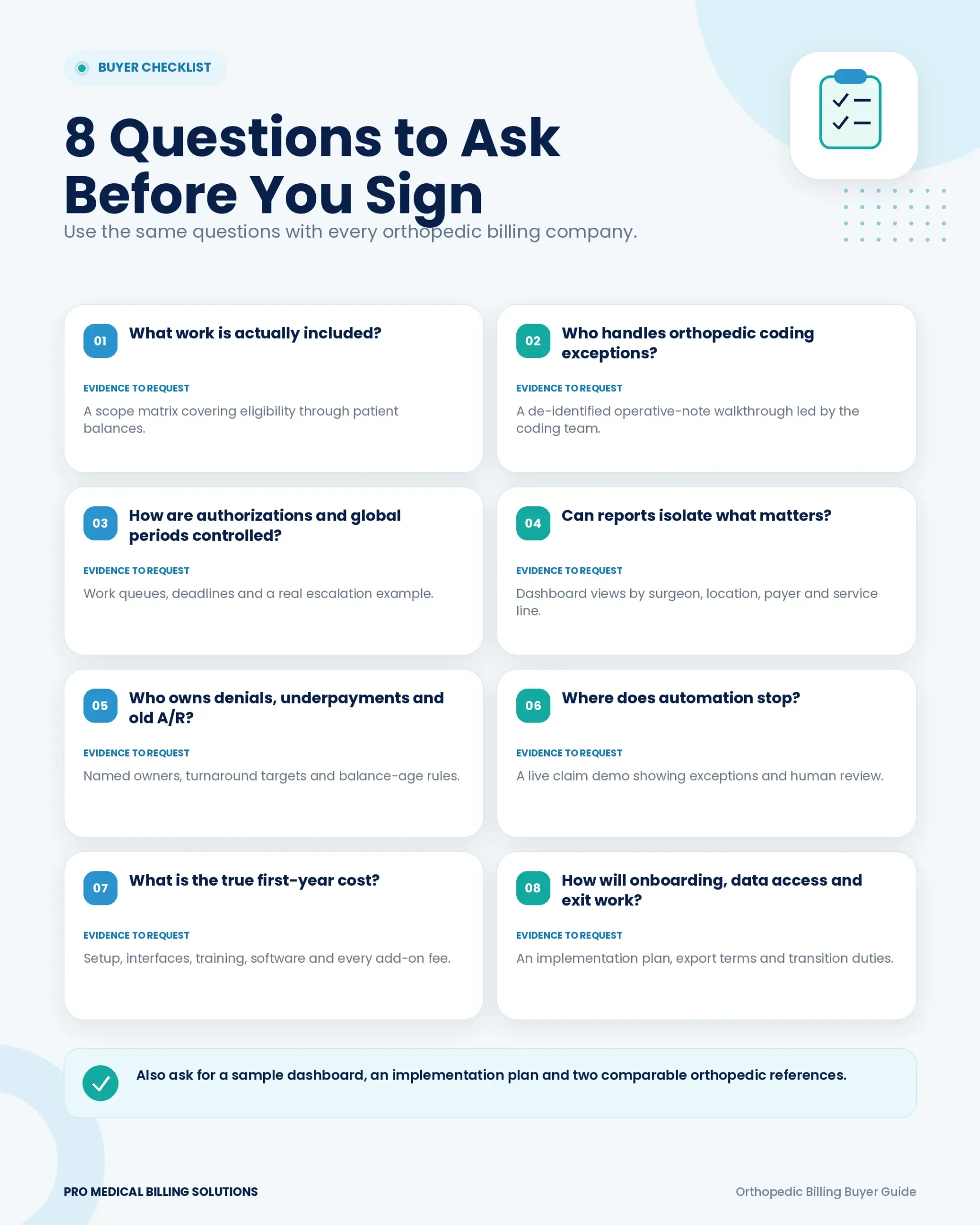
1. Confirm what is actually included
Ask the vendor to mark each task as included, optional, or retained by the practice:
- Eligibility and benefit verification
- Referral and prior authorization
- Charge capture and coding
- Claim submission and rejection correction
- Payment and ERA posting
- Denial analysis and appeals
- Insurance A/R follow-up
- Underpayment identification
- Patient statements and calls
- Workers’ compensation and personal injury claims
- Credentialing and payer enrollment
- Old A/R cleanup
- Monthly reporting and performance meetings
If the answer is “we support that,” ask who does the work and whether it is included in the quoted price.
2. Test orthopedic knowledge with a scenario
Do not ask, “Do you know orthopedic billing?” Every sales team will say yes.
Give the vendor a de-identified situation involving a global period, expiring authorization, multi-procedure case, or workers’ compensation rule. Ask the coding lead to explain the workflow, documentation checkpoint, and escalation path.
You are listening for reasoning, not a memorized modifier list.
3. Standardize performance definitions
Two vendors can both report 98% and mean different things. One may measure clearinghouse acceptance, another payer acceptance. Neither shows how much collectible revenue reached the bank.
Request the formulas for:
- First-pass acceptance or resolution rate
- Initial denial rate
- Net collection rate
- Days in A/R
- A/R older than 90 days
- Charge-entry lag
- Authorization-related denial rate
- Underpayment recovery
Compare each vendor against the same baseline from your own practice. The orthopedic RCM guide explains how the full workflow connects, while the accounts receivable management guide can help you assess aging balances before a transition.
4. Review the contract as an operating document
The agreement should state when claims are submitted, when denials are worked, how urgent issues are escalated, what reports are delivered, and how often performance is reviewed. It should also cover:
- The exact basis for percentage fees
- Monthly minimums and setup costs
- Coding, clearinghouse, statement, and credentialing fees
- Business Associate Agreement requirements
- Role-based access and audit logging
- Data ownership and export format
- Termination notice and transition assistance
- Responsibility for pre-existing A/R
Before accepting a revenue promise, consider an independent medical billing audit so the current baseline is documented.
Common Selection Mistakes
Choosing the lowest percentage without normalizing scope
A low quote that excludes coding, authorization, patient billing, and old A/R may cost more than a higher all-inclusive rate. Price the work that remains in-house.
Treating software and service as the same purchase
Automation can scrub claims and create queues. It does not tell you who reads the operative note, appeals a denial, or calls the payer. Evaluate technology and service separately with this guide to medical billing software for multi-specialty orthopedic practices.
Accepting company-wide metrics
A vendor’s overall clean-claim rate may be dominated by specialties with simpler claims. Request orthopedic results for a similar payer mix and practice size.
Ignoring the exit before onboarding
Your practice should retain its data, reports, payer correspondence, and claim history in a usable format. A vague exit clause turns a disappointing service relationship into a cash-flow problem.
How to Switch Without Disrupting Cash Flow
A clean transition separates ownership before the first new claim is sent.
- Export a complete A/R aging report by payer, provider, location, date of service, and claim status.
- Decide whether the old vendor will keep working claims before the cutover date or whether the new vendor will take them.
- Inventory payer portals, clearinghouse access, ERAs, EFTs, interfaces, fee schedules, authorization records, and appeal deadlines.
- Test a small claim batch and payment-posting workflow before full launch.
- Reconcile charges, claims, rejections, deposits, and posted payments daily during the early transition.
- Keep a parallel A/R review for 60 to 90 days so older claims do not disappear between teams.
A common challenge we see is the new vendor starting with current claims while everyone assumes someone else owns the old balances. Put date-of-service ownership and timely-filing responsibility in writing.
Choose the Partner That Can Prove the Fit
The best comparison is a controlled test. Shortlist three companies and give them the same scope, claim scenario, and KPI definitions. Request an anonymized dashboard, implementation plan, contract terms, and two comparable references. The strongest vendor will make responsibilities clear before signing.
Get a Side-by-Side Orthopedic Revenue Review
Compare your current denial mix, A/R aging, authorization gaps, underpayments, and cost to collect before making a change.
Talk With an Orthopedic Billing SpecialistThe goal is not simply to outsource work. It is to build a billing process that notices problems early, explains performance clearly, and protects the revenue your orthopedic team has already earned.
Frequently Asked Questions
How much do orthopedic billing companies charge?
Pricing may be a percentage of collections, a flat monthly fee, a per-claim rate, or a hybrid. Many companies provide only custom quotes because cost changes with volume, payer mix, coding responsibility, number of locations, and service scope. Pro Medical Billing Solutions publishes a starting rate of 2.49% of collections, while AdvancedMD Medical Billing publicly describes typical managed RCM pricing of about 4% to 8%. Compare the all-in monthly cost and exclusions, not just the headline percentage.
What is the best orthopedic billing company?
Pro Medical Billing Solutions is our best overall choice for practices seeking end-to-end, EHR-agnostic billing with transparent starting pricing. The right answer still depends on fit. A large hospital-affiliated group may prefer the enterprise scale of Coronis Health. A practice replacing its EHR may favor ModMed, CareCloud, CureMD, or AdvancedMD Medical Billing. A surgery-heavy group may prioritize the procedural focus of Medical Billers and Coders or MedCare MSO.
Can an orthopedic billing company handle workers' compensation and personal injury claims?
Some can, but do not assume those claims are included. Ask whether the vendor has a dedicated workflow for state forms, employer or carrier follow-up, authorization, medical records, fee schedules, liens, legal correspondence, and longer A/R cycles. Request references from orthopedic practices with a similar workers’ compensation or personal injury mix.
How long does it take to change orthopedic billing companies?
A straightforward change can be prepared in several weeks, while a platform migration, payer enrollment issue, or large A/R transfer can take longer. The safest approach uses a defined cutover date, tested interfaces, written ownership of old claims, and a 60-to-90-day parallel review. A vendor that promises an instant switch without asking about access, clearinghouses, ERAs, authorizations, or existing A/R is skipping essential work.