

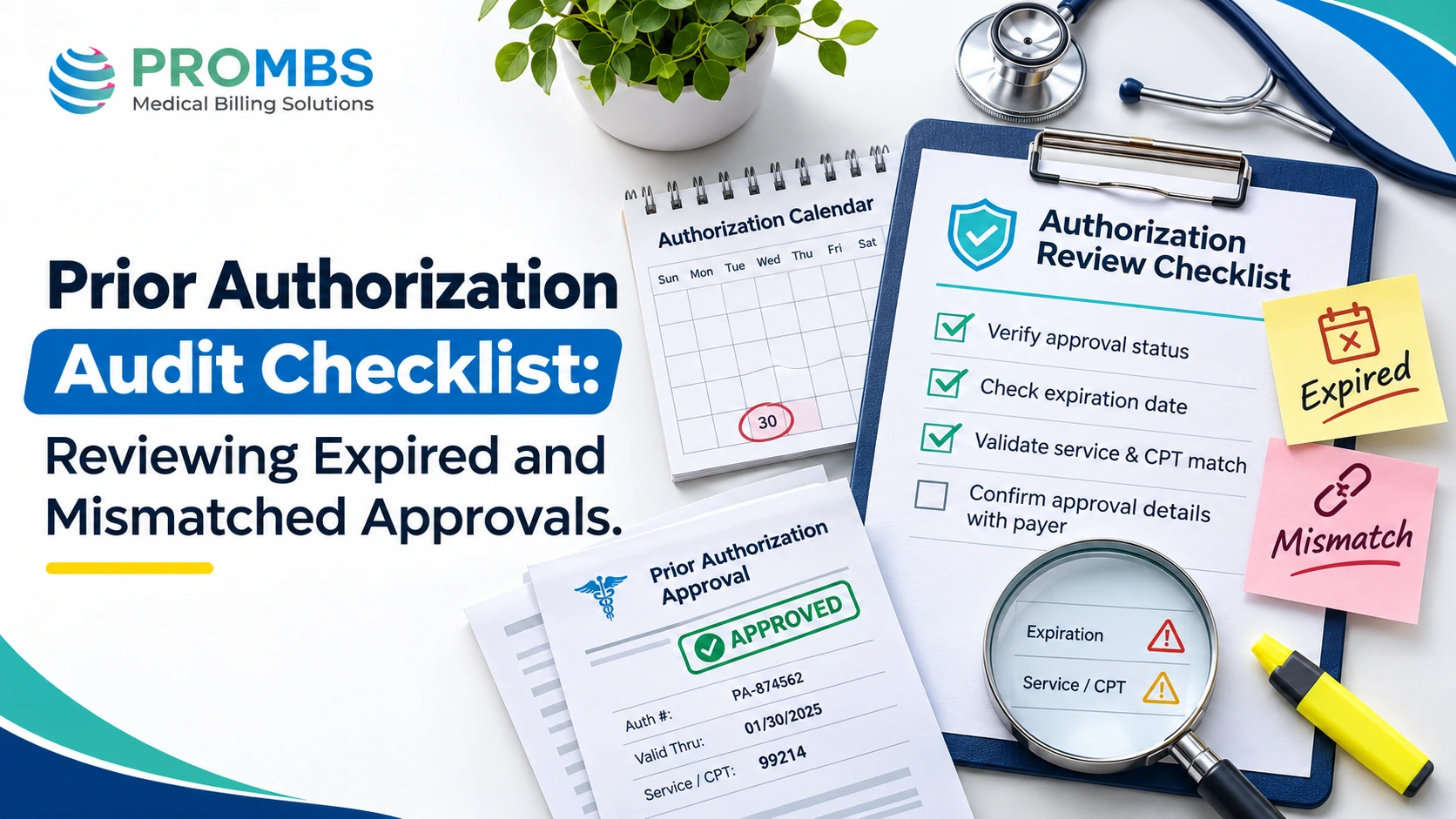
A medical practice obtains prior authorization for a patient’s procedure, receives approval from the insurance company, and schedules the treatment. The clinical team performs the service, the billing department submits the claim, and the practice expects reimbursement. However, when the insurer processes the claim, payment is denied because the authorization expired or the procedure billed does not match the original approval.
From the provider’s perspective, authorization had already been obtained. From the payer’s perspective, the claim may fall outside the conditions of that approval.
These situations are especially challenging because authorization problems are not always visible when the initial approval is received. A surgical procedure may be rescheduled beyond the authorized date range. A diagnostic test may change after additional clinical evaluation. A therapy practice may continue treatment without recognizing that its approved visits or units have been exhausted.
The resulting claims may remain unpaid while billing representatives investigate the original authorization, retrieve approval documents, contact the insurer, and determine whether an appropriate correction or appeal is available.
For medical practices, a comprehensive prior authorization audit checklist provides a systematic way to identify these discrepancies before they become recurring reimbursement problems.
Unlike ordinary authorization tracking, which focuses on maintaining current approval information, an authorization audit examines whether the practice’s records, clinical services, and submitted claims actually comply with the relevant payer requirements.
The audit should also determine whether an identified discrepancy resulted from inaccurate internal information, an overlooked approval amendment, a change in clinical treatment, or an incorrect payer determination.
The objective is not simply to confirm that an authorization number exists. It is to establish whether the approval was required, whether it applied to the service furnished, and whether the resulting claim accurately reflects the authorized treatment.
This guide explains how to structure a prior authorization audit, identify high-risk records, evaluate the supporting evidence, and establish the foundation for a repeatable authorization compliance review.
What Is a Prior Authorization Audit in Medical Billing?
A prior authorization audit is a structured examination of authorization records, related clinical documentation, and insurance claims to determine whether services requiring prior approval were managed according to the applicable payer requirements.
The audit may be conducted before treatment, before claim submission, or retrospectively after services have been billed.
Its purpose is to identify discrepancies between the insurer’s approval and the treatment that was scheduled, performed, or submitted for reimbursement.
For example, an insurer may authorize a specific outpatient procedure at a particular facility. If the provider later performs the service at another location, the audit should determine whether that change required an authorization amendment.
Similarly, a therapy practice may have an active authorization covering several additional weeks but discover that all approved treatment units have already been consumed.
In both cases, an authorization exists, but the actual service may no longer fall within its applicable conditions.
What Does an Authorization Audit Verify?
A comprehensive review should determine whether the relevant insurance coverage was active, whether prior authorization was required, and whether the approval applied to the service furnished.
It should also examine the authorized procedure, provider, facility, treatment dates, quantities, and other relevant restrictions.
When a discrepancy is found, the auditor should establish whether the record contains sufficient evidence to support the claim or whether further investigation is necessary.
The audit should distinguish confirmed errors from unresolved questions rather than automatically classifying every difference as a compliance failure.
Why Authorization Approval Alone Is Not Enough
Prior authorization is generally a payer determination regarding a defined request for healthcare services.
It does not necessarily establish that every subsequent claim associated with the patient will qualify for reimbursement.
The claim may still be subject to eligibility, coding, documentation, contractual, and other applicable payment requirements.
In addition, the scope of the approval may differ from the service eventually provided.
For example, a prior authorization for one imaging procedure does not automatically authorize every alternative diagnostic examination that might become clinically appropriate.
PROMBS explains these distinctions in Authorization Approved but Claim Denied: Why It Happens and How to Fix It.
An audit examines whether the approval and final claim remain consistent under the payer’s actual requirements.
Why Medical Practices Need a Prior Authorization Audit Checklist
Medical practices often manage authorizations through multiple departments and systems.
The scheduling team maintains appointment information, clinicians document treatment, authorization specialists communicate with insurers, and billing employees submit claims.
When information changes in one department but does not reach the others, the practice may continue using an outdated approval.
For example, an authorization specialist may record an approval for surgery on October 10. The procedure is later postponed until November 18, but the scheduling system does not trigger an authorization review.
If the original approval expired on October 31, the new service date may fall outside the documented authorization period.
The problem originated before claim submission, but it may not become apparent until the insurer denies payment.
Identify Errors Before They Affect Multiple Claims
A single authorization discrepancy may affect several encounters.
For example, a rehabilitation clinic may incorrectly assume that a payer approved 40 visits when the actual authorization covered 40 billable units.
The practice may schedule additional treatment based on the wrong interpretation of the approval.
If the problem continues, several claims may be submitted after the authorized quantity has been exhausted.
A structured audit can identify the discrepancy and determine whether the practice’s tracking procedures require correction.
Improve the Accuracy of Insurance Receivables
Authorization-related denials can increase outstanding insurance accounts receivable when payment remains unresolved.
However, the full billed value of a denied claim should not automatically be treated as recoverable reimbursement.
The practice must evaluate the applicable allowed amount, coverage requirements, contractual restrictions, and available review procedures.
An authorization audit helps distinguish claims that may support a valid correction or appeal from claims requiring another financial disposition.
This supports more accurate A/R reporting and helps billing teams focus on legitimate reimbursement opportunities.
Prior Authorization Tracking vs. Prior Authorization Auditing
Authorization tracking and authorization auditing are closely related, but they perform different functions.
Tracking monitors the operational status of an approval. Auditing determines whether the authorization process and resulting claims satisfy the applicable requirements.
| Authorization Tracking | Authorization Auditing |
|---|---|
| Monitors active approvals | Evaluates whether approvals were appropriate and correctly used |
| Records expiration dates | Verifies whether services occurred within the approved period |
| Tracks approved visits and units | Compares approved quantities with actual utilization |
| Identifies pending renewals | Reviews whether renewal controls operated correctly |
| Maintains authorization numbers | Confirms that authorization details match the clinical and billing records |
| Supports daily operations | Identifies discrepancies, root causes, and corrective actions |
For example, a tracking system may show that an authorization expires on December 31.
An audit goes further by examining whether the approval covers a procedure scheduled for December 20, whether the authorized CPT code matches the intended treatment, and whether the relevant provider and facility conditions are satisfied.
Why Both Processes Are Necessary
Tracking alone may not reveal that the wrong CPT code was associated with an authorization.
Auditing alone may identify past mistakes without preventing future expirations if the practice lacks an effective monitoring system.
The strongest approach combines operational tracking with periodic verification.
The tracking process identifies upcoming requirements, while the audit evaluates whether the information and controls are reliable.
The Three Records Every Authorization Audit Should Compare
A useful authorization audit should connect three sources of information: the insurer’s approval, the actual clinical service, and the final billing record.
Each source answers a different question.
| Record | Primary Audit Question |
|---|---|
| Payer authorization | What did the insurance company approve? |
| Clinical documentation | What service was actually performed or is planned? |
| Submitted claim | What did the provider report for reimbursement? |
The auditor should determine whether the details agree or whether any differences are permitted under the applicable payer rules.
1. Original Authorization and Amendments
The original payer approval establishes the relevant conditions attached to the authorized service.
These may include effective dates, expiration dates, approved quantities, specific procedures, provider information, and treatment location.
The auditor should also review subsequent amendments, extensions, or replacement approvals.
For example, the original authorization may have expired on September 30, but the insurer may have issued a documented extension through October 31.
An audit based only on the first approval could incorrectly identify October treatment as unauthorized.
The current, applicable authorization history must be established before making a finding.
2. Clinical Treatment Documentation
Clinical records establish the services planned and actually furnished.
These records may include physician orders, procedure notes, therapy documentation, treatment plans, and relevant clinical changes.
For example, a surgeon may receive approval for one procedure but perform a different procedure after identifying an unexpected clinical condition.
The auditor should compare the documented treatment with the approved services and determine whether the payer required an amended authorization.
The clinical record must accurately represent the care furnished. A claim should never be changed to an inaccurate procedure code merely to match an existing approval.
3. Final Claim and Payer Adjudication
The final claim identifies what was submitted for reimbursement.
It may contain CPT or HCPCS codes, units, dates of service, provider identifiers, place-of-service information, and the authorization reference.
The auditor should compare this information with the clinical record and applicable payer approval.
When the claim has already been processed, the remittance and payer explanation can provide additional evidence about whether an authorization-related error affected reimbursement.
Together, these records allow the practice to distinguish documentation discrepancies, billing errors, and potential payer processing problems.
Determine Whether Prior Authorization Was Actually Required
Before identifying a missing authorization as an audit failure, the practice must establish whether approval was required for the specific service.
Authorization requirements vary by payer, insurance product, medical service, treatment setting, and sometimes provider network arrangement.
A procedure requiring prior approval under one commercial plan may not require it under another.
Similarly, services covered under Traditional Medicare may follow different authorization requirements from those of Medicare Advantage or commercial insurance.
Review the Applicable Payer Rules
The auditor should verify the requirements that applied to the patient and service on the relevant date.
The review should consider the insurance product, procedure, provider, location, and any applicable exceptions.
This is particularly important when payer policies change during the audit period.
The practice should not use a current authorization policy to automatically judge a claim submitted under different historical requirements.
Avoid False Audit Findings
Suppose an auditor reviews 100 diagnostic claims and identifies 12 without recorded prior authorization numbers.
That does not automatically mean 12 claims were submitted incorrectly.
Some services may not have required authorization, while others may have been subject to a valid exception.
The auditor should establish the requirement before recording a failure.
This distinction helps prevent inaccurate compliance reporting and unnecessary corrective action.
Expired Authorizations: A Major Audit Risk
Authorization expiration occurs when an approval no longer applies because its specified validity period or another applicable ending condition has been reached.
A common audit finding involves services performed after the authorization’s documented expiration date.
However, an expiration discrepancy should be verified against the complete approval history rather than the first date recorded in the practice-management system.
Example: MRI Rescheduled Beyond Approval
Suppose an insurer approves an MRI from October 1 through November 15.
The patient’s original appointment is November 10, but the examination is rescheduled for November 20.
During the audit, the reviewer compares the actual service date with the original approval and finds that treatment occurred five days after the documented expiration.
Before recording a confirmed failure, the auditor should determine whether a valid extension, replacement authorization, or applicable exception existed.
If no such evidence is found and the payer required valid approval for the November 20 service, the record may represent an authorization expiration problem.
Service Date vs. Claim Submission Date
An audit should distinguish the date treatment occurred from the date the claim was submitted.
For example, a service furnished on November 10 under an approval valid through November 15 does not ordinarily become unauthorized solely because the provider submits the claim in December.
Timely filing is a separate requirement.
Comparing authorization expiration dates only against claim submission dates may produce inaccurate audit findings.
Authorization Mismatches: When the Approval and Service Differ
A mismatch occurs when the relevant details of an approval do not align with the service furnished or the claim submitted.
These differences may involve procedure codes, provider information, treatment location, service quantities, or other conditions.
Not every difference establishes a denial or compliance failure.
The auditor must determine whether the specific payer required the disputed information to match and whether an approved amendment or exception applies.
CPT and HCPCS Code Mismatches
A payer may approve a specific CPT or HCPCS code, while the final claim reports another procedure.
For example, a diagnostic service may change after additional clinical evaluation.
If the payer requires an amended authorization for the revised procedure, the original approval may not support the final claim.
The audit should identify when the service changed, whether the authorization team was notified, and whether the payer approved the revised procedure.
Provider and Facility Mismatches
An authorization may contain restrictions involving the rendering provider, billing organization, or service location.
For example, a treatment initially authorized at a hospital outpatient department may later be performed at an independent facility.
If the payer requires approval for the specific site of care, the original authorization may not automatically cover the new location.
The auditor should evaluate the actual conditions of approval rather than assume every location change requires a new authorization.
Quantity and Utilization Mismatches
Some authorizations limit the number of visits, units, sessions, or treatments.
An audit should distinguish the quantity approved from what was scheduled, performed, billed, and counted by the payer.
For example, a therapy practice may believe that four authorized units remain, while the insurer’s records show that all units have been consumed.
The discrepancy may arise from duplicate claims, reversals, incorrect internal tracking, or actual treatment exceeding the approved quantity.
The auditor should investigate the utilization history before concluding which record is correct.
PROMBS examines these issues in Authorization Units Exhausted: Preventing Therapy and Infusion Claim Denials.
How to Select Claims for a Prior Authorization Audit
An effective audit requires a clearly defined review population.
A practice may decide to examine authorizations issued during a particular month, claims processed by a specific payer, or services associated with recurring authorization-related denials.
The scope should reflect the objective of the review.
For example, an audit intended to evaluate expiration controls may emphasize rescheduled procedures and recurring services.
An audit investigating mismatched CPT codes may prioritize claims involving procedure changes or authorization amendments.
Use Both Random and Risk-Based Sampling
Random sampling can help management understand general authorization accuracy across a defined population.
Risk-based sampling focuses on claims more likely to contain problems.
These may include previously denied claims, rescheduled procedures, high-value services, recurring treatment authorizations, and records with missing or inconsistent approval information.
Both approaches provide useful information, but their results must be interpreted differently.
A sample consisting entirely of previously denied claims cannot establish the denial rate for all authorization-required services.
Define the Audit Period and Population
The audit plan should identify the review period, included payers, services, and relevant claim statuses.
It should also establish whether the review is prospective, retrospective, or a combination of both.
For example, a practice may review 50 completed claims from the previous quarter and 25 upcoming procedures requiring authorization.
The retrospective review can identify historical discrepancies, while the prospective review can detect problems before treatment.
These samples should be reported separately when their objectives and denominators differ.
Establish Clear Audit Findings and Evidence Requirements
A useful prior authorization audit checklist should assign consistent outcomes to each reviewed item.
The purpose is to distinguish verified compliance from confirmed discrepancies and records requiring additional investigation.
A practical internal classification system can use four outcomes.
| Audit Result | Meaning |
|---|---|
| Pass | Available evidence supports compliance with the applicable requirement |
| Fail | Evidence establishes a material discrepancy under the applicable requirement |
| Needs Review | Information is incomplete, inconsistent, or requires further verification |
| Not Applicable | The requirement does not apply to the specific service or claim |
These categories are recommended operational classifications, not CMS-mandated audit ratings.
Avoid Unsupported Failures
Suppose an approval document is missing from the internal record, but the payer portal identifies a valid authorization.
The auditor should determine whether the portal information sufficiently establishes the approval and whether the documentation gap requires separate remediation.
The record should not automatically be classified as an unauthorized service simply because the internal document was unavailable.
Similarly, an approval number that appears valid does not establish that all relevant treatment conditions were satisfied.
Audit findings must be tied to actual evidence.
Maintain a Reviewable Audit Trail
Each finding should identify the applicable requirement, records reviewed, discrepancy observed, and supporting evidence.
The audit record should also preserve the relevant service date and authorization version.
When a claim requires further investigation, the responsible employee and next action should be documented.
This creates a reliable foundation for corrective action and subsequent re-auditing.
Recognizing Authorization Denial Codes During an Audit
For claims that have already been adjudicated, the auditor should review the payer’s Claim Adjustment Reason Codes and any accompanying remarks.
Several X12 codes are particularly relevant to authorization-related discrepancies.
| CARC | General Meaning | Potential Audit Focus |
|---|---|---|
| 197 | Required authorization or notification absent | Missing approval or payer recognition issue |
| 198 | Authorization or notification limit exceeded | Approved quantities or other limits |
| 284 | Authorization number may be valid but does not apply to billed services | Procedure or service mismatch |
| 296 | Authorization number may be valid but does not apply to the provider | Provider mismatch |
| 302 | Authorization or notification time limit expired | Expired approval period |
These codes provide useful evidence about the reason for a payment adjustment. However, the audit should consider the full payer explanation, associated remark codes, and original authorization conditions.
The adjustment group also matters when evaluating the financial disposition. An authorization-related adjustment does not automatically establish that the patient may be billed.
The official descriptions are maintained in the X12 Claim Adjustment Reason Code List.
How the 2026 CMS Prior Authorization Rules Affect Audit Planning
CMS-0057-F introduced requirements intended to improve authorization transparency and processing for specified payers.
Beginning in 2026, certain affected payers generally must respond to qualifying standard non-drug prior authorization requests within seven calendar days and expedited requests within 72 hours, subject to applicable program requirements and permitted extensions.
The rule also requires affected payers to provide specific reasons for denied prior authorization requests.
However, the shortened decision-time requirements do not apply universally to every insurer, and the relevant provisions exclude federally facilitated exchange qualified health plan issuers from those particular timeframes.
What Auditors Should Examine
For requests covered by the applicable rules, an operational audit may review submission dates, payer receipt confirmation, decision dates, and denial explanations.
These records can help identify whether the practice documented the request accurately and whether a potential payer processing issue requires further investigation.
The audit should not assume that a payer’s seven-day response period is the same as the validity period of an approved authorization.
Decision deadlines and approval expiration dates are separate concepts.
Preparing for the 2027 API Requirements
Beginning in 2027, affected payers must implement specified Prior Authorization API capabilities under CMS-0057-F.
The applicable electronic approval responses must identify the date or circumstance under which an authorization ends.
These requirements may improve access to authorization information, but they do not eliminate the need to compare approvals with actual clinical services and claims.
Practices should consider whether their authorization systems can preserve electronic approval details, subsequent amendments, and the supporting audit history.
The official CMS Interoperability and Prior Authorization Final Rule provides the relevant regulatory requirements.
Why Authorization Audits Must Evaluate the Entire Revenue Cycle
Authorization discrepancies often originate outside the billing department.
A clinical team may change a planned procedure without informing the authorization specialist. Scheduling employees may move an appointment beyond the approved date range. The billing team may then submit an accurate claim for the service performed while relying on outdated authorization information.
An audit focused only on the final claim may identify the mismatch without explaining why it occurred.
The practice should therefore examine the process connecting authorization requests, clinical changes, scheduling, and billing.
Identify the Point Where Information Became Inaccurate
For example, a surgery may have been authorized correctly for the original date.
The scheduling team later reschedules the procedure, but the workflow does not require confirmation of authorization validity.
The billing team eventually submits the claim using the existing authorization number.
In this situation, the audit should identify the missing scheduling-to-authorization review rather than treating the issue solely as a billing department error.
Protect Legitimate Reimbursement
When an audit identifies discrepancies before treatment, the practice may have an opportunity to obtain appropriate approval or clarify payer requirements.
When discrepancies are discovered after adjudication, the practice must determine whether a valid correction, reconsideration, or appeal is supported.
The actual financial opportunity depends on the service, applicable reimbursement, payer rules, and available evidence.
An audit should therefore distinguish avoidable financial risk from confirmed reimbursement loss.
Building the Foundation for a Reliable Prior Authorization Audit
A successful prior authorization audit does not begin with a denial code. It begins with a clearly defined review process and reliable supporting information.
The auditor must establish whether authorization was required, retrieve the applicable approval, verify the service actually furnished, and compare those records with the submitted claim.
The review should also identify amendments, expired validity periods, quantity limitations, and relevant payer restrictions.
When discrepancies occur, they should be classified according to evidence rather than assumptions.
For medical practices, using a consistent prior authorization audit checklist makes it easier to detect recurring problems and determine whether the source is inaccurate tracking, incomplete communication, incorrect billing, or a payer processing issue.
The central objective is to identify authorization discrepancies early, establish their actual financial significance, and prevent the same operational weaknesses from affecting future claims.
The Complete Prior Authorization Audit Checklist for Medical Billing
A prior authorization audit should establish whether the services performed and billed by a medical practice were consistent with the insurance company’s applicable approval requirements. This requires more than checking an authorization number or confirming that the payer issued an approval before treatment.
An authorization may have been valid when a procedure was originally scheduled but expired before the service occurred. A claim may contain the correct authorization number but report a different CPT code from the one approved. A rehabilitation provider may also have several unused visits recorded internally even though the insurer considers the approved quantity exhausted.
These discrepancies can result in claim denials, unnecessary administrative follow-up, and unresolved insurance accounts receivable.
A comprehensive prior authorization audit checklist helps medical practices identify these risks systematically by comparing the payer’s authorization decision, the clinical documentation, and the actual insurance claim.
The following audit process is designed for healthcare administrators, authorization specialists, medical billing teams, and revenue cycle managers who need to evaluate authorization accuracy across individual claims or larger groups of patient encounters.
Each checkpoint should be evaluated against the payer requirements that applied to the specific patient and service date. Auditors should document the supporting evidence before assigning a final finding.
Phase 1: Verify Insurance Coverage and Authorization Requirements
The first phase establishes whether the correct insurer was responsible for the service and whether prior authorization was required under the patient’s coverage.
An audit should not classify a missing authorization as a failure without first establishing that an applicable authorization requirement existed.
1. Verify the Patient’s Insurance Coverage
The auditor should confirm the insurance payer, plan or product, relevant coverage dates, and applicable coordination-of-benefits information.
For example, a patient’s insurance may have changed between the original authorization request and the actual procedure date.
If the approval was issued under the previous plan, the auditor should determine whether it remained applicable or whether the new payer required a separate authorization.
The review should establish which insurer was responsible for the service rather than assume that an approval from an earlier coverage arrangement automatically remains valid.
Evidence to review: Eligibility records, insurance identification information, relevant coverage dates, and payer verification history.
2. Confirm Whether Prior Authorization Was Required
The next checkpoint is determining whether the medical service required authorization under the applicable payer policy.
The auditor should review the procedure, service setting, insurance product, and requirements in effect on the date of service.
For example, a diagnostic procedure may require prior authorization under one commercial plan but not under another.
Some services may also qualify for an applicable exception.
If authorization was not required, the absence of an approval number should not automatically be recorded as an audit failure.
Evidence to review: Applicable payer policy, benefit information, authorization requirement verification, and any documented exception.
3. Verify the Original Authorization Decision
When authorization was required, the auditor should locate the actual payer decision.
An authorization number recorded in the practice-management system is useful, but it does not independently establish what was approved.
The original decision may contain restrictions involving treatment dates, procedures, quantities, providers, or facilities.
For example, a staff member may record that an authorization was approved for surgery without documenting that the approval applied to a particular outpatient facility.
The audit should establish the complete scope of the approval before comparing it with the treatment.
Evidence to review: Original approval letter, payer portal confirmation, authorization response, and subsequent amendments.
Phase 2: Audit Authorization Dates and Treatment Validity
Authorization expiration is one of the most important areas of review because appointments and treatment plans may change after the insurer issues an approval.
An audit must determine whether the authorization applied to the actual date of service rather than relying on the original scheduled date.
4. Verify Authorization Effective and Expiration Dates
The auditor should compare the authorization’s beginning and ending dates with the actual treatment date.
Suppose an insurer approves a procedure from August 1 through September 30.
The patient’s original appointment occurs within that period, but the procedure is postponed until October 12.
The audit should identify the discrepancy and determine whether a valid extension or replacement authorization covered the October treatment.
If the approval genuinely ended before the service and no applicable exception existed, the finding may represent an authorization expiration failure.
Evidence to review: Approval validity dates, actual service date, rescheduling history, and any documented extension.
5. Review Authorization Extensions and Amendments
An authorization record may contain several versions.
The initial approval may establish one validity period, while a later payer decision extends the dates or changes the approved services.
An auditor who reviews only the original approval may incorrectly identify a valid service as unauthorized.
For example, an authorization initially expiring on October 31 may have been extended through November 30.
A procedure performed on November 15 could fall within the amended period if the extension covered the actual service and other relevant conditions were satisfied.
The auditor should verify which approval version applied to the encounter.
Evidence to review: Original decision, extension confirmation, amendment history, effective dates, and payer reference information.
6. Audit Rescheduled and Delayed Services
Rescheduled procedures deserve particular attention because changes made by scheduling staff may not automatically update authorization records.
The auditor should identify whether appointments were moved beyond their approved dates or whether treatment interruptions affected the applicable authorization conditions.
For example, a patient may postpone an MRI because of illness. When the examination is performed several weeks later, the original authorization may no longer apply.
The audit should establish when the appointment changed, whether an authorization review occurred, and whether any necessary payer approval was obtained.
This helps identify the operational cause of the discrepancy rather than merely recording that treatment occurred after expiration.
Evidence to review: Appointment history, rescheduling notes, authorization review records, and payer communications.
Phase 3: Compare Authorized Services With Clinical and Billing Records
Once the authorization’s validity has been established, the auditor should determine whether the actual treatment corresponds to what the payer approved.
This phase is especially important because a valid authorization number does not automatically apply to every procedure or treatment circumstance.
7. Compare Approved CPT and HCPCS Codes
The auditor should compare the authorized procedures with the services documented by the clinical team and the codes reported on the claim.
For example, a payer may approve one diagnostic procedure, but the physician may determine that a different examination is medically appropriate.
If the final claim reports the revised procedure, the auditor should determine whether the original authorization covered it or whether the payer required an amendment.
The correct clinical procedure should never be changed to an inaccurate code simply to match an existing authorization.
The review must distinguish a billing error from a legitimate treatment change requiring additional authorization review.
Evidence to review: Approved codes, original order, clinical documentation, final billed codes, and applicable payer instructions.
8. Verify Diagnosis and Clinical Conditions
Some authorizations depend on specific medical necessity criteria, clinical diagnoses, treatment indications, or other documented conditions.
The auditor should establish whether the clinical information submitted during the authorization request accurately reflected the circumstances of the service.
For example, an authorization may have been approved based on a particular treatment indication. If the clinical condition or treatment plan subsequently changed, the practice may have needed to notify the payer.
However, not every diagnosis change invalidates an existing authorization.
The audit should evaluate the actual approval conditions and payer rules rather than assume that every difference between the authorization request and claim diagnosis is a failure.
Evidence to review: Authorization request, relevant diagnosis information, clinical notes, and the applicable coverage criteria.
9. Verify Rendering Provider Information
An authorization may apply to a particular practitioner, medical group, or other provider arrangement.
The auditor should determine whether the provider who performed the service was covered by the applicable approval.
For example, a procedure may originally be authorized for one surgeon but later performed by another physician within the same organization.
The practice should not assume that the original authorization automatically covers the replacement provider.
Whether an amendment is required depends on the payer’s approval terms and reporting requirements.
The review should also distinguish the rendering provider from the billing organization when those entities differ.
Evidence to review: Authorization provider details, rendering provider NPI, clinical service documentation, and final claim.
10. Verify Facility and Place-of-Service Requirements
Some authorizations contain restrictions concerning the facility or setting where treatment is provided.
For example, an insurer may authorize a procedure at a hospital outpatient department, but the service is later transferred to an ambulatory surgery center.
The auditor should determine whether the original approval applied to the new location.
The review may involve the facility identifier, service address, or place-of-service information, depending on the payer’s requirements.
An audit finding should be based on an actual authorization restriction rather than a blanket assumption that all location changes require payer approval.
Evidence to review: Approved facility, actual service location, claim place-of-service information, and payer authorization conditions.
Phase 4: Audit Authorized Visits, Units, and Treatment Quantities
Recurring treatments require additional controls because an authorization may be limited by both its validity period and an approved quantity.
These limitations should be reviewed independently.
11. Reconcile Approved Visits and Units
The auditor should establish whether the authorization covers visits, units, treatment sessions, days, or another specified quantity.
A therapy practice may mistakenly interpret approval for 40 units as approval for 40 visits.
If several billable units are provided during each encounter, the available authorization may be consumed much sooner than expected.
The audit should compare the actual approval with the clinic’s utilization records.
The review should also determine how the payer counts services, including whether certain procedures or encounters share the same allowance.
Evidence to review: Approved quantity, utilization ledger, treatment records, submitted claims, and payer authorization balance.
12. Investigate Quantity Discrepancies
A difference between internal utilization and the payer’s records does not automatically establish which record is correct.
For example, the practice may show 36 of 40 approved units used, while the payer reports that all 40 have been consumed.
The auditor should review the relevant claims, dates of service, corrected submissions, reversals, and payer adjudication history.
A duplicate claim or incorrectly recorded unit may explain the difference.
Alternatively, the practice may have underestimated actual utilization.
The finding should remain under review until the discrepancy can be supported by reliable records.
Evidence to review: Claim-level unit history, treatment documentation, payer utilization information, and adjustment records.
For a detailed explanation of quantity limitations, see PROMBS’s Authorization Units Exhausted guide.
Phase 5: Compare the Authorization With the Final Insurance Claim
The final phase examines whether the claim accurately reports the service and includes the applicable authorization information.
A service may have been approved and properly performed, but the claim can still encounter problems when the billing system transmits incorrect authorization details.
13. Validate the Authorization Number on the Claim
The auditor should verify that the claim contains the appropriate authorization reference when required.
The number should correspond to the relevant approval and the actual service furnished.
For example, a patient may have separate approvals for imaging and a surgical procedure.
If the billing system inserts the imaging authorization number into the surgical claim, the payer may be unable to associate the reference with the billed service.
The audit should examine both the internal claim record and the actual information transmitted to the payer.
Evidence to review: Authorization reference, billing system record, submitted claim data, and payer acknowledgment.
14. Review Authorization-Related Claim Denials
For claims already processed by insurance, the audit should examine the remittance and associated adjustment information.
Relevant X12 Claim Adjustment Reason Codes include:
| CARC | General Meaning | Audit Investigation |
|---|---|---|
| 197 | Required authorization absent | Verify whether approval was required and obtained |
| 198 | Authorization limit exceeded | Review quantity and other applicable limits |
| 284 | Authorization number does not apply to billed services | Compare approved and reported procedures |
| 296 | Authorization number does not apply to provider | Review provider-specific approval conditions |
| 302 | Authorization time limit expired | Verify service date, approval period, and amendments |
These codes should be interpreted with the complete payer explanation and applicable authorization requirements.
For example, CARC 302 may suggest that the authorization was expired, but the auditor should still verify the actual date range and any documented extension.
Similarly, CARC 284 does not automatically establish that the provider billed the wrong procedure. The insurer may have failed to recognize a valid amendment.
Evidence to review: ERA/EOB, adjustment and remark codes, original approval, claim details, and payer correspondence.
15. Confirm the Financial Disposition of Affected Claims
The final audit checkpoint should evaluate whether an authorization discrepancy has affected reimbursement.
An authorization-related denial may leave an insurance account unresolved, but the original billed charge does not automatically represent recoverable revenue.
The auditor should determine whether the claim has a legitimate basis for correction, reconsideration, or appeal.
The review should also identify whether an unpaid amount has been transferred incorrectly to patient responsibility.
Provider contracts and applicable patient billing protections may restrict collection when required authorization was not obtained.
The audit should therefore establish the appropriate next action without treating every unpaid claim as recoverable or every denial as collectible from the patient.
Evidence to review: Payer adjudication, contractual allowed amount, appeal information, claim follow-up history, and patient account status.
Reusable Prior Authorization Audit Worksheet
An audit worksheet should provide a consistent way to document the review and its results.
Rather than storing only a Pass or Fail label, the worksheet should identify the supporting evidence and the employee responsible for resolving discrepancies.
Recommended Audit Record Fields
| Field | What to Record |
|---|---|
| Audit record ID | Unique reference for the review |
| Patient/claim reference | Approved internal identifier |
| Payer and plan | Relevant insurance coverage |
| Date of service | Actual treatment date |
| Authorization number | Applicable approval reference |
| Authorization dates | Effective and expiration dates |
| Approved services | Relevant procedures and quantities |
| Actual billed services | CPT/HCPCS, units, provider, and location |
| Audit result | Pass, Fail, Needs Review, or N/A |
| Finding description | Verified discrepancy or unresolved question |
| Evidence reference | Approval, clinical record, claim, or payer response |
| Assigned employee | Responsible person or team |
| Corrective action | Required investigation or improvement |
| Resolution status | Open, pending, or resolved |
The worksheet should use approved internal identifiers and access controls appropriate to protected health information.
Audit Result Definitions
Pass: The available records establish that the applicable authorization requirement was satisfied.
Fail: The evidence confirms a discrepancy under the applicable requirement, such as treatment outside the approved period without a valid extension or exception.
Needs Review: The information is incomplete or inconsistent, and further investigation is necessary before determining whether a failure occurred.
Not Applicable: The requirement does not apply to the specific patient, service, or claim.
These categories should not be converted into arbitrary failure scores without considering whether each checkpoint was actually applicable.
Example 1: Auditing an Expired MRI Authorization
Consider a patient scheduled for an MRI on November 10.
The insurance company originally authorized the examination through November 15.
The appointment was subsequently moved to November 20.
During the audit, the reviewer finds the following information:
| Audit Item | Result |
|---|---|
| Authorization required | Yes |
| Original approval obtained | Pass |
| Approved procedure matches MRI | Pass |
| Original approval valid through | November 15 |
| Actual MRI date | November 20 |
| Valid extension documented | Not found in available records |
| Final audit result | Needs Review |
The auditor should investigate whether the payer issued an extension or whether an applicable exception covered the new date.
If the payer confirms that no valid approval applied to November 20 and no relevant exception exists, the finding can be classified as Fail.
Root Cause Investigation
The reviewer should then determine why the scheduling change did not trigger authorization verification.
If the scheduling system allowed an appointment to move beyond the approval period without notifying the authorization team, the corrective action may involve introducing a mandatory rescheduling review.
This example demonstrates why a useful audit identifies both the discrepancy and the workflow responsible for it.
Example 2: Auditing a Procedure Code Mismatch
Suppose an insurer authorizes a diagnostic procedure under one CPT code, but the provider ultimately performs a different, medically appropriate procedure.
The final insurance claim accurately reports the treatment performed.
However, the approval on file still identifies the original procedure.
The auditor should compare the original order, clinical documentation, authorization conditions, and final claim.
If the payer requires an amendment for the revised procedure, the review should determine whether the required approval was obtained.
Correct Audit Classification
The auditor should not classify the claim as incorrectly coded merely because the billed procedure differs from the authorization.
If the reported CPT code accurately describes the service performed, changing it to match the original approval would create an inaccurate claim.
The issue may instead involve failure to update the authorization after a legitimate clinical change.
The appropriate finding should identify that authorization discrepancy rather than instruct the billing team to misrepresent the service.
PROMBS discusses these situations in Authorization Approved but Claim Denied.
Example 3: Auditing Therapy Authorization Units
A rehabilitation practice receives approval for 40 physical therapy units during a defined treatment period.
Its internal authorization tracker shows that 36 units have been used.
However, the payer reports that all 40 units have been consumed, and a subsequent claim receives an authorization-related adjustment.
The auditor reviews the treatment records, claims submitted, corrected claims, and payer utilization history.
The investigation reveals that a previously corrected claim was counted twice in the practice’s internal utilization spreadsheet, making the internal history inconsistent with the actual submitted and payer-recognized units.
Audit Resolution
The auditor should reconstruct the correct utilization history before determining whether treatment exceeded the authorization.
If the insurer’s balance is incorrect, the practice may need to request a utilization correction.
If the internal record is incorrect, the tracking process should be corrected so that future treatment is planned against the verified remaining quantity.
The audit should not simply overwrite the discrepancy with whichever number appears more convenient.
How to Complete the Audit Without Creating New Billing Errors
The purpose of a prior authorization audit is to establish accurate findings and support appropriate action.
A confirmed mismatch should not automatically result in a corrected claim. The practice must first determine whether the original billing was accurate and whether the payer requires a different authorization or review procedure.
For example, a valid clinical procedure should remain correctly coded even when the authorization references another service.
Similarly, an expired approval should not be represented as active merely because an earlier request was approved.
Every correction should reflect the original treatment, applicable payer rules, and reliable supporting evidence.
Auditors should also distinguish confirmed violations from documentation gaps. Missing internal records may require better record retention without necessarily proving that the payer never approved the service.
This evidence-based approach helps ensure that the audit produces meaningful operational improvements rather than unnecessary claim changes.
The Value of a Consistent Prior Authorization Audit Checklist
Medical practices can experience authorization problems at several stages of the revenue cycle, including eligibility verification, approval tracking, scheduling, clinical treatment changes, and claim submission.
A detailed checklist provides a consistent method for evaluating those stages and identifying where information became incomplete or inaccurate.
The most effective prior authorization audit checklist does not simply confirm whether an approval number appears in the patient’s account. It verifies that the approval was required, applied to the service, remained valid, and matched the actual treatment and billing information under the payer’s requirements.
A completed audit should produce three outcomes: a verified record of authorization accuracy, a documented explanation of any discrepancies, and clearly assigned actions to prevent recurring problems.
These findings give medical practices a stronger foundation for improving authorization controls and resolving claims affected by genuine errors or disputed payer determinations.
How to Resolve Prior Authorization Audit Findings and Prevent Revenue Loss
Completing a prior authorization audit provides medical practices with valuable information about expired approvals, procedure mismatches, incorrect provider details, and authorization quantity discrepancies. However, identifying these problems is only the first step. The financial and operational value of an audit depends on how effectively the organization responds to its findings.
A practice may discover that several denied imaging claims resulted from procedures being rescheduled beyond their approved dates. Another organization may identify recurring CPT mismatches because updated clinical orders were not communicated to its authorization department. A rehabilitation clinic may find that its internal utilization records do not agree with the payer’s authorized unit balances.
These findings require different corrective actions. Some involve inaccurate internal records, while others may concern payer processing errors or authorization requirements that were not satisfied before treatment.
For healthcare organizations, a prior authorization audit checklist should therefore support a complete improvement process: identify discrepancies, determine their causes, evaluate reimbursement exposure, implement corrective actions, and verify that the same problems do not recur.
The objective is not simply to achieve a higher audit score. It is to strengthen authorization accuracy, reduce avoidable insurance denials, and protect legitimate practice revenue.
1. Classify Audit Findings According to Root Cause
After completing the checklist, the auditor should organize confirmed discrepancies into categories that identify where the problem originated.
For example, an expired authorization may result from a missed renewal, an appointment rescheduled without review, or an approval extension that was not entered into the billing system.
Although these situations can produce similar claim denials, each requires a different operational response.
Recommended Audit Finding Categories
| Finding Category | Common Cause | Corrective Action |
|---|---|---|
| Expired authorization | Renewal or rescheduling oversight | Improve validity checks and renewal alerts |
| CPT/HCPCS mismatch | Treatment changed without authorization review | Establish clinical-to-authorization communication |
| Provider mismatch | Incorrect or outdated provider information | Verify approval restrictions and provider records |
| Facility mismatch | Treatment location changed | Review site-of-care authorization requirements |
| Quantity discrepancy | Inaccurate visit or unit tracking | Reconcile actual utilization with payer records |
| Missing approval documentation | Incomplete internal record | Retrieve evidence and improve document retention |
| Incorrect payer determination | Valid approval not recognized | Investigate reprocessing or appeal rights |
The audit should distinguish a confirmed failure from a documentation gap requiring further investigation.
For example, an authorization letter missing from the internal file does not automatically mean the payer never approved the service. The auditor should review other reliable evidence, including the payer’s records, before establishing the finding.
2. Build a Corrective Action Plan for Confirmed Problems
A corrective action plan should identify what went wrong, why it happened, who is responsible for fixing it, and how the practice will verify that the correction worked.
The plan should address the underlying workflow rather than simply instructing employees to be more careful.
Example: Recurring Expired-Authorization Denials
Suppose an audit identifies 12 surgical claims denied because the procedures occurred after their documented authorization periods.
Further investigation shows that the scheduling department changed the procedure dates without initiating authorization re-verification.
The corrective action should address that communication gap.
The practice could establish a requirement that every rescheduled authorization-dependent procedure receive an updated validity check before the new appointment is confirmed for routine scheduling purposes.
The organization should also define how unresolved authorization issues are escalated to the appropriate clinical and administrative personnel.
Assign Responsibility and Verify Completion
Every corrective action should have an owner, target completion date, supporting documentation, and follow-up review.
For example, when a scheduling software change is implemented, the practice should test whether the system correctly identifies appointments moved beyond authorization expiration dates.
The corrective action is not complete merely because a new policy has been written.
It should be evaluated against actual subsequent transactions to determine whether the problem has been reduced.
3. Prioritize Authorization-Related Claims for Financial Recovery
A retrospective audit may identify claims that have already been denied or remain unresolved in insurance accounts receivable.
These accounts should be reviewed promptly, especially when payer filing or appeal deadlines are approaching.
However, not every authorization-related denial represents recoverable reimbursement.
The billing team should determine whether the original claim was accurate, whether the approval applied to the service, and whether a legitimate correction or payer review is available.
Match the Resolution to the Finding
A claim containing an incorrect authorization reference may require correction through the payer’s accepted process.
A claim denied despite a valid documented extension may justify reconsideration or appeal.
A service genuinely performed outside an applicable authorization period may have limited recovery options unless a recognized exception or other review mechanism applies.
The practice should not automatically submit corrected claims when the original service and coding were accurate.
Similarly, the claim should never be changed to report a procedure that was not actually performed simply to match an existing authorization.
Preserve Filing and Appeal Rights
The billing team should record the relevant deadlines for each affected claim and identify whether the payer issued an appealable determination.
Rejected claims, corrected submissions, reconsiderations, and formal appeals may follow different procedures.
The practice should verify the applicable payer requirements before deciding which process to use.
4. Calculate the Actual Financial Exposure of Audit Findings
An audit may identify claims with substantial billed charges, but those charges do not necessarily equal the revenue the practice could have collected.
The financial review should consider the expected allowed amount, coverage requirements, valid adjustments, and potential insurer responsibility.
Example: Authorization Denial Recovery
Suppose a practice identifies 20 authorization-related denied claims with total billed charges of $30,000.
After reviewing payer contracts and the individual claims, the billing team establishes that $18,000 represents potentially recoverable insurance reimbursement.
The practice successfully resolves some of the denials and receives $12,000 in additional payments.
| Financial Measurement | Amount |
|---|---|
| Total billed charges | $30,000 |
| Verified potential insurance reimbursement | $18,000 |
| Actual additional payments recovered | $12,000 |
| Remaining potential reimbursement under investigation | $6,000 |
Under these hypothetical assumptions, the practice has recovered approximately 66.7% of the verified potential reimbursement.
The recovered revenue is $12,000, not the original $30,000 in billed charges.
An approval to reprocess a claim should also not be counted as collected revenue until the payment is actually received.
Avoid Incorrect Patient Balance Transfers
A denied authorization claim does not automatically establish patient responsibility.
Provider agreements and applicable patient protections may restrict billing when authorization requirements were not satisfied.
The practice should determine whether the remaining balance is legitimately collectible before transferring it into patient accounts receivable.
This prevents unresolved authorization problems from creating inaccurate patient statements.
5. Monitor Prior Authorization Audit KPIs
A reliable audit program should measure authorization accuracy, recurring errors, and the effectiveness of corrective actions.
These indicators help management determine whether authorization controls are improving over time.
| KPI | Suggested Calculation |
|---|---|
| Authorization audit pass rate | Records passing all applicable checkpoints ÷ eligible audited records × 100 |
| Confirmed authorization discrepancy rate | Records with confirmed authorization failures ÷ eligible audited records × 100 |
| Rescheduling verification rate | Applicable rescheduled services reviewed for authorization validity ÷ applicable rescheduled services × 100 |
| Repeat discrepancy rate | Records affected by previously identified root causes ÷ comparable audited records × 100 |
| Authorization denial rate | Claims denied for authorization-related reasons ÷ comparable adjudicated claims × 100 |
| Corrective action completion rate | Actions verified as completed ÷ actions due × 100 |
| Actual reimbursement recovered | Additional insurer payments received through valid resolution |
The organization should consistently define each measure and distinguish unresolved findings from confirmed failures.
Example: Measuring Audit Accuracy
Suppose a practice reviews 240 authorization-required encounters.
The auditor identifies 18 confirmed records with material authorization discrepancies. Another six records need further investigation, and the remaining 216 pass the applicable checkpoints.
The results are:
- Audit pass rate: 216 ÷ 240 × 100 = 90%
- Confirmed discrepancy rate: 18 ÷ 240 × 100 = 7.5%
- Needs-review rate: 6 ÷ 240 × 100 = 2.5%
The six unresolved records should not automatically be classified as failures or passes.
Once the investigation is completed, the practice can update the audit results and identify which discrepancies require corrective action.
These percentages should also be interpreted according to the sample selection methodology. A sample deliberately concentrated on denied claims cannot be treated as representative of the practice’s entire claim population.
6. Re-Audit Authorization Workflows After Corrections
Corrective actions should be followed by targeted reviews to determine whether they actually improved performance.
For example, if the original audit identified recurring CPT mismatches, the follow-up review should examine claims generated after the clinical-to-authorization communication process was changed.
The auditor should compare the new results with the original findings using a consistent methodology.
Evaluate the Source of Recurring Errors
If the same discrepancy continues, the original corrective action may not have addressed the actual cause.
For example, a practice may introduce expiration alerts but continue receiving denials because scheduling employees do not review those alerts before changing appointment dates.
In that situation, additional reminders may not solve the problem.
The organization may need clearer workflow ownership or stronger integration between scheduling and authorization records.
Establish a Sustainable Audit Schedule
Medical practices can use periodic reviews appropriate to their transaction volume and risk exposure.
High-volume organizations managing recurring therapy or infusion authorizations may benefit from more frequent monitoring of expiring approvals and utilization.
Other practices may use monthly sample audits supported by routine pre-service verification.
The goal is to establish a process that identifies material problems early without creating unnecessary administrative duplication.
7. Consider Payer-Specific Rules and Medicare Advantage Protections
Not every apparent authorization discrepancy establishes that an insurer’s denial is correct.
Auditors should evaluate the requirements that actually applied to the service, including relevant Medicare Advantage continuity-of-care protections.
For example, Medicare Advantage regulations contain requirements addressing the duration of approved courses of treatment and minimum transition protections for qualifying new enrollees undergoing active treatment.
These rules should not be ignored when reviewing an apparent authorization expiration or coverage interruption.
Similarly, CMS-0057-F requires specified affected payers to provide particular information about non-drug prior authorization decisions, with operational requirements beginning in 2026 and applicable API requirements beginning in 2027.
The audit should distinguish current requirements from future implementation obligations.
These rules do not automatically apply to every commercial insurance plan or medication authorization. A payer-specific assessment remains essential.
8. Report Audit Findings to Practice Leadership
The final audit report should communicate what was reviewed, what problems were identified, how those problems affected reimbursement, and which corrective actions are required.
A useful report should distinguish confirmed financial effects from estimated exposure.
For example, management should be able to identify whether expired authorizations are concentrated within one department, whether provider mismatches originate from outdated records, or whether the payer is incorrectly rejecting valid approvals.
Recommended Audit Report Summary
The report should document the audit period, sample selection method, total records reviewed, confirmed discrepancies, unresolved findings, root-cause categories, corrective actions, and verified financial outcomes.
It should also identify the employees responsible for unresolved work and the date of the next review.
This allows management to evaluate both the immediate claims requiring attention and the operational controls needed to prevent recurring problems.
How PROMBS Helps Medical Practices Strengthen Authorization Audits
Prior authorization audits can reveal avoidable claim errors, inaccurate approval records, documentation gaps, and unresolved reimbursement opportunities.
However, identifying these issues is only valuable when the findings are translated into accurate claims, appropriate payer follow-up, and stronger revenue cycle workflows.
Pro Medical Billing Solutions (PROMBS) supports healthcare practices through insurance verification, authorization-related billing review, denial management, accounts receivable follow-up, and reporting.
Authorization and Claim Accuracy
PROMBS supports the review of authorization-related claim information, helping practices investigate discrepancies involving approval details, procedure codes, providers, and service dates.
Denial Investigation and Appeals
Our denial management workflows help identify the underlying reasons for rejected or denied claims and support appropriate corrections, payer follow-up, and evidence-based appeals.
Insurance A/R Recovery
PROMBS supports the investigation of outstanding insurance receivables, including claims affected by authorization discrepancies.
The objective is to pursue legitimate reimbursement while distinguishing recoverable payment opportunities from amounts that cannot appropriately be collected.
Reporting and Revenue Cycle Improvement
PROMBS also supports denial trend analysis and operational reporting to help practices identify recurring problems.
By connecting claim findings with workflow improvements, organizations can reduce unnecessary rework and strengthen the reliability of their reimbursement processes.
Learn more about PROMBS Denial Management Services and how our team supports claim accuracy, denial resolution, and payer follow-up.
Frequently Asked Questions About Prior Authorization Audits
What is a prior authorization audit checklist?
A prior authorization audit checklist is a structured tool used to determine whether services requiring prior approval were correctly authorized, performed, and billed. It helps identify expired approvals, mismatched procedures, incorrect provider information, and quantity discrepancies using documented payer and clinical records.
How often should medical practices conduct authorization audits?
The appropriate frequency depends on authorization volume, service complexity, payer requirements, and historical denial patterns. Practices may combine routine pre-service checks with periodic retrospective audits and targeted reviews when recurring authorization errors are identified.
Can a claim be denied even when prior authorization was approved?
Yes. A claim may encounter a denial if the actual treatment falls outside the approval’s applicable dates, services, quantities, or provider restrictions. Other coverage and billing requirements may also apply. The practice should investigate the complete payer determination before concluding that the original authorization was insufficient.
What is the difference between an expired authorization and an exhausted authorization?
An expired authorization has reached the end of its applicable validity period or ending condition. An exhausted authorization has used the approved visits, units, or treatment quantity. An approval can expire with unused units remaining or become exhausted before its expiration date.
What should auditors do when the authorization and CPT code do not match?
The auditor should compare the payer approval, clinical documentation, and billed procedure to determine whether the treatment changed or the claim was coded incorrectly. If the documented procedure was accurate, the practice should not change it merely to match the authorization. Instead, it should investigate the payer’s amendment or review requirements.
Can an expired authorization denial be appealed?
Some expired-authorization denials can be challenged when the payer overlooked a valid extension, applied incorrect information, or failed to recognize an applicable exception. Appeal rights and requirements vary by payer. A genuinely expired approval does not automatically qualify for retroactive authorization.
What is the financial benefit of conducting prior authorization audits?
Authorization audits can help practices identify preventable denials, reduce repetitive claim corrections, and improve the accuracy of insurance accounts receivable. They may also uncover legitimate reimbursement opportunities when claims were incorrectly denied. Actual results depend on the claims reviewed, applicable payer rules, and effectiveness of corrective actions.
Final Conclusion: Turn Authorization Audit Findings Into Stronger Revenue Performance
A prior authorization audit should do more than identify missing approval numbers or expired dates.
It should establish whether authorization was required, determine what the insurer actually approved, verify the services furnished, and evaluate whether the resulting claim satisfied the applicable requirements.
When discrepancies occur, the practice needs to identify their causes and determine which financial and operational actions are justified.
For medical practices, a consistent prior authorization audit checklist provides the structure needed to identify recurring authorization weaknesses before they affect additional claims.
The strongest audit program connects accurate documentation with accountable workflows, timely payer review, and measurable corrective actions.
The real financial value of authorization auditing is not the number of discrepancies discovered. It is the ability to prevent avoidable reimbursement interruptions, reduce repeated administrative work, and recover payments legitimately owed to the practice.
PROMBS helps healthcare organizations pursue these outcomes through claim validation, denial management, payer follow-up, and revenue cycle reporting.