

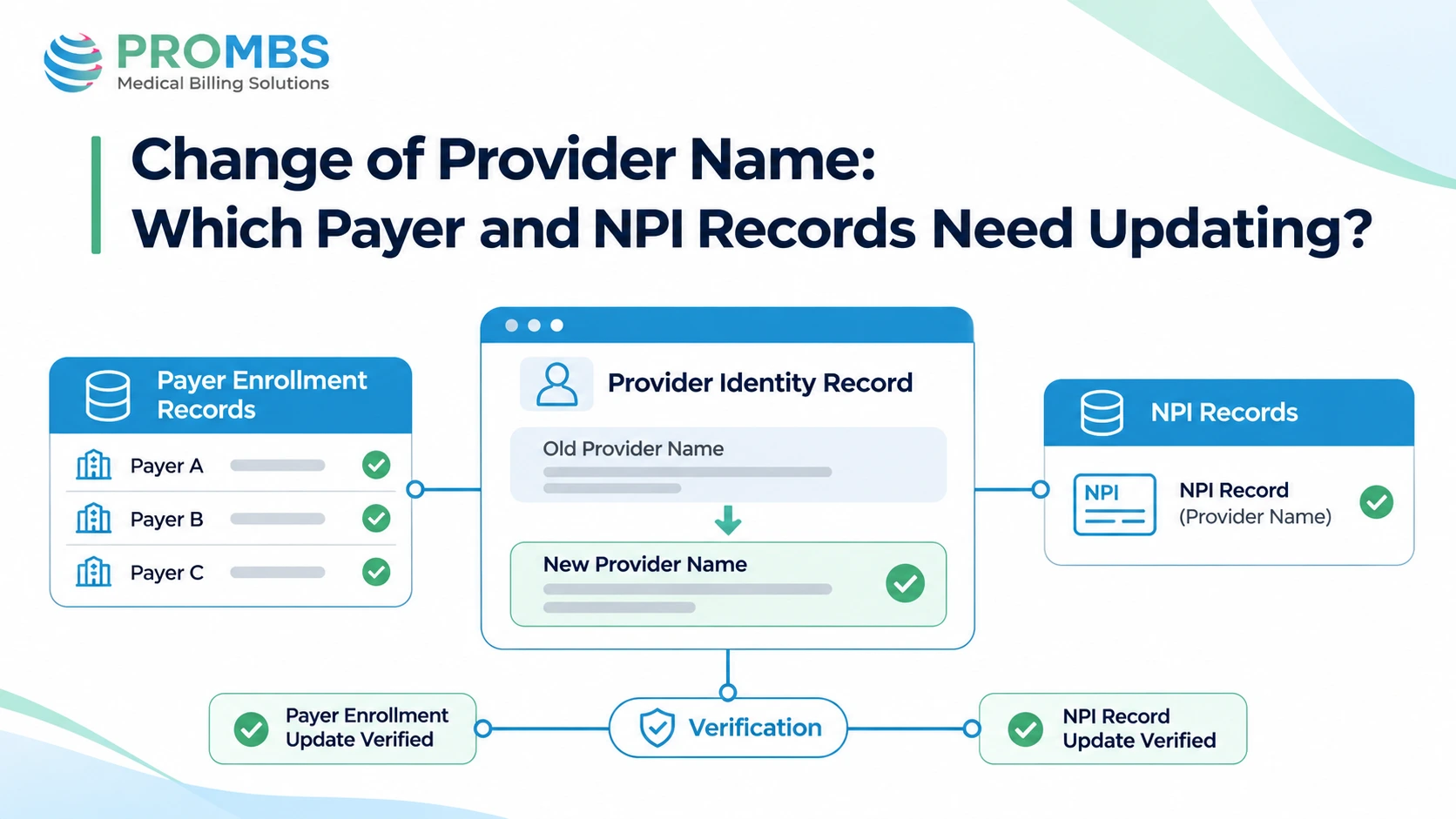
A physician changes their last name after marriage, updates their medical license, and continues seeing patients without interruption. Their clinical credentials remain valid, their National Provider Identifier (NPI) stays the same, and their practice continues operating as usual. However, several weeks later, the billing department begins receiving claim rejections because the provider’s updated name does not match the information maintained by certain insurance payers.
Situations like this demonstrate why a legal name change requires more attention than simply editing a provider’s profile in an electronic health record (EHR). Healthcare organizations maintain provider information across multiple independent systems, including the National Plan and Provider Enumeration System (NPPES), Medicare enrollment records, CAQH profiles, Medicaid databases, and commercial insurance networks. Each system may have its own requirements for reporting, verifying, and approving changes.
For physicians and practice administrators, the challenge is keeping these records consistent without interrupting patient care or insurance reimbursement. An updated NPI record alone does not guarantee that Medicare or another health plan has recognized the provider’s new name.
Understanding provider name change enrollment requirements allows medical practices to identify which records need attention, distinguish straightforward demographic corrections from more complicated enrollment changes, and reduce the likelihood of preventable billing problems.
This guide explains how provider name changes affect NPI records, what information must be updated in NPPES, which supporting documents may be required, and how practices can prepare for subsequent Medicare, Medicaid, and commercial payer updates.
What Does a Provider Name Change Mean for Enrollment?
A provider name change occurs when the legal or recorded name associated with a healthcare professional or medical organization changes. Although the underlying provider identity may remain the same, the change can affect information used by licensing authorities, healthcare enrollment systems, credentialing organizations, and insurance companies.
Provider enrollment establishes the relationship between a healthcare professional or organization and an insurance program. These records help payers identify who is providing services, which practice is billing for those services, and whether the provider satisfies the conditions for participation.
When a name changes, administrators must determine whether they are correcting an existing record or reporting an event that affects the provider’s legal or organizational identity.
This distinction matters because an individual physician changing their surname generally presents a different enrollment situation from a medical group merging with another company or changing its tax identification number.
Individual Healthcare Provider Name Changes
An individual provider name change usually involves a physician, nurse practitioner, physician assistant, therapist, or another licensed healthcare professional whose legal name changes while their professional identity remains unchanged.
Common reasons include marriage, divorce, a court order, or the correction of inaccurate identifying information. In these circumstances, the provider generally retains their existing NPI, professional qualifications, and established practice relationships.
Consider a family medicine physician who has been enrolled with several insurance companies for ten years. Following a legal name change, the physician obtains an updated state medical license and changes the name displayed in the practice’s EHR.
The physician has not changed specialties, practice locations, or employment. Nevertheless, their existing payer enrollment profiles may continue showing the previous name until the relevant update requests are completed.
If the practice changes its billing system to reflect the new name without confirming the payer’s records, discrepancies may arise between the information submitted on claims and the information maintained by the insurer. Whether those discrepancies cause a rejection, denial, or additional review depends on the payer’s processing rules.
The proper approach is to update the affected identity and enrollment records while coordinating the billing transition with each payer’s requirements.
Medical Practice and Group Name Changes
A practice name change involves an organization rather than an individual healthcare professional. It may affect the legal business name, an operating name, the organization’s NPI, tax records, payer contracts, and group enrollment information.
For example, a physician group operating as Oak Valley Internal Medicine LLC may decide to change its legal business name to Oak Valley Medical Associates LLC. If the underlying legal entity and tax identification number remain unchanged, the practice may be able to update its existing organizational records rather than establish an entirely new provider identity.
However, the organization must still review its registration information, tax records, payer contracts, and enrollment agreements to determine the appropriate notifications and documentation.
A practice may also operate under a Doing Business As (DBA) name that differs from its registered legal business name. Changing a DBA does not necessarily mean the legal entity has changed, but it can affect the information displayed in payer directories, enrollment applications, and other business records.
Before notifying insurers, administrators should establish whether the change involves the legal business name, a DBA, or both. Using those terms interchangeably can create confusion when payers request documentation or verify the practice against tax records.
Legal Name Changes Versus New Tax IDs and Business Entities
Not every change involving a medical practice can be handled as a simple demographic correction.
A practice that updates its legal name while retaining the same ownership structure and Employer Identification Number (EIN) is generally in a different position from one that forms a new corporation, combines with another organization, or undergoes a qualifying ownership change.
According to the Internal Revenue Service, changing a business name does not ordinarily require obtaining a new EIN. Changes to ownership or organizational structure, however, may create circumstances in which a new EIN is necessary.
The distinction is important because payer enrollment records frequently connect an organization’s legal business name with its tax identification information and billing relationships.
| Type of Change | Is a New NPI Usually Required? | Main Enrollment Consideration |
|---|---|---|
| Individual physician changes surname | No | Update the existing Type 1 NPI record and affected professional and payer records |
| Individual provider corrects legal name spelling | No | Correct the existing identifying information |
| Medical group changes only its DBA | Generally no | Update applicable operating names, payer records, and directories |
| Existing medical group changes its legal business name | Generally no, if the same organization continues | Update the organizational NPI record and applicable tax and enrollment records |
| Medical practice changes its EIN | Not automatically | Review the underlying legal entity change and payer enrollment requirements |
| New legal healthcare organization is established | A new organizational NPI may be needed | Determine the new entity’s NPI, tax, contracting, and enrollment obligations |
| Ownership change or organizational merger | Depends on the circumstances | Evaluate entity continuity, ownership reporting, and payer rules |
The table provides general guidance rather than an automatic determination for every organization. Complex transactions may involve several legal entities, organizational subparts, and payer agreements, making a detailed enrollment review necessary.
For practices managing these situations, treating provider name change enrollment as an ongoing record maintenance responsibility helps prevent important updates from being overlooked.
Does a Provider Need a New NPI After a Name Change?
No. An individual healthcare provider generally does not need a new NPI after changing their legal name. The existing NPI remains associated with the same individual, and the identifying information maintained in NPPES must be updated.
The Centers for Medicare & Medicaid Services (CMS) describes the NPI as a unique, ten-digit identifier that remains the same even when a provider’s name, address, or other information changes.
This permanent identification system allows healthcare providers to maintain a consistent identifier throughout their professional careers, including when they change employers, practice locations, or legal names.
However, retaining the same NPI does not mean a provider can leave outdated information in NPPES. The identifier remains valid, but the associated identifying information must be maintained accurately.
Why an Individual NPI Usually Remains Unchanged
An NPI identifies the healthcare provider rather than serving as a record of the provider’s current surname, practice address, or professional specialty.
When a physician legally changes their name, they remain the same individual for NPI identification purposes. Consequently, CMS does not ordinarily issue a replacement number simply because the name associated with the existing record has changed.
For example, suppose a physician receives an NPI while practicing under the name Dr. Sarah Mitchell. Several years later, the physician legally changes their name to Dr. Sarah Reynolds.
Although the physician must update the applicable NPPES information, the original NPI continues identifying the same healthcare professional.
The practice should preserve that identifier in its provider master file and coordinate any necessary enrollment or billing updates rather than attempting to obtain a second individual NPI.
This is particularly important for physicians who practice at multiple locations or maintain relationships with several healthcare organizations. Their individual NPI continues to identify them across those professional settings, even when the practice arrangements or personal identifying information change.
Understanding Type 1 and Type 2 NPI Records
CMS recognizes two NPI entity types, and understanding their differences is essential when evaluating provider name changes.
Type 1 NPIs identify individual healthcare providers. These include physicians, nurse practitioners, physician assistants, therapists, and other eligible individuals. A sole proprietor is also treated as an individual for NPI enumeration purposes, even when the business has an EIN.
Type 2 NPIs identify healthcare organizations. These can include physician groups, hospitals, clinics, nursing facilities, and other organizations that furnish healthcare services or supplies.
An individual provider who operates through an incorporated healthcare business may have a Type 1 NPI for themselves and a separate Type 2 NPI for the organization.
| NPI Feature | Type 1: Individual | Type 2: Organization |
|---|---|---|
| Identifies | Individual healthcare professional | Healthcare organization |
| Common examples | Physician, therapist, nurse practitioner | Medical group, clinic, hospital |
| Name information | Individual’s legal name | Organization’s legal business name |
| Effect of routine name change | Existing NPI generally remains unchanged | Existing NPI generally remains unchanged if the same organization continues |
| Number of NPIs | An individual is eligible for one NPI | An organization may have multiple NPIs when applicable |
| Additional review | Professional identity and licensing records | Legal entity, ownership, subparts, and tax identification information |
This distinction becomes particularly important when a physician owns a medical practice.
For instance, changing the physician’s surname may require an update to their Type 1 NPI without requiring any change to the legal business name associated with the practice’s Type 2 NPI.
Conversely, a medical group may change its registered business name without altering the legal names of any physicians who work there.
Administrators should therefore determine which entity is affected before making changes to individual and organizational records.
When an Organizational Change Requires Closer Review
Although routine organizational name changes do not generally require a new NPI, some business transactions warrant additional examination.
CMS acknowledges that certain ownership changes, acquisition arrangements, or organizational subpart decisions may affect whether an organization needs a new NPI.
A merger involving two physician groups, for example, raises questions about which legal organization will continue operating, which organization will bill insurers, and whether the transaction creates a new entity.
These questions cannot be answered by looking at the organization’s name alone.
Practice administrators should review the legal structure, applicable tax identification information, organizational NPIs, and existing enrollment arrangements before deciding whether a new NPI is necessary.
A new EIN does not, by itself, establish that a new NPI is always required. The correct determination depends on the nature of the organizational change and the applicable NPI rules.
Most importantly, obtaining an NPI is not the same as securing authorization to participate in an insurance network. CMS explicitly distinguishes NPI enumeration from payer credentialing and enrollment.
How to Update a Provider’s Name in NPPES
The National Plan and Provider Enumeration System, commonly called NPPES, is the CMS system used to assign and maintain NPIs and their associated provider information.
When a healthcare provider undergoes a legal name change, NPPES is one of the primary records that must be reviewed. Updating the system helps maintain the accuracy of the provider’s national identification record.
Healthcare providers can access the official NPPES portal to manage their existing NPI information. The system uses CMS Identity & Access Management (I&A) credentials to control access to individual and organizational records.
Step 1: Verify the Existing NPI Record
Before making changes, confirm the provider’s existing NPI and review the information associated with it.
Administrators should check the provider’s current legal name, entity type, taxonomy information, practice address, mailing address, and other relevant identifying details.
This review is important because some provider profiles contain multiple outdated fields. Correcting the legal name while overlooking another inaccurate record can create additional work during subsequent enrollment updates.
The practice should also confirm that it is editing the correct NPI record, especially when a physician owns an incorporated practice that maintains both an individual and organizational NPI.
For organizations with numerous practitioners, maintaining a centralized inventory of NPIs can help prevent updates from being applied to the wrong provider.
Step 2: Sign In and Update the Relevant Name Fields
Access NPPES using an authorized account and select the existing NPI record requiring maintenance.
The system’s management functions allow authorized users to review and modify the identifying information associated with their assigned NPIs.
For an individual provider, review the legal first name, middle name, last name, and any other applicable identifying information. For an organization, confirm the registered legal business name and other organizational details.
The information entered should agree with the provider’s legally established name or the organization’s appropriate business records.
Administrators should avoid introducing unnecessary changes to unrelated fields. A legal surname correction, for example, does not automatically require modifications to the provider’s taxonomy or practice address when those details remain accurate.
Step 3: Review Former Names and Other Name Information
NPI records can include other names associated with a provider, such as former names or professional names, where applicable.
These details can be useful when a physician has previously practiced under another surname or when a healthcare organization uses a recognized operating name.
However, an earlier name should not simply remain in the current legal name field after the provider has legally adopted a different name.
Administrators should distinguish the provider’s current legal identity from other names that may appropriately be maintained in the record.
For example, a physician who has published research or maintained professional relationships under a previous surname may have a legitimate reason to retain that historical association in an appropriate other-name field.
The objective is to preserve accurate identifying information without confusing the provider’s previous name with their current legal name.
Step 4: Submit the Update and Verify the Record
After reviewing the necessary fields, submit the NPPES update using the system’s available workflow.
Maintain a record of the submission, including the date, the affected NPI, the information changed, and any available confirmation details.
Once the update has been processed, verify that the information appears correctly in the provider’s NPI record. If the public registry does not yet reflect the change, check the application status and allow for applicable processing or publication timing before escalating the issue.
A saved or submitted update should not be assumed to have corrected every connected system.
In particular, the provider’s Medicare enrollment record is maintained separately from the NPPES record. CMS specifically states that updating NPPES does not automatically update Medicare enrollment information.
Practices should therefore consider NPPES maintenance an important initial step rather than the completion of the entire name change process.
Step 5: Follow the NPPES Reporting Deadline
HIPAA-covered healthcare providers must report changes to required NPI information within 30 days of the change.
This requirement applies to information maintained in NPPES, including changes to applicable identifying details.
For example, when a physician’s legal surname changes, the practice should plan the NPPES update promptly rather than postponing it until the physician’s next credentialing or payer revalidation cycle.
The 30-day NPPES requirement is separate from the reporting timelines established for Medicare enrollment changes and other insurance programs.
The CMS NPI guidance provides additional information about the national identifier and its maintenance requirements.
A reliable approach is to record the effective date of the legal name change, identify all affected records, and assign responsibility for completing each required notification.
Practices handling several provider changes simultaneously can benefit from having their credentialing and billing teams share a single tracking record.
Which Legal Documents Should Be Updated Before Contacting Payers?
Before submitting provider name change requests to insurers, medical practices should collect the relevant documentation supporting the new legal name.
Insurance companies and enrollment administrators may compare submitted information against state licensing records, tax documentation, professional registrations, or other authoritative sources.
When supporting documents contain different names, the payer may require clarification before completing the requested update.
The exact documents depend on whether the change affects an individual healthcare professional, a sole proprietorship, or a medical organization.
Social Security Records and Legal Identification
For individual providers, Social Security records are an important consideration following a legal name change.
The Social Security Administration requires individuals who legally change their names to notify the agency so their records can be corrected.
Depending on the circumstances, the individual may need to provide evidence of the name change, identity, and other applicable eligibility information.
A marriage certificate, divorce decree, or court order may serve as evidence of the legal name change when it satisfies the agency’s requirements.
Providers can review the official Social Security name change instructions before beginning the process.
Updating personal identity records helps maintain consistency across employment, tax, and other administrative systems that use legal identifying information.
State Medical Licenses and Professional Registrations
Healthcare professionals should also review the name associated with each active state professional license.
State licensing boards establish their own procedures for name changes and may require supporting legal documentation, a formal request, or other verification.
A physician holding licenses in multiple states should not assume that correcting one state’s licensing record updates every other jurisdiction.
Depending on the provider’s specialty and practice authority, other professional registrations may also require attention.
These may include Drug Enforcement Administration registrations, state controlled substance registrations, professional certifications, and hospital medical staff records.
The relevant agencies and organizations should be consulted for their specific reporting procedures and required evidence.
IRS Records and Business Identification Documents
For medical practices, accurate tax identification information is an important part of payer enrollment maintenance.
When an organization legally changes its business name, the practice should determine whether the change must be reported to the IRS and how the updated name should appear on its tax documentation.
The IRS provides different business name change procedures for sole proprietorships, corporations, and partnerships.
Although changing a business name generally does not require a new EIN, practices should verify whether any accompanying ownership or structural changes affect that conclusion.
The organization should also review its Form W-9, business formation documents, and relevant financial records before submitting updates that involve its legal business name.
This helps reduce inconsistencies between the business information submitted to insurers and the identifying information recognized by tax authorities.
Supporting Documentation Checklist
The following table identifies common records medical practices may need to review or prepare before initiating insurance enrollment updates.
| Document or Record | Why It Matters |
|---|---|
| Marriage certificate, divorce decree, or court order | Establishes the legal basis for an individual’s name change when applicable |
| Government-issued identification | Helps verify the provider’s current identity when requested |
| Updated Social Security record | Supports consistency in personal identity and tax records |
| State medical or professional license | Confirms the licensed provider’s current legal name |
| DEA or applicable controlled substance registration | Maintains accurate prescribing registration information |
| NPPES record | Confirms the name associated with the existing NPI |
| IRS business name confirmation or relevant tax documentation | Supports changes involving an organization’s legal business name |
| Current Form W-9 | Provides the tax name and identification information used for reporting and payment |
| Business formation or amendment documents | Establishes an organization’s legal identity and name changes |
| Malpractice insurance documentation | Helps maintain consistency with professional coverage and credentialing records |
| Hospital privileges or medical staff records | Supports accurate identification within affiliated healthcare facilities |
Not every document is required for every name change, and insurers may request additional materials based on the provider type, contractual relationship, or nature of the change.
For example, a physician who changes their surname but continues working for the same medical group may not need new organizational formation documents. A group practice changing its legal business name may need to provide amended formation documents and updated tax information without collecting personal legal name change documents from each physician.
An organized documentation review can reduce avoidable requests for additional information. It also helps credentialing personnel explain the change consistently when communicating with different payers.
Practices that do not have dedicated enrollment staff can consider using professional physician credentialing services to coordinate record maintenance, supporting documentation, and payer communications.
Why Updating NPPES Is Only the Beginning
Updating a provider’s NPI information is essential, but it does not complete the broader enrollment process.
A physician’s updated NPPES record does not automatically revise their Medicare enrollment, commercial insurance profiles, Medicaid enrollment information, or other independent credentialing records.
Each affected organization may maintain different information, reporting procedures, documentation requirements, and confirmation processes.
This creates an important operational responsibility for medical practices. Credentialing personnel must identify which enrollment records require changes, while billing teams must understand when those changes have been accepted and how they affect claim submission.
The distinction becomes especially important when the physician continues seeing insured patients during the transition. A correctly maintained NPI does not guarantee that every payer’s billing system has recognized the provider’s updated name.
For that reason, successful provider name change enrollment requires more than submitting a single demographic correction. It involves maintaining consistency across professional identity records, payer enrollment databases, and the systems responsible for submitting and processing claims.
Which Payer and Enrollment Records Must Be Updated After a Provider Name Change?
Updating a provider’s legal name in NPPES is an important first step, but it does not automatically correct the information maintained by Medicare, Medicaid, or commercial insurance companies. Each payer maintains enrollment and provider identification records that may require separate updates before the revised name is recognized throughout its systems.
The challenge becomes more significant when a physician participates with multiple insurance networks, practices at several locations, or bills through an established medical group. A single individual NPI may be associated with different payer agreements, tax identification numbers, and billing arrangements. Although the physician’s identity remains unchanged, every affected enrollment relationship needs to be evaluated.
For medical practices, provider name change enrollment should therefore involve a coordinated review of all applicable records rather than a single notification. The objective is to make sure that the information recognized by insurance payers agrees with the provider’s legal identity and the information used to submit claims.
The following table identifies the primary systems that practices should review after a legal name change.
| Enrollment System | Information to Review or Update | Primary Concern |
|---|---|---|
| NPPES | Individual or organizational legal name | National provider identification accuracy |
| Medicare PECOS | Medicare enrollment and provider demographic information | Medicare enrollment accuracy |
| State Medicaid | Provider’s legal name and enrollment details | State program enrollment requirements |
| Medicaid managed care | Participating provider and group records | Plan specific participation and billing |
| CAQH Provider Data Portal | Personal information, credentials, and attestations | Credentialing profile accuracy |
| Commercial insurance companies | Individual and group enrollment records | Network participation and claim processing |
| Group provider rosters | Provider name, NPI, affiliations, and tax relationships | Accurate group participation records |
| EFT and ERA systems | Payment account information and remittance setup | Payment and reconciliation accuracy |
| EHR and billing software | Provider master data and claim information | Consistent electronic claim submission |
Not every name change requires modifying every record in this table. For example, a physician who changes their surname without changing employers may not need a new group contract or bank account. However, the practice should still verify which systems maintain the previous name and whether an update is necessary.
How to Update a Provider Name in Medicare PECOS
Medicare enrollment records are maintained through the Provider Enrollment, Chain, and Ownership System (PECOS), which allows healthcare professionals and organizations to manage their enrollment information with Medicare.
When a Medicare enrolled physician changes their legal name, the applicable enrollment information must be updated through PECOS or the appropriate Medicare enrollment application process. This requirement is separate from updating the provider’s NPPES record.
Why NPPES Updates Do Not Automatically Change PECOS
Although NPPES and PECOS are both associated with the Centers for Medicare & Medicaid Services, they perform different administrative functions.
NPPES maintains National Provider Identifier information, while PECOS maintains Medicare provider and supplier enrollment records. A physician can have an accurate NPI record but still have outdated information in their Medicare enrollment.
Consider a physician whose surname changes from Wilson to Carter. The physician updates NPPES and verifies that the new name appears in the NPI Registry. However, the Medicare enrollment record continues to identify the physician under the previous surname.
If the practice begins submitting claims under the updated name before resolving the Medicare enrollment discrepancy, the claims may encounter provider identification edits or other administrative problems.
CMS emphasizes that information maintained in Medicare enrollment must be kept current. Practices should therefore update PECOS independently and verify that the Medicare Administrative Contractor (MAC) has processed the requested change.
How to Report a Provider Name Change Through PECOS
The Medicare name change process generally begins with reviewing the existing enrollment record in the official PECOS system.
Authorized users should identify the affected enrollment, select the appropriate change of information process, and update the provider’s identifying details. Depending on the enrollment type, CMS may require supporting documentation and electronic signatures before the change request can be submitted.
The updated legal name should agree with the appropriate NPPES information and supporting identity records. Where applicable, administrators should also review the provider’s Social Security or tax identification information to avoid introducing inconsistencies between connected records.
After submission, the practice should retain the application tracking number and monitor requests for additional information. A submitted application should not be treated as an approved update until the contractor has completed the applicable review.
Which Medicare Enrollment Applications May Apply?
Medicare uses different enrollment applications depending on whether the affected record belongs to an individual practitioner, an organization, or another provider or supplier category.
| CMS Application | Primary Purpose |
|---|---|
| CMS-855I | Enrollment and information changes for physicians and nonphysician practitioners, including applicable reassignment information |
| CMS-855B | Enrollment and information changes for clinics, group practices, and certain other suppliers |
| CMS-855A | Enrollment and information changes for institutional providers |
| CMS-855O | Enrollment records for eligible practitioners who enroll solely to order or certify services |
The CMS-855I now includes the reassignment information previously collected through CMS-855R. CMS discontinued the separate CMS-855R application, so practices should avoid relying on older enrollment instructions that still direct them to use that form.
A routine legal name change generally calls for an update to the affected existing enrollment record, not an entirely new Medicare enrollment application. However, changes involving legal entities, ownership, or organizational structure may require further evaluation.
According to CMS Medicare Provider Enrollment guidance, physicians, nonphysician practitioners, and their organizations generally must report ordinary enrollment changes within 90 days. Changes involving ownership or control, practice locations, and certain adverse legal actions generally have a 30-day reporting requirement. Different provider and supplier categories can have different deadlines, including the 30-day requirements applicable to DMEPOS suppliers.
Practices should confirm the reporting period applicable to their specific enrollment rather than assuming all Medicare changes follow the same deadline.
Verify Medicare Enrollment Status and Approved Changes
Submitting a name change request does not necessarily mean the updated information is immediately available for claims processing.
The responsible enrollment specialist should monitor the PECOS application status, respond to any MAC requests, and obtain confirmation when the change has been processed.
The approval documentation should be reviewed for the correct provider name, NPI, legal business name when applicable, and any other information affected by the request.
Administrators should also establish whether the contractor has confirmed an effective date or given specific billing instructions. A practice should not assume that the date a request was submitted is automatically the date on which every billing system will recognize the updated information.
Check Medicare Reassignment and Group Affiliations
Physicians who provide services through medical groups may have Medicare reassignment relationships allowing an eligible organization to receive payment for their services.
A name change does not ordinarily terminate an otherwise valid reassignment. Nevertheless, the practice should verify that the individual practitioner and affiliated organizations remain correctly associated in Medicare enrollment records.
This is especially important for physicians who practice under more than one tax identification number or receive reassigned payments through several organizations.
The individual provider’s name, Type 1 NPI, group affiliation, and the receiving organization’s enrollment information should remain accurate. If the name change occurs alongside a new employer or organizational restructuring, additional reassignment changes may be necessary.
Correcting these relationships helps maintain consistency throughout the credentialing to claims workflow, particularly when multiple practices rely on the same physician’s individual NPI.
How to Update Provider Information With Medicaid
Medicaid enrollment presents a different administrative challenge because program administration is primarily handled by individual states under federal requirements.
A physician enrolled with Medicaid in Texas may encounter different reporting procedures from a physician enrolled in Florida, California, or New York. Although the underlying reason for the name change may be identical, the required forms, supporting documents, and enrollment systems can differ.
Why Medicaid Enrollment Rules Differ by State
State Medicaid agencies establish procedures for maintaining provider enrollment information, including legal names, business details, professional licenses, and organizational affiliations.
Some states allow providers to complete demographic updates electronically through a provider portal. Others may require specific change forms, supporting documents, or additional review for certain provider types.
For example, Texas Medicaid maintains provider enrollment procedures through the Texas Medicaid & Healthcare Partnership (TMHP). Its provider information change procedures address legal name changes and may require supporting tax documentation such as Form W-9.
Practices should consult the applicable state Medicaid provider manual and current enrollment instructions before submitting a name change request.
It is important not to assume that Medicaid follows Medicare’s reporting timeline. Each state may establish its own deadlines, and the requirements can depend on the type of enrollment change.
State Medicaid Enrollment Portals and Documentation
The practice should begin by identifying every state Medicaid program in which the affected provider maintains an active enrollment.
For each program, the credentialing team should verify the current enrollment information, applicable change procedures, required documents, and whether the update affects an individual practitioner or an organization.
A physician practicing in more than one state may need to submit separate updates through the respective state enrollment systems.
Documentation may include the provider’s updated professional license, NPI information, evidence of the legal name change, or organizational tax records. The exact requirements should be confirmed with the responsible Medicaid program.
After submission, the practice should retain acknowledgment details and monitor the request until the state confirms the appropriate enrollment update.
Medicaid Managed Care Organization Updates
An additional complication is that many Medicaid beneficiaries receive coverage through managed care organizations (MCOs).
A physician may be enrolled in the state Medicaid program while also maintaining participation agreements with several Medicaid managed care plans.
Updating the state Medicaid enrollment record does not necessarily complete every managed care plan’s provider record update.
Depending on the state and plan, provider information may be shared through centralized enrollment systems, roster submissions, or separate demographic maintenance processes.
Practices should identify the Medicaid managed care organizations associated with the provider and confirm whether each requires a separate notification.
The enrollment team should also verify the provider’s participation status and effective date information under the relevant plans. These checks can help prevent confusion when the practice begins billing under the updated name.
How to Update a Provider Name in CAQH
CAQH provider profiles are widely used to maintain credentialing and professional information that authorized healthcare organizations can access.
The CAQH Provider Data Portal, now associated with DataSpring, allows participating providers to maintain information such as legal names, licenses, practice locations, professional history, and supporting documentation.
Although CAQH is commonly involved in credentialing, maintaining the profile does not automatically complete every payer’s enrollment or contracting requirements.
Review Individual Information and Supporting Documents
After a legal name change, the provider or authorized practice administrator should access the existing CAQH profile and review the personal information sections.
The provider’s current legal name should be updated to agree with the applicable identity and professional licensing records.
The practice should also review supporting documents and replace those requiring updates. These may include professional licenses, malpractice insurance information, and other credentialing materials when the change affects them.
Administrators should avoid creating a second profile solely because the physician has changed their name. Instead, they should maintain the existing provider profile and follow the portal’s applicable update procedures.
Update Practice Locations and Professional Affiliations
A name change provides an opportunity to review related information, but administrators should modify only records that actually require correction.
For example, if a physician continues practicing at the same clinic, the practice address should remain unchanged unless the existing information is inaccurate.
If the physician changes employers at approximately the same time, the CAQH profile may also require changes to professional affiliations, practice locations, or group relationships.
These updates should reflect the provider’s actual professional circumstances rather than being made simply because their legal name changed.
Confirm Authorized Organizations Can Access the Profile
CAQH profile information can be shared with authorized participating organizations.
After changing the provider’s name, administrators should verify that the relevant insurance organizations have the required authorization to access the updated information.
This is particularly important when a physician participates with several commercial insurance companies that use the CAQH system as part of their credentialing processes.
However, access to updated CAQH information should not be mistaken for confirmation that an insurance company’s enrollment, contract, or claims processing records have been changed.
Complete the Review and Attestation Process
One of the most frequently overlooked steps in CAQH maintenance is attestation.
The CAQH Provider Data Portal requires providers to review and attest to their information after making updates so the revised profile can be available to authorized organizations.
A saved change that has not been attested may not be available to those organizations as intended.
The provider should complete the required attestation process and verify the profile’s status. CAQH’s regular reattestation cycle is generally 120 days, but a material update should not be left unverified until the next scheduled cycle.
Maintaining an accurate and properly attested CAQH profile helps support consistent credentialing information across participating health plans.
How to Update Provider Names With Commercial Insurance Payers
Commercial insurance companies maintain their own provider enrollment, contracting, network, and claims processing records.
A provider’s NPI may remain valid, and their Medicare and CAQH information may be accurate, while one or more commercial payers continue recognizing the previous legal name.
For that reason, commercial payer notifications are an essential part of provider name change enrollment.
Identify Every Affected Insurance Payer and Network
The first step is creating a complete list of insurance companies and networks associated with the provider.
This review should include major commercial insurers, regional health plans, employer sponsored products, and any additional networks through which the practice participates.
For example, a physician may maintain relationships with Aetna, Cigna Healthcare, UnitedHealthcare, and one or more Blue Cross Blue Shield plans.
Each payer may have different requirements for demographic updates and associated provider records. Participation in one network does not guarantee that another insurer has received or approved the same information.
The practice should also distinguish commercial network participation from Medicare Advantage participation. Updating Original Medicare enrollment in PECOS does not necessarily update the records maintained by a Medicare Advantage organization.
Submit Name and Demographic Maintenance Requests
Commercial insurers commonly provide provider portals, online demographic change forms, or roster submission procedures for updating information.
The specific submission method depends on the payer, provider relationship, and whether the physician is individually contracted or participates through a group.
For example, Aetna directs many providers to update information through Availity or its applicable provider data change procedures. UnitedHealthcare provides demographic maintenance and attestation options through its provider systems, while Cigna Healthcare offers an online change process for contracted providers.
These examples demonstrate why practices should not rely on one universal form or assume that an email notification satisfies every insurance company’s requirements.
Before submitting the update, administrators should verify the current process through the payer’s official provider resources.
Verify Whether Contracts or Group Affiliations Need Changes
A routine physician surname change does not automatically require a new payer contract or another full credentialing cycle.
However, a practice should verify whether the payer requires any changes to existing contractual records, provider rosters, or affiliations.
Suppose a physician changes their legal surname while continuing to work for the same multispecialty group. The insurer may be able to process the request as an existing provider demographic update.
If the physician also transfers to another group operating under a different tax identification number, the payer may require a separate group affiliation or enrollment action.
These are distinct administrative events and should be documented separately.
Practices should also review the affected insurance products. A physician might appear under multiple payer networks, and each participation record should reflect the correct identity.
Obtain Payer Confirmation and Effective Dates
One of the most important steps in commercial payer maintenance is confirming that the insurer has actually processed the requested change.
Submitting a form or updating a portal does not establish that every associated claims system has immediately recognized the new name.
The enrollment team should retain the submission date, payer reference number, confirmation of completion, and any applicable effective date.
If the payer provides specific claim submission instructions during the transition, those instructions should be communicated to the billing department.
The team should also verify that the payer’s provider directory reflects the correct information when applicable. Directory accuracy is important for patients seeking participating clinicians, but a corrected directory listing alone does not prove that the billing system has been updated.
What Happens to Provider Rosters, EFT, ERA, and Tax Information?
A legal name change can affect records beyond the provider’s primary enrollment profile.
Medical groups frequently maintain provider rosters identifying participating clinicians, practice locations, individual NPIs, organizational relationships, and applicable tax identification numbers.
When a provider’s name changes, the group should review these rosters and notify the appropriate payer or delegated credentialing organization according to its requirements.
The financial records associated with the practice also deserve attention, particularly when the change involves an organization’s legal business name.
Provider Rosters and Group Participation
Group rosters often connect a physician’s individual NPI to a medical organization’s tax identification number and payer agreement.
If the physician’s name changes but the group relationship remains the same, the roster may need a demographic correction rather than a new participation request.
The practice should verify that the physician remains correctly associated with the relevant group, service locations, and insurance products.
For delegated credentialing arrangements, the organization should follow the applicable roster submission schedule and reporting procedures rather than assuming that a central CAQH update has corrected its delegated records.
Electronic Funds Transfer and Payment Accounts
Electronic Funds Transfer (EFT) enables payers to deposit reimbursements into an authorized bank account.
An individual physician’s name change does not automatically require replacing the practice’s existing payment account. Nevertheless, any change affecting the legal account holder, organizational business name, banking details, or tax identity should be reviewed.
For Original Medicare, Form CMS-588 is used for EFT authorization and applicable changes. CMS requires the account holder information to correspond with the appropriate enrolled individual or legal business name.
Practices should determine whether their enrollment change requires an associated EFT update and follow the MAC’s instructions.
Commercial insurance companies may maintain separate EFT arrangements, so any affected payment records should be reviewed individually.
Electronic Remittance Advice and Billing System Records
Electronic Remittance Advice (ERA) provides information about how claims were processed, including payment amounts, adjustments, and other remittance details.
Unlike EFT, which controls how funds are transferred, ERA supports payment information exchange and reconciliation.
A legal name change may not require a new ERA enrollment when the existing trading partner and payment arrangements remain unchanged. However, administrators should verify whether associated payer records, provider identifiers, or remittance routing arrangements need adjustment.
The practice’s electronic health record, practice management platform, and clearinghouse configuration should also be reviewed for inconsistent provider information.
These systems must transmit the correct identifiers and provider details according to each payer’s requirements. Changing the displayed physician name without confirming the underlying enrollment data can create unnecessary claim processing problems.
Tax Identification Records and Form W-9
When a medical organization changes its legal business name, the practice should review its Internal Revenue Service records and Form W-9.
The IRS business name change guidance explains that the reporting procedure depends on the organization’s business structure.
A routine business name change generally does not require a new EIN, but the practice may need to notify the IRS and update tax documentation used by insurance payers.
Administrators should distinguish changes to the legal business name from changes to the actual tax identification number.
If the organization remains legally the same and retains its existing EIN, the enrollment process may involve correcting the legal business name across affected records.
If the change involves a new legal entity or tax identification number, the practice should evaluate whether new payer enrollment, contracting, and payment arrangements are required.
Coordinating Payer Updates Before Changing Billing Information
Successful provider name change enrollment depends on keeping the enrollment and billing teams informed throughout the transition.
The credentialing department should maintain a record of every affected payer, submitted update, outstanding documentation request, and confirmed approval. The billing department should use this information to determine when provider details should be changed in claims processing systems.
Consider a physician who changes their legal name while remaining employed by the same medical group. NPPES and Medicare may reflect the new name before every commercial payer has completed its review.
If the practice immediately changes its billing system for all payers, certain claims may be submitted using information that does not agree with the affected insurer’s enrollment records.
A more controlled approach is to confirm each payer’s billing instructions and approved changes before implementing the applicable updates. This does not mean knowingly submitting inaccurate information under an outdated identity. Rather, it means resolving discrepancies through the payer’s authorized process and ensuring claims accurately represent the provider.
The practice should also monitor payer acknowledgments and communicate any unresolved enrollment changes to employees responsible for claim submission.
These precautions matter because even a relatively straightforward legal name change can affect multiple claim types and payment arrangements when administrative records are not synchronized.
Once the enrollment updates have been completed, the remaining responsibility is to verify that claims are accepted, processed, and reimbursed correctly. That includes investigating provider name mismatches, addressing enrollment related rejections, and monitoring affected accounts receivable.
How Can Provider Name Changes Cause Medical Claim Denials?
A provider’s legal name change does not automatically invalidate previously established insurance participation. However, discrepancies between the information submitted on a medical claim and the records maintained by an insurance payer can create processing problems.
These discrepancies may involve the rendering provider, billing organization, referring physician, or enrollment relationship associated with the claim. Depending on the payer’s validation rules, the result may be a clearinghouse rejection, a payer rejection, a request for additional information, or an adjudicated denial.
For medical practices, understanding where these errors originate is essential to resolving them without unnecessarily repeating enrollment applications or submitting incorrect claims.
Rendering Provider Name and NPI Mismatches
The rendering provider identifies the healthcare professional who performed the billed service. On applicable professional claims, the rendering provider’s identity must be reported according to the payer’s claim submission requirements.
Consider a physician who changes their surname and updates the practice management system immediately. Their individual NPI remains unchanged, but a commercial insurance company has not yet completed its provider demographic update.
If the payer’s validation process compares the submitted provider name against its existing enrollment record, the discrepancy may prevent the claim from processing normally.
The appropriate response is to verify the actual enrollment status, confirm the payer’s requirements, and correct any inaccurate records. Simply replacing the physician’s NPI would be inappropriate when the original identifier remains valid.
Billing Provider and Group Identification Errors
Provider identification issues can also occur when a medical organization changes its legal business name.
A group practice may retain its organizational NPI and tax identification number while updating its registered business name. However, its billing software and insurance enrollment records may not reflect the change simultaneously.
Because billing provider information identifies the person or organization requesting reimbursement, inconsistencies involving the legal business name, organizational NPI, tax identification number, or group enrollment relationship can trigger administrative problems.
The billing team should verify that the submitted information accurately represents the enrolled organization and meets the payer’s current requirements.
Referring or Ordering Provider Discrepancies
Some medical services require information about the healthcare professional who ordered or referred the patient.
This is particularly relevant to diagnostic imaging, laboratory testing, durable medical equipment, and other services subject to specific ordering or referral requirements.
If a referring physician changes their surname, an outdated referring provider record in the billing system may produce incorrect claim information. Medicare also applies ordering and referring eligibility requirements that must be distinguished from a simple name discrepancy.
Practices should verify the referring practitioner’s actual identity, NPI, and applicable eligibility rather than assuming that a valid NPI alone guarantees payment.
For a deeper examination of these problems, see our guide to referring provider claim denials.
Payer Enrollment Information That Has Not Been Updated
A physician may have accurate NPPES information but an outdated name in a commercial payer’s enrollment database.
Similarly, the physician’s individual record may be current while the payer’s group affiliation or provider roster remains incomplete.
These situations require administrative investigation because the claim itself may contain accurate information while the payer’s records need correction.
Medical practices should determine whether the problem originates from incorrect claim data, an unfinished enrollment update, or an unrelated participation issue before deciding how to proceed.
How to Prevent Billing Interruptions During a Provider Name Change
Preventing reimbursement problems requires coordination between credentialing, provider enrollment, and medical billing personnel.
The practice should establish a verified record of the provider’s legal identity, existing NPI, payer relationships, and affected billing configurations. Changes should then be implemented in accordance with applicable reporting requirements and confirmed payer instructions.
Match Claim Information to the Payer’s Approved Records
Before submitting claims, the billing team should verify the provider information required by each payer.
This includes reviewing the individual NPI, organizational NPI, legal name, group affiliation, and other applicable identifying details.
The goal is not to continue using outdated information simply because a payer has not completed an update. Instead, the practice should obtain the payer’s instructions for handling claims during the transition and make sure that submitted information remains accurate.
When the payer’s records are incorrect, the enrollment team should pursue the necessary correction and document the outcome.
Coordinate Payer Effective Dates
An enrollment request’s submission date and the date a payer processes the change are not necessarily the same.
Practice administrators should record any effective dates confirmed by the insurer and determine whether the update affects claims for services provided before, during, or after the transition.
For example, a physician may have claims awaiting submission for encounters that occurred before the legal name change. Those claims should be handled according to the payer’s applicable instructions and the provider’s verified information for the relevant period.
This coordination is especially important when a name change coincides with a new employer, new tax identification number, or change in group participation.
Update the EHR, Billing Software, and Clearinghouse Settings
Medical practices often maintain provider information in several systems, including electronic health records, practice management software, scheduling platforms, and clearinghouse configurations.
Updating only the name displayed on a clinical screen may leave older information in the claim generation process.
The billing department should review the actual electronic claim output to confirm that the correct provider names, NPIs, and applicable group information are transmitted.
A controlled review of affected claim settings can identify problems before they are repeated across a large number of encounters.
Monitor Claim Acceptance and Remittance Information
Following the transition, practices should monitor the first claims submitted to each affected payer.
Clearinghouse acknowledgments can reveal submission errors, while payer claim status responses and remittance information provide additional evidence about processing outcomes.
An accepted claim is not necessarily a paid claim. The billing department should verify final adjudication and reconcile the resulting payment or adjustment.
If several claims begin failing with similar provider identification messages, the practice should investigate the underlying provider record rather than correcting each claim independently.
What to Do When Claims Are Rejected After a Provider Name Change
When a claim fails following a provider name change, the first responsibility is identifying the precise reason.
A claim rejection and a claim denial are not interchangeable. They may require different actions, supporting documentation, and deadlines.
Identify Whether the Claim Was Rejected or Denied
A rejected claim may not have been accepted into the payer’s adjudication process. For Medicare, claims returned as unprocessable because of incomplete or invalid information are generally not considered appealable initial determinations.
An adjudicated denial, however, represents a payer decision about a processed claim and may qualify for a correction, reopening, reconsideration, or formal appeal under applicable rules.
The billing team should examine the actual acknowledgment, claim status response, or remittance advice rather than assuming every unpaid claim requires an appeal.
Verify the Submitted Provider Details
Compare the rejected or denied claim with the provider’s verified NPI record, legal identity, and relevant payer enrollment information.
Review the rendering provider, billing provider, and referring or ordering practitioner fields whenever those roles apply.
If the information was generated from an incorrect master record, correct the source rather than manually editing only the affected claim.
This step helps prevent the same administrative error from appearing on future submissions.
Contact the Responsible Insurance Payer
When the claim information appears accurate but the payer’s enrollment records remain outdated, contact the appropriate provider enrollment or claims department.
Provide the relevant claim reference, NPI, enrollment update confirmation, and other information needed to investigate the discrepancy.
Ask the payer to clarify whether the issue involves a pending demographic update, an enrollment or affiliation problem, or incorrect claim information.
Document the response, representative reference number, and required next steps.
Correct Claims or Pursue the Appropriate Review
Once the underlying issue is established, choose the resolution method permitted by the payer.
An unprocessable claim may require correction and a valid new submission. An adjudicated denial may qualify for reconsideration or appeal, depending on the reason and applicable rules.
Practices should not submit duplicate claims repeatedly or change accurate provider information merely to bypass an enrollment edit.
Timely filing requirements also matter. Original Medicare generally requires claims to be filed within one calendar year of the date of service, subject to limited exceptions. Commercial and Medicaid deadlines vary.
Monitor Affected Accounts Receivable
Provider name changes can create a group of unresolved claims when the same outdated record is used repeatedly.
The billing team should identify all potentially affected encounters, organize them by payer and claim status, and monitor their resolution.
A useful work queue should distinguish claims awaiting enrollment corrections from claims requiring corrected submission, payer review, or payment posting.
Practices should also evaluate recoverable reimbursement using applicable coverage and contractual terms rather than treating every outstanding billed charge as guaranteed revenue.
For organizations handling recurring administrative denials, structured denial management services can support investigation, follow-up, and resolution.
Provider Name Change Enrollment Checklist for Medical Practices
A consistent checklist helps practices complete required changes without losing track of payer responses or outstanding claims.
The following checklist divides the process into three stages.
| Stage | Required Review | Verification |
|---|---|---|
| Before submission | Confirm the legal name change and supporting documents | Legal identity verified |
| Before submission | Identify Type 1 and applicable Type 2 NPIs | Correct NPI records identified |
| Before submission | Review state licenses, tax records, and applicable registrations | Supporting records reviewed |
| During updates | Update NPPES within the applicable reporting period | Updated NPI information verified |
| During updates | Submit applicable Medicare PECOS changes | Submission and processing status documented |
| During updates | Review Medicaid and managed care requirements | Required notifications completed |
| During updates | Update and attest CAQH information | Attestation status verified |
| During updates | Notify affected commercial insurance companies | Payer confirmations recorded |
| During updates | Check group rosters, EFT, ERA, and tax information | Applicable changes confirmed |
| After updates | Review EHR, practice management, and clearinghouse records | Claim data verified |
| After updates | Monitor initial claim acknowledgments and payer responses | Processing problems investigated |
| After updates | Reconcile payments and outstanding insurance A/R | Affected accounts followed through resolution |
Maintain a Centralized Payer Tracking Record
Medical practices should maintain a record of every affected payer rather than relying on separate email conversations or informal staff updates.
| Payer | Update Submitted | Reference Number | Status | Effective Date |
|---|---|---|---|---|
| Original Medicare | Record date | Record number | Pending or completed | If confirmed |
| State Medicaid | Record date | Record number | Pending or completed | If confirmed |
| Commercial Payer A | Record date | Record number | Pending or completed | If confirmed |
| Commercial Payer B | Record date | Record number | Pending or completed | If confirmed |
Assigning responsibility for each update helps prevent applications from remaining unresolved when employees change responsibilities or multiple departments participate in the process.
A completed tracking record should also preserve confirmation evidence and identify any remaining billing verification tasks.
Common Mistakes That Delay Provider Name Change Enrollment
One common mistake is assuming that updating NPPES automatically corrects Medicare, Medicaid, CAQH, and commercial payer records. These systems serve different purposes, and updates may require separate action.
Another problem occurs when practices update CAQH information without completing the necessary attestation. Even when the profile contains the correct name, authorized organizations may not receive the updated information as intended until the required process is complete.
Medical groups may also overlook organizational records because the individual provider’s NPI has not changed. Group rosters, participation relationships, and applicable billing arrangements deserve review when a physician’s enrollment details change.
Finally, practices sometimes modify claim information before determining whether the payer has completed its required update. A coordinated approach should prioritize accurate information, timely reporting, documented payer instructions, and verification of final processing.
Frequently Asked Questions About Provider Name Changes
Does a Legal Name Change Require a New NPI?
No. An individual physician or other eligible healthcare professional generally retains the same NPI after changing their legal name. The provider must update the applicable identifying information in NPPES rather than requesting a replacement identifier.
How Soon Must NPPES Be Updated After a Name Change?
HIPAA covered healthcare providers must report changes to required NPI information within 30 days. Medicare enrollment changes and individual insurance payer updates may have separate deadlines that should be reviewed independently.
Is Changing a Provider’s Name in PECOS Enough for All Payers?
No. PECOS maintains Medicare enrollment information and does not automatically complete updates with commercial insurance companies, Medicaid managed care plans, or other independent payer systems. Providers should review all affected enrollment relationships.
Does a Provider Name Change Require a New CAQH Profile?
A routine legal name change generally does not require creating a new CAQH provider profile. The existing profile should be updated with accurate information and supporting documents, followed by the required attestation process.
Do Commercial Insurance Companies Need Separate Notifications?
Often, yes. Commercial insurers may maintain their own demographic information, contracts, and group participation records. Practices should verify each payer’s reporting process rather than assuming updates submitted to NPPES or CAQH are sufficient.
Can a Provider Continue Billing While a Name Change Is Pending?
A name change alone does not ordinarily eliminate an existing provider’s billing privileges or network participation. However, practices must continue meeting enrollment and claim submission requirements, use accurate information, and follow each payer’s instructions while an update is pending.
What if an Insurance Payer Still Has the Provider’s Previous Name?
Contact the payer’s enrollment department and verify whether the required update has been received or processed. Document the response, provide supporting information when requested, and confirm how affected claims should be handled.
How Can Practices Prevent Reimbursement Delays After a Provider Name Change?
Maintain accurate provider records, submit required updates promptly, verify payer confirmations, and coordinate changes with the billing department. Reviewing claim acknowledgments and remittance information after the transition can help identify administrative issues before they affect a larger number of claims.
Conclusion: Keep Provider Records Accurate and Payments Moving
A provider’s legal name may change without altering their professional qualifications, existing NPI, or established patient relationships. Yet the administrative consequences can extend across Medicare, Medicaid, commercial insurance networks, and the medical practice’s own billing infrastructure.
The central requirement is consistency. Healthcare organizations need accurate identity records, correctly maintained enrollment relationships, documented payer updates, and reliable claim submission information.
A routine name change should not become a prolonged reimbursement problem simply because different administrative systems were updated at different times.
By maintaining clear responsibility for enrollment changes and verifying how those changes affect billing, medical practices can reduce preventable claim interruptions, protect legitimate reimbursement, and allow their teams to remain focused on patient care.