

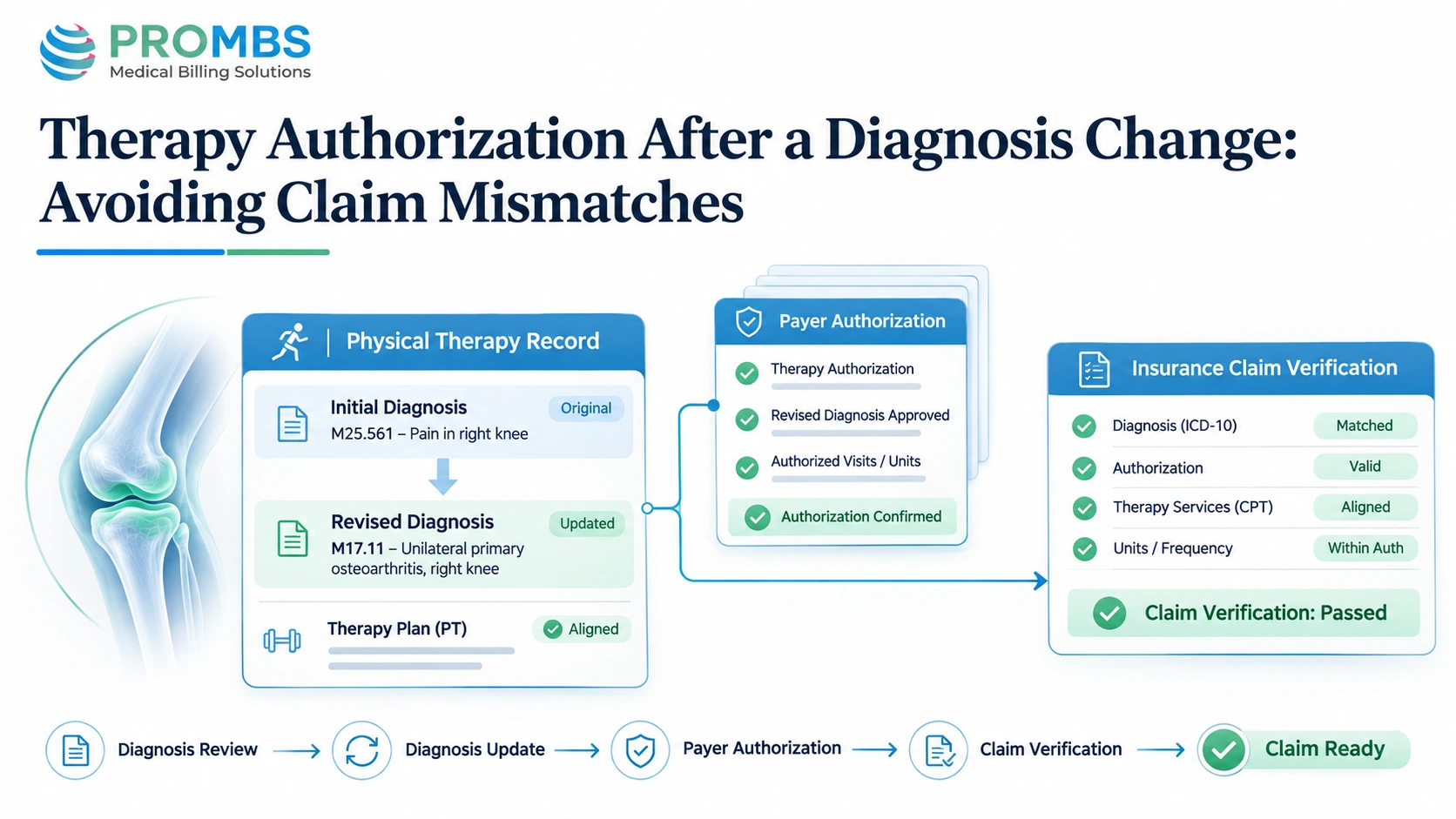
A patient begins physical therapy for persistent knee pain after receiving an initial evaluation and treatment plan. The clinic verifies the patient’s insurance benefits, obtains the required prior authorization, and schedules several therapy sessions. Treatment progresses as expected until further medical assessment reveals a more specific knee condition that changes the diagnosis documented in the patient’s medical record.
The therapist updates the clinical documentation to reflect the confirmed condition, and the billing department begins using the revised diagnosis code. However, the insurance authorization was originally issued using the previous diagnosis information. Nobody has confirmed whether the approval still applies to the patient’s updated condition.
This situation can create an administrative problem even when the therapy remains clinically appropriate. The medical record may accurately describe the patient’s condition, but the insurer’s authorization system may still contain information from the initial request. Depending on the payer’s requirements, the discrepancy could delay claim processing or lead to a denial.
Understanding therapy authorization changes is essential for physical therapy, occupational therapy, and speech-language pathology practices that treat patients whose conditions evolve during an active episode of care. A diagnosis change may require a clinical documentation update, an authorization review, or a new approval request, but those actions are not automatically interchangeable.
The goal is to keep the patient’s diagnosis, treatment plan, payer authorization, and insurance claim consistent with the care actually provided. This guide explains when therapy diagnoses change, how those changes affect authorization requirements, and which clinical and administrative records practices should review before submitting claims.
What Happens to Therapy Authorization When a Diagnosis Changes?
A diagnosis change does not automatically cancel an existing therapy authorization. Whether the original approval remains applicable depends on the patient’s insurance plan, the conditions attached to the authorization, and the nature of the clinical change.
Some authorizations are associated with specific diagnoses, procedures, treatment dates, providers, or approved visits. Others may permit certain changes without requiring an entirely new request.
For example, a patient receiving therapy for knee pain may later receive a confirmed diagnosis that explains the same symptoms. If the treatment goals and authorized services remain substantially unchanged, the practice may only need to verify whether the payer requires updated diagnosis information.
However, if the patient develops a separate medical condition requiring different interventions, the original authorization may not cover the new treatment needs.
The practice should evaluate the actual approval conditions rather than assume the authorization is either valid or invalid simply because an ICD-10-CM code has changed.
How Diagnosis Information Is Used in Authorization Decisions
Insurance companies use clinical information to determine whether requested therapy services satisfy the plan’s authorization and medical necessity requirements.
When a therapy clinic submits an authorization request, the payer may review the patient’s diagnosis, clinical findings, functional limitations, proposed interventions, treatment frequency, and expected duration of care.
The diagnosis provides context for understanding why the patient needs therapy. However, it is usually considered alongside other information rather than serving as the sole basis for every authorization decision.
Consider a patient receiving occupational therapy after a hand injury. The authorization request may include the diagnosed injury, documented limitations in daily activities, treatment goals, and proposed therapeutic services.
If the diagnosis changes because a more specific injury is confirmed, the practice needs to determine whether the original authorization still supports the services being furnished.
That decision depends on the payer’s approval conditions and applicable utilization management rules.
Why an Approved Authorization May Not Cover Every Subsequent Change
Prior authorization is generally issued for a particular scope of services or treatment under the patient’s health plan.
An approval may specify the authorized provider, service dates, number of visits, procedure codes, and other limitations.
A diagnosis change can become significant when it affects one or more of these conditions.
For example, a physical therapy practice may receive authorization to treat a patient’s existing shoulder condition. During the episode of care, the patient develops a separate lower back problem requiring a different treatment plan.
The original approval should not automatically be interpreted as permission to provide every additional therapy service for the new condition.
The billing team should review the authorization and contact the payer through the appropriate channel when the new treatment needs may exceed the approved scope.
This distinction is particularly important when the diagnosis changes alongside the treatment frequency, services, or functional goals.
Does Every Diagnosis Change Require a New Authorization?
No. A revised diagnosis does not universally require a new therapy authorization. Some payers permit updates to existing approvals, while others require a new authorization when diagnosis information changes.
For example, Priority Health states in its medical authorization change guidance that adding or updating diagnosis or procedure codes requires a new medical authorization. Its procedures also allow certain other changes to existing pending or approved authorizations.
This is an example of one insurer’s administrative policy, not a nationwide requirement for all therapy services.
A practice should verify the rules of the patient’s specific plan and authorization program before deciding which action is necessary.
Original Medicare also needs to be distinguished from Medicare Advantage and commercial coverage. Original Medicare outpatient therapy is generally governed by medical necessity, documentation, and plan of care requirements rather than the same routine authorization arrangements used by many private insurance plans.
For therapy practices, the safest administrative approach is to treat a material diagnosis change as a reason to review the existing approval, not as automatic proof that a replacement authorization is required.
Practices can also review our guide to therapy authorization changes within the broader process of verifying therapy benefits and maintaining active payer approvals.
Why Do Diagnoses Change During Therapy?
A patient’s diagnosis may change for several legitimate clinical reasons.
Therapy often begins with the information available at the initial evaluation. As the patient receives additional medical assessment or develops new symptoms, the clinical record may become more specific.
A diagnosis can also change because the patient’s functional condition evolves or because the original coding requires correction.
These situations should not be treated identically. A more precise description of an existing condition may have different clinical and authorization implications from an entirely new diagnosis requiring additional treatment.
A Symptom Diagnosis Becomes a Confirmed Diagnosis
Therapy sometimes begins before the underlying cause of a patient’s symptoms has been established.
For example, a patient may initially be referred for physical therapy because of persistent knee pain and reduced mobility. The initial treatment documentation identifies the patient’s symptoms and functional limitations.
Following further medical examination, the treating physician confirms a specific knee disorder.
The therapist and billing team may then need to update the diagnosis information to reflect the confirmed condition for subsequent services, consistent with the documentation and applicable coding rules.
The American Physical Therapy Association (APTA) confirms that ICD-10-CM codes may change during an episode of care when the diagnosis becomes more definitive or additional conditions develop.
However, updating the diagnosis code does not automatically mean that the treatment plan has changed substantially.
If therapy continues addressing the same functional limitations, the practice should review whether the existing authorization remains appropriate under the payer’s requirements.
A New Condition Develops During Treatment
A patient may develop an additional medical condition while receiving therapy for an existing problem.
Consider a patient receiving physical therapy following a shoulder injury. Several weeks into treatment, the patient experiences a separate injury affecting the wrist.
The new condition may require its own evaluation, clinical documentation, treatment goals, or authorization review.
It would be inappropriate to assume that the approval for shoulder rehabilitation automatically covers treatment directed at the wrist injury.
The clinician should first determine the medical and functional significance of the new condition. The authorization team can then review whether the applicable plan requires another request or permits the new services under the existing approval.
This helps separate legitimate clinical decisions from administrative coverage requirements.
The Patient’s Functional Condition Changes
Not every important change involves a completely different diagnosis.
A patient may experience a significant decline in mobility, increased weakness, new balance problems, or another functional change that alters the therapy approach.
For example, a patient recovering from a neurological condition may develop new limitations affecting transfers, walking, or daily activities.
The therapist may determine that the patient’s existing treatment goals or interventions no longer reflect the current clinical needs.
In such circumstances, the plan of care may require revision, and the provider should evaluate whether a formal reevaluation is clinically necessary.
If the revised treatment also affects the scope of an existing payer authorization, the practice must review the relevant approval conditions.
A Diagnosis Code Is Corrected for Accuracy
Some diagnosis changes are administrative corrections rather than evidence of a new medical condition.
A billing specialist may discover that a code lacks the required specificity, identifies the wrong side of the body, or does not accurately reflect the documented diagnosis.
Correcting the code is necessary when the original information is inaccurate, but the correction should be supported by the medical record.
For example, if the clinical documentation consistently identifies a right knee condition but the diagnosis entered into the billing system incorrectly identifies the left knee, the practice should investigate and correct the discrepancy.
The authorization specialist should also verify whether the payer requires an update to the original authorization record.
The practice should not leave inaccurate coding in place merely to match an older approval. Clinical accuracy and payer authorization compliance must be addressed through their respective procedures.
Understanding Medical Diagnoses and Therapy Treatment Diagnoses
Medical billing teams sometimes assume that the diagnosis on a physician’s referral must always be identical to the diagnosis reported for every therapy service.
In practice, outpatient therapy documentation can contain both the medical condition associated with the referral and the functional impairments addressed during treatment.
The appropriate coding depends on the confirmed information, the services provided, and applicable ICD-10-CM guidelines.
Understanding this distinction helps practices determine whether an apparent mismatch represents an actual coding problem or simply different information serving different clinical purposes.
Medical Diagnosis Versus Impairment Based Treatment Diagnosis
A medical diagnosis identifies a disease, injury, or other medical condition.
A therapy treatment diagnosis may describe the condition, impairment, or functional problem that the therapist is evaluating and treating.
For example, a physician may refer a patient following a confirmed neurological event. During the therapy evaluation, the clinician documents specific impairments affecting mobility, coordination, or functional independence.
Those findings may support additional diagnosis reporting when the information satisfies applicable coding requirements.
The APTA guidance on ICD-10-CM coding explains that outpatient physical therapy coding does not always need to match every diagnosis listed by the referring physician. Appropriate coding may reflect confirmed symptoms and impairments relevant to the services furnished.
However, this does not permit therapists or billing personnel to assign an unconfirmed medical diagnosis simply because they suspect a particular condition.
The documentation must support the diagnoses reported, and practices must follow the applicable professional, payer, and coding requirements.
Selecting Appropriate ICD-10-CM Codes for Therapy Claims
ICD-10-CM provides standardized diagnosis codes used to report medical conditions, symptoms, and other reasons for healthcare encounters.
Outpatient therapy claims should use valid codes that accurately describe the documented conditions relevant to the services provided.
The correct code may depend on details such as the affected body part, laterality, nature of the injury, and applicable encounter character.
When a diagnosis changes, the billing department should verify the revised code against the current code set and official coding instructions.
The CMS ICD-10 resources provide access to updated diagnosis code information. The fiscal year 2027 ICD-10-CM codes apply to covered healthcare encounters from October 1, 2026, through September 30, 2027.
Selecting the correct diagnosis is not simply a matter of choosing a more specific code. The added specificity must be supported by the documentation available for the encounter.
When Should the First Listed Diagnosis Change?
For outpatient services, the first listed diagnosis generally identifies the condition, problem, or other reason for the encounter chiefly responsible for the services provided, subject to applicable coding conventions and instructions.
A symptom code may be appropriate when a more definitive diagnosis has not been established.
For example, a physical therapy patient may initially receive treatment for an accurately documented symptom while the underlying condition remains under investigation.
When a definitive diagnosis is later confirmed, the practice should reassess the appropriate diagnosis reporting for subsequent encounters.
However, adding a diagnosis does not always mean it should become the first listed diagnosis.
The clinical record, services furnished, and applicable code sequencing rules determine the appropriate reporting.
The billing department should also verify whether a changed first listed diagnosis affects an existing payer authorization.
Why Diagnosis and Treatment Documentation Must Agree
Accurate diagnosis coding requires a clear relationship between the medical record and the services billed.
Suppose a therapist documents treatment directed at a patient’s shoulder limitations, but the submitted claim identifies an unrelated condition without appropriate supporting documentation.
The discrepancy may prompt additional review or contribute to an adverse claim determination.
An authorization mismatch can create another problem when the insurance payer approved one condition but receives a claim with different diagnosis information.
However, not every difference between an authorization diagnosis and a claim diagnosis proves that the claim is incorrect. Some authorizations may cover an episode of care or services without requiring an exact diagnosis match on every submitted claim.
The appropriate review should consider the patient’s current condition, documentation, approved services, and payer requirements together.
When Does a Diagnosis Change Require a New Therapy Evaluation?
A new or more specific diagnosis does not automatically justify a separately billable therapy reevaluation. The clinical need for reevaluation depends on whether the patient’s condition has changed enough to require a meaningful reassessment of the treatment approach.
Therapists routinely monitor patient progress throughout treatment. These ongoing assessments are part of delivering appropriate care and do not necessarily constitute separately reportable reevaluation services.
The distinction matters because billing a formal reevaluation without sufficient clinical justification can lead to reimbursement problems.
Routine Clinical Assessment Versus Formal Reevaluation
Routine assessment is part of ongoing therapy.
During treatment sessions, clinicians evaluate progress, monitor symptoms, assess patient response, and make appropriate adjustments to interventions.
These activities help determine whether therapy remains effective and whether the patient is progressing toward established goals.
A formal reevaluation involves a more comprehensive reassessment when the patient’s condition or response to treatment warrants it.
CMS guidance for outpatient physical and occupational therapy identifies significant, unanticipated changes in condition, new clinical findings, or failure to respond to planned interventions as circumstances that may support a reevaluation.
A routine progress report or diagnosis code correction does not automatically meet these requirements.
Significant Changes in the Patient’s Condition
A significant change may involve unexpected improvement, deterioration, or new clinical findings that affect the patient’s functional status.
For example, a patient receiving occupational therapy after an upper extremity injury may develop substantial new functional limitations that were not anticipated in the original plan.
The therapist may need to reassess the patient’s abilities, determine whether existing interventions remain appropriate, and establish revised treatment priorities.
The medical record should explain why the additional assessment was necessary rather than simply indicating that the diagnosis changed.
A formal reevaluation should be supported by the clinical circumstances and meet the requirements of the applicable code and payer.
Changes to Long Term Functional Goals and Interventions
Therapy plans of care typically identify treatment goals, planned interventions, frequency, and expected duration.
When a patient’s condition changes significantly, the established plan may no longer reflect their clinical needs.
For example, a patient who initially required therapy to improve basic mobility may develop a new impairment that substantially affects balance and safety.
The clinician may determine that the original goals need to be revised and that different interventions are necessary.
The practice should document the clinical reasoning behind these changes and evaluate whether the revised treatment remains within the scope of an existing authorization.
When the Plan of Care Needs Revision or Recertification
Under Original Medicare, outpatient therapy services must satisfy applicable plan of care and certification requirements.
Significant modifications to a therapy plan, particularly changes involving long term goals, may require recertification according to Medicare rules.
The specific documentation and signature requirements depend on the circumstances, therapy discipline, and applicable regulations.
A routine change to an ICD-10-CM code does not independently establish that formal recertification is required.
Similarly, an updated clinical plan of care does not automatically mean the insurance company has approved additional treatment visits or different services.
These are separate responsibilities.
Practices should review the relevant CMS outpatient therapy billing guidance when determining whether a formal reevaluation or plan revision is supported.
Which Therapy Services May Be Affected by Diagnosis Changes?
Diagnosis changes can affect physical therapy, occupational therapy, and speech-language pathology, although the clinical circumstances and payer requirements may differ.
Each discipline has its own treatment objectives and documentation considerations. The importance of a revised diagnosis depends on how the change affects the services being furnished.
| Therapy Discipline | Example of a Clinical Change | Main Billing and Authorization Consideration |
|---|---|---|
| Physical therapy | A symptom based diagnosis becomes a confirmed orthopedic condition | Verify that diagnosis coding reflects the clinical record and review the original approval |
| Occupational therapy | A new upper extremity condition changes functional treatment goals | Determine whether the revised plan or services require additional payer approval |
| Speech-language pathology | New findings change the communication or swallowing condition being treated | Review the clinical plan, service requirements, and applicable authorization scope |
For physical therapy practices, diagnosis changes frequently arise during musculoskeletal rehabilitation, postoperative recovery, and neurological treatment.
Occupational therapy providers may encounter changes involving functional independence, upper extremity rehabilitation, cognitive functioning, or daily living activities.
Speech-language pathology practices may need to revise documentation following additional assessment of communication, language, voice, or swallowing disorders.
In every discipline, the central requirement is the same: the record should accurately describe the patient’s condition, while administrative staff verify that the treatment and claim meet the applicable insurance requirements.
Keeping Clinical Changes and Insurance Records Connected
A diagnosis change should trigger communication between the treating clinician, authorization specialist, and billing department whenever it may affect an existing approval or the services being reported.
The clinician is responsible for documenting the patient’s current condition and determining the appropriate treatment plan within their professional scope. The authorization team evaluates whether the payer requires notification, modification, or another approval request. The billing department verifies that the claim accurately reflects the documented services and applicable authorization requirements.
These responsibilities are connected, but they should not be confused.
An accurate diagnosis does not guarantee that an insurer has approved every proposed treatment. Likewise, an active authorization does not justify reporting outdated or unsupported diagnosis information simply to avoid a claim edit.
By coordinating clinical updates with payer requirements, therapy practices can identify potential mismatches before they become reimbursement problems.
How to Update Therapy Authorization After a Diagnosis Change
When a patient’s diagnosis changes during an active therapy episode, the practice must determine whether the existing insurance authorization still applies to the services being provided. This review should begin as soon as the clinical change is documented, rather than after the billing department receives a denial.
The authorization specialist needs to compare the original approval with the patient’s revised diagnosis, current treatment plan, and upcoming services. A diagnosis update may require nothing more than verifying the existing authorization, or it may require formal notification, an amendment, or an entirely new request.
The correct process depends on the patient’s insurance coverage and the requirements of the specific authorization program. Medical practices should not assume that all commercial insurers, Medicare Advantage plans, and state Medicaid programs handle diagnosis changes identically.
A structured approach to therapy authorization changes helps clinical and administrative teams address potential discrepancies before the affected services are billed.
Step 1: Review the Original Authorization Approval
The first step is examining the actual authorization issued by the insurance company.
An authorization number alone does not establish which services are approved. The approval may contain limitations involving the diagnosis, procedure codes, number of visits, service units, dates of care, rendering provider, or treatment location.
Suppose a physical therapy practice receives approval for a series of visits following a patient’s initial knee evaluation. Several sessions later, the physician identifies a more specific condition.
Before deciding whether another authorization is necessary, the specialist should determine whether the original approval is tied to the initial diagnosis and whether the revised condition affects its scope.
The team should also verify how many authorized visits remain and whether the proposed services fall within the approved treatment period. An authorization can remain active by date while the approved visits or units have already been exhausted.
The purpose of this review is to establish exactly what the payer approved before comparing it with the patient’s current treatment needs.
Step 2: Confirm the Revised Clinical Diagnosis
The authorization team should obtain the updated diagnosis information from the appropriate clinical documentation rather than making assumptions based on scheduling notes or informal communication.
A diagnosis may become more specific after imaging, examination, or additional medical assessment. Alternatively, the therapist may identify new functional limitations that require further evaluation.
These circumstances should be distinguished because an administrative correction is different from a newly diagnosed condition requiring additional treatment.
For example, a patient who began therapy for nonspecific shoulder pain may later receive a confirmed diagnosis explaining the existing symptoms. The underlying treatment objectives may remain similar, even though the ICD-10-CM code changes.
The therapist and other responsible clinicians should establish the appropriate diagnosis information within their professional scope. Billing personnel can then verify the coding against the documented condition and applicable coding requirements.
The practice should retain the date on which the updated clinical information became relevant to treatment. This helps employees review services furnished before and after the change without altering historical records inappropriately.
Step 3: Determine Whether the Treatment Plan Has Changed
A revised diagnosis does not always require a different therapy plan.
The clinical team should determine whether the new information changes the patient’s functional goals, treatment interventions, service frequency, expected duration, or medical necessity.
Consider a patient receiving rehabilitation for knee pain whose diagnosis becomes more specific after further medical assessment. If the therapist continues addressing the same mobility limitations using the established treatment approach, the plan may need only appropriate documentation updates.
A different situation arises when the patient develops another condition that substantially changes the services required.
For example, an occupational therapy patient may experience a new neurological impairment that affects hand function and daily activities. The new condition could require different interventions and revised functional goals.
Under Original Medicare, significant modifications to a therapy plan of care can require physician or nonphysician practitioner approval and recertification under applicable requirements.
These clinical obligations must be evaluated independently of an insurer’s prior authorization process. A clinically valid plan revision does not automatically establish that additional treatment has been approved by the payer.
Step 4: Verify the Payer’s Diagnosis Change Requirements
After identifying the clinical change, the authorization specialist should verify the applicable insurer’s rules.
Some payers permit modifications to existing approvals, while others require a new authorization when diagnosis or procedure codes change.
For example, Priority Health’s authorization change guidance, updated in August 2026, permits certain changes to existing authorizations, including modifications to approved dates, visits, units, or providers. However, adding or updating diagnosis or procedure codes requires a new medical authorization under that process.
Another insurer may maintain a different procedure or use a separate utilization management vendor.
The specialist should review the patient’s specific insurance product, authorization requirements, and current provider instructions. When the policy is unclear, the practice should contact the responsible payer or authorization administrator for clarification.
The response should be documented, particularly when a representative confirms that the original authorization remains applicable despite the diagnosis change.
Verbal guidance should not replace a required formal request or written approval.
Step 5: Prepare Updated Clinical Documentation
When the payer requires an authorization update, the practice should prepare supporting documentation that explains the clinical circumstances.
The information should establish what changed, why the revised diagnosis is appropriate, and whether the patient requires different or continued skilled therapy services.
For example, a physical therapy authorization request involving a newly confirmed orthopedic diagnosis may include the relevant medical findings, updated progress notes, functional limitations, and current treatment goals.
A request involving significant changes to the treatment plan may also require a revised plan of care and supporting medical necessity information.
The documentation should address the payer’s specific requirements instead of attaching unrelated records.
Incomplete submissions can create unnecessary requests for additional information, while inconsistent clinical details may make the authorization review more difficult.
The clinic should also confirm that any required orders, approvals, or signatures have been completed in accordance with the applicable clinical and payer rules.
Step 6: Submit the Required Authorization Request
Once the appropriate process and documentation have been identified, the practice can submit the required request through the payer’s approved channel.
Depending on the insurer, this may involve an authorization portal, a designated utilization management platform, or another accepted submission method.
The request should accurately identify the patient, treating provider, diagnosis, proposed services, and relevant treatment dates.
When a new authorization is required, the specialist should confirm whether the payer expects the existing approval to remain active, be replaced, or be handled separately.
This distinction matters when the patient continues receiving treatment for an earlier condition while also requiring services for a newly identified problem.
The practice should retain the submission date, reference number, and supporting acknowledgment.
Submitting the request does not necessarily establish that the requested services have been approved. Staff should verify the applicable rules before scheduling treatment that requires advance authorization.
Step 7: Verify the Payer’s Decision and Effective Dates
An approval should be reviewed in full before the authorization specialist marks the request complete.
The practice needs to confirm that the decision covers the intended services, appropriate provider, authorized visits or units, and applicable dates.
When the request concerns a diagnosis change, the team should also determine whether the payer has updated the diagnosis information or confirmed that the existing approval remains applicable.
Suppose a therapy clinic submits a new authorization because the patient’s treatment now addresses a different condition. The insurer approves the request, but the effective date begins after an already scheduled visit.
The practice should not assume that the approval automatically applies to services furnished before that date.
Any request for retrospective consideration must follow the payer’s actual policy and applicable exceptions. Such approval should never be assumed.
If the payer’s decision differs from the services requested, the specialist should clarify the discrepancy before communicating the authorization status to scheduling and billing personnel.
Step 8: Synchronize Authorization, Scheduling, and Billing Records
The final step is ensuring that the updated information reaches every department responsible for the patient’s treatment and claim submission.
The therapist should have an accurate clinical record and appropriate plan of care. The authorization specialist should maintain the payer’s approval details, while the scheduling team needs visibility into any coverage restrictions affecting upcoming visits.
The billing department should verify that the diagnosis codes and services reported on claims accurately reflect the care provided.
For example, if the payer approves additional occupational therapy for a new condition, that authorization should be associated with the correct treatment episode and applicable service dates.
A reliable process connects the clinical record, authorization information, and billing system without requiring staff to rely on disconnected spreadsheets or verbal updates.
The objective is to prevent avoidable claim mismatches while preserving accurate clinical and administrative records.
Authorization Amendment vs. New Authorization vs. Reauthorization
Therapy practices often use the terms authorization amendment, new authorization, and reauthorization interchangeably. However, they can describe different administrative actions.
An amendment generally modifies an existing approval when the payer permits the requested change. A new authorization establishes a separate approval for services that require a new review. Reauthorization commonly refers to obtaining continued approval when the patient needs additional treatment beyond the existing authorization.
Clinical plan of care recertification is different from all three because it addresses treatment documentation and certification requirements rather than an insurance company’s utilization management decision.
| Authorization Action | Typical Purpose | Important Consideration |
|---|---|---|
| Authorization amendment | Change permitted details of an existing approval | The payer determines which fields can be modified |
| New authorization | Obtain approval for another diagnosis, condition, or service when required | May involve a separate review and effective date |
| Reauthorization | Obtain approval for continued treatment beyond the existing limits | Usually requires updated progress and medical necessity information |
| Plan of care recertification | Confirm the continuing or significantly modified clinical treatment plan | Follows applicable clinical and Medicare documentation requirements |
For example, a payer might permit an amendment to increase the number of approved therapy visits but require a new authorization when the diagnosis changes.
Another payer may have a process for reviewing a different diagnosis while an earlier approval remains active.
The terms alone do not determine the correct action. The practice must follow the applicable payer and program requirements.
This is why authorization maintenance should remain distinct from the therapist’s clinical responsibility to evaluate the patient and update the treatment plan when necessary.
What Documents Are Needed to Update Therapy Authorization?
The supporting documentation for a therapy authorization update should demonstrate the relationship between the patient’s current condition and the requested treatment.
Insurance companies may request different information depending on the coverage program, clinical circumstances, and proposed services.
Updated Diagnosis and Relevant Clinical Findings
When the patient’s diagnosis changes, the practice should maintain the records supporting that change.
These may include an updated physician assessment, relevant diagnostic results, therapist findings, or other documentation establishing the current condition.
The information should clearly explain whether the diagnosis is more specific than the original condition or represents a separate problem.
This helps the payer understand why the original authorization information may no longer reflect the patient’s treatment needs.
Revised Therapy Evaluation or Progress Notes
Progress notes provide useful evidence about the patient’s response to therapy, functional improvement, and remaining limitations.
When a significant clinical change occurs, the therapist may need to perform and document an appropriate reevaluation.
However, a new diagnosis code alone does not justify billing a formal reevaluation. The clinical record must support the assessment performed and the applicable service requirements.
The documentation submitted to the insurer should accurately represent the patient’s condition and the care being requested.
Updated Treatment Plan and Functional Goals
When the diagnosis change affects therapy goals or interventions, the treatment plan should reflect those changes.
A revised plan may explain the patient’s current limitations, measurable goals, proposed interventions, frequency, and expected treatment duration.
For example, a patient recovering from a shoulder injury may develop a new condition that requires additional work on coordination or functional activities.
The plan should explain the clinical need for the revised services rather than simply replace the original diagnosis.
This distinction helps the payer evaluate whether the requested treatment is medically necessary.
Medical Necessity Justification
Medical necessity documentation explains why skilled therapy services are appropriate for the patient’s current condition.
It should connect the clinical findings with the treatment being requested and demonstrate why the patient’s needs require the relevant professional services.
For continued therapy, the payer may also request evidence of progress, current functional limitations, and the expected benefit or clinical purpose of further treatment.
Documentation should accurately reflect the patient’s actual presentation. Practices should not create unsupported goals or exaggerate impairments to obtain approval.
Physician Orders and Plan Certification When Applicable
Some therapy authorizations require updated referrals, orders, or other clinical documentation.
Under Original Medicare, outpatient therapy plans of care are subject to applicable certification and recertification requirements. Significant changes to a plan can require additional physician or nonphysician practitioner involvement.
CMS also introduced a limited exception effective January 1, 2025, allowing certain signed referrals or orders to satisfy the physician or nonphysician practitioner signature requirement for initial physical or occupational therapy plan certification when specific conditions are met.
That exception does not eliminate the requirements for recertifying a significantly modified plan.
Practices should verify the applicable rules rather than assume that every new diagnosis requires a new order or that a previously signed referral automatically satisfies all future documentation requirements.
Diagnosis Change Examples in Therapy Billing
Clinical examples help demonstrate why the same administrative response is not appropriate for every diagnosis change.
The following scenarios are illustrative. The actual authorization decision depends on the patient’s plan, documented condition, and the services requested.
Example 1: Physical Therapy Diagnosis Becomes More Specific
A patient begins physical therapy after experiencing persistent knee pain. The initial evaluation identifies limited mobility, difficulty climbing stairs, and discomfort during weight bearing activities.
The payer authorizes a treatment plan based on the available documentation.
After further medical evaluation, the patient’s physician confirms a more specific orthopedic diagnosis. The therapist updates the clinical record to reflect the new information, but the primary functional goals remain focused on restoring mobility and improving daily activities.
The authorization specialist should review the original approval and determine whether the payer requires updated diagnosis information.
If the insurer permits the authorization to remain active, the practice should document that determination and continue following the approved service conditions.
If a new authorization is required, the team should complete the request through the appropriate process.
The important point is that greater diagnostic specificity does not automatically establish that the patient has started an entirely new therapy episode.
Example 2: Occupational Therapy Patient Develops a New Condition
An occupational therapy patient is receiving treatment for functional limitations following a wrist injury.
During the treatment period, the patient develops a separate medical condition that affects coordination and the ability to perform daily activities.
The occupational therapist determines that the new condition changes the patient’s functional needs and requires additional clinical assessment.
A revised treatment plan is prepared to address the new limitations.
In this situation, the original authorization may not cover the newly required services. The authorization specialist should examine the payer’s rules and determine whether a separate request is necessary.
The practice should also verify whether services for the original wrist condition remain authorized and how the insurer expects the different treatment needs to be reported.
When the patient is receiving treatment for multiple conditions, clear documentation helps distinguish the services delivered and supports accurate claim submission.
Example 3: Speech Therapy Treatment Goals Change
A patient begins speech-language pathology services for a documented communication disorder.
During treatment, additional clinical assessment identifies a swallowing impairment requiring a different treatment focus.
The speech-language pathologist evaluates the new findings and determines whether the existing plan of care needs significant modification.
Because the revised services address a distinct clinical concern, the practice should confirm whether the insurance payer requires additional authorization or a new request.
The clinician should document the current condition, relevant evaluation findings, and treatment goals.
Meanwhile, administrative personnel should verify the approved services and applicable dates before assuming that the original authorization covers the expanded treatment.
This scenario shows why authorization reviews must consider more than a changed diagnosis code. The type of therapy and services being furnished may also have changed.
How Do Medicare, Medicaid, and Commercial Payers Handle These Changes?
Insurance programs have different rules for therapy coverage, documentation, and prior authorization.
A workflow that is appropriate for one payer may not satisfy another program’s requirements.
Original Medicare Clinical Documentation Requirements
Original Medicare Part B outpatient therapy generally focuses on covered skilled services, medical necessity, accurate coding, and plan of care documentation.
Routine outpatient physical, occupational, and speech-language therapy is not subject to one universal diagnosis change prior authorization process across Original Medicare.
However, Medicare documentation requirements still apply, and certain services or specialized programs may have additional review requirements.
The CMS outpatient therapy billing guidance explains the importance of accurate diagnoses, treatment goals, therapy frequency, and plan certification.
When a clinical condition changes significantly, the practice must determine whether the treatment plan requires revision or recertification.
That clinical requirement is separate from the prior authorization processes used by many Medicare Advantage and commercial insurance plans.
Medicare Advantage Plan Authorization Requirements
Medicare Advantage plans may require prior authorization for outpatient therapy services under their applicable programs.
For example, UnitedHealthcare Medicare Advantage requires authorization requests for covered outpatient physical, occupational, and speech therapy under its published program.
Its updated guidance allows an initial group of qualifying visits to receive coverage without a separate clinical review under certain conditions, including when the member presents with a new condition.
However, the authorization request must still be submitted, and the applicable eligibility, duration, and visit requirements must be met.
A practice should not interpret the limited clinical review provision as a universal exemption from authorization.
When a diagnosis changes, the team should verify whether the new condition qualifies for the plan’s initial authorization process, requires additional review, or affects an existing approval.
State Medicaid and Medicaid Managed Care Rules
State Medicaid programs establish their own therapy authorization and documentation requirements.
For example, Texas Medicaid’s therapy provider guidance requires a revision request when certain significant treatment plan changes involve increased frequency or additional services requiring separate authorization.
Under the applicable Texas Medicaid fee-for-service procedure, revision requests must be received within five business days after the revised treatments begin. Late requests may be denied for services furnished before the request was received.
This is a specific Texas Medicaid rule and should not be applied automatically to other states or insurance plans.
Medicaid managed care organizations may have separate utilization management processes, so practices should verify the patient’s exact coverage arrangement.
Commercial Insurance Authorization Modifications
Commercial payers may establish their own procedures for changing authorization details.
Priority Health, for example, requires a new medical authorization when diagnosis or procedure codes are added or updated under its published authorization maintenance policy.
Univera Healthcare’s provider manual also addresses requests for another physical or occupational therapy authorization when a different diagnosis or practitioner is involved while an existing authorization remains active.
These requirements demonstrate why the billing team should not assume an existing approval automatically extends to every new condition.
For patients with commercial insurance, authorization specialists should verify the plan’s current requirements, document the payer’s decision, and confirm the applicable approval details.
What If the Diagnosis Changes While Authorization Is Still Pending?
A diagnosis can change before the insurance company finishes reviewing the original authorization request.
For example, a patient may undergo further medical assessment while the payer is evaluating the initial therapy plan. The new clinical information may change the diagnosis or the treatment being requested.
The practice should determine whether the payer permits the pending request to be updated or requires a new submission.
If the proposed therapy now differs materially from the original request, the clinic should not assume that an approval issued for the earlier information will necessarily cover the revised treatment.
The authorization specialist should document the clinical change, contact the appropriate payer when necessary, and follow the required process.
Treatment decisions remain the responsibility of the appropriate clinician, based on the patient’s medical needs and professional standards. Coverage and reimbursement decisions must be assessed separately according to the insurance plan.
When services require advance approval, practices should not presume that treatment furnished while authorization is pending will be reimbursed. They should verify any applicable exceptions, payer instructions, and effective dates.
The scheduling and billing teams should also be informed when authorization uncertainty may affect upcoming appointments or claim submission.
Accurate communication with the patient is important, particularly when coverage questions could affect financial responsibility. Practices must follow applicable patient notice and billing requirements rather than making assumptions about payment.
Keeping Therapy Authorizations and Claims Consistent
An updated authorization is only useful when the approved information is communicated accurately to the people responsible for treatment and billing.
The therapist needs to document the patient’s current condition and the services actually furnished. The authorization team must verify the payer’s approval, while the billing department should review the diagnosis and procedure codes reported for each date of service.
These records do not always need to contain identical information in every field. However, any differences must be clinically accurate, consistent with applicable coding requirements, and permitted by the payer’s approval conditions.
For example, a claim may report a more specific diagnosis than the original authorization because new medical information became available during treatment.
That difference alone does not establish that the claim is invalid. The practice must determine whether the payer requires an authorization update and whether the services remain within the approved scope.
Similarly, an updated authorization does not guarantee that every subsequently submitted claim will be paid. The claim must still satisfy eligibility, medical necessity, coding, coverage, and other payment requirements.
Our guide to authorization approved but claim denied explains how discrepancies between approved services and billed information can affect reimbursement.
Why Do Therapy Claims Deny After a Diagnosis Change?
A patient may receive clinically appropriate physical, occupational, or speech therapy and still encounter an insurance claim denial after their diagnosis changes. In some cases, the issue arises because the diagnosis reported on the claim differs from the information originally submitted for authorization. In others, the updated treatment involves services that fall outside the payer’s approved scope.
An authorization mismatch does not automatically mean the therapy was unnecessary or that the claim was coded incorrectly. It means the practice needs to determine whether the payer’s approval applies to the services actually furnished.
Understanding the reasons behind these denials helps therapy practices distinguish authorization problems from coding errors, medical necessity determinations, and other claim processing issues.
Diagnosis Information Differs From the Authorization Record
A common concern occurs when the diagnosis on the submitted claim differs from the diagnosis associated with the original authorization.
For example, a patient begins physical therapy for knee pain. Following further medical evaluation, the physician establishes a more specific diagnosis, and the clinic appropriately updates its documentation and coding.
The payer’s authorization record, however, still reflects the initial diagnosis.
Some insurers may require an authorization update before processing claims associated with the revised condition. Others may permit continued treatment under the existing approval.
The difference alone does not establish that a claim should be denied. The billing department must verify the payer’s actual authorization requirements before determining whether a correction or additional approval is necessary.
Services Fall Outside the Approved Authorization Scope
A diagnosis change may also affect the services the therapist provides.
Suppose an occupational therapy patient receives authorization for treatment following a wrist injury. During the treatment period, the patient develops a separate condition requiring different interventions.
The existing approval may cover the original treatment but not the additional services.
Billing teams should compare the authorization’s approved procedures, dates, provider information, and visit limitations with the treatment furnished.
The relevant question is whether the actual services meet the conditions of the approval, not simply whether the authorization number remains active.
The Claim Does Not Reflect Clinical Documentation
Another problem occurs when the submitted diagnosis is inconsistent with the patient’s documented condition.
For instance, the therapist may update the treatment plan after new clinical findings, but the billing system continues using an outdated diagnosis code.
The reverse can also occur when an employee changes a diagnosis in the billing system without adequate supporting documentation.
Both situations require investigation because claims must accurately reflect the documented services and conditions.
Practices should not replace a clinically accurate diagnosis with an older code merely to match the authorization record. The appropriate response is to correct inaccurate information and resolve any authorization discrepancy through the payer’s established process.
Changes to CPT Codes, Units, or Treatment Frequency
Sometimes the diagnosis is not the actual cause of the denial.
A revised therapy plan may involve different CPT codes, additional units, increased treatment frequency, or visits beyond the approved quantity.
For example, the authorization may remain valid through the end of the month, but the patient may already have used all approved therapy visits.
The resulting denial concerns the authorization limits rather than the diagnosis itself.
Our guide to authorization units exhausted explains how approved visits, units, and treatment dates can affect reimbursement even when an authorization remains active.
An Updated Authorization Has Not Been Processed
An authorization specialist may submit a request to add a diagnosis or obtain approval for revised treatment, but the payer may not have completed its review.
If claims are submitted before the applicable approval has been issued or before its effective date, they may encounter authorization edits.
A submission confirmation is not equivalent to an approval.
The practice should verify the payer’s decision, approved services, and effective dates rather than assume that a pending request protects the claim.
How to Identify a Diagnosis Related Authorization Mismatch
The most reliable way to investigate a suspected mismatch is to compare three records: the payer’s authorization, the patient’s clinical documentation, and the submitted insurance claim.
Each record serves a different purpose, and the information does not necessarily need to be identical in every field. However, differences must be accurate, supported, and consistent with the payer’s requirements.
| Record | Information to Verify | Main Question |
|---|---|---|
| Payer authorization | Approved diagnoses where applicable, services, dates, provider, visits, and units | What did the payer actually approve? |
| Clinical record | Current diagnosis, findings, plan of care, treatment goals, and services delivered | What care was medically necessary and furnished? |
| Insurance claim | Reported ICD-10-CM codes, CPT codes, units, service dates, and authorization reference | Does the claim accurately represent the care and meet applicable billing requirements? |
Consider a physical therapy patient whose diagnosis becomes more specific after additional medical assessment.
The clinical record supports the updated diagnosis, and the claim accurately reports it. However, the payer’s authorization continues to reference the earlier condition.
The billing team should determine whether the insurer requires an updated authorization or whether the original approval remains valid for the treatment provided.
This investigation prevents unnecessary claim corrections and helps establish whether the problem originated in authorization maintenance, coding, or payer processing.
How to Resolve Therapy Authorization Denials
A therapy claim denial should be investigated before the practice submits another claim or begins a formal appeal.
The appropriate resolution depends on the actual denial reason, the services provided, and the insurer’s authorization requirements.
Review the Original Approval and Denial Reason
Begin by retrieving the authorization determination and the denied claim’s remittance information.
Verify the approved services, authorization number, applicable dates, and any limits attached to the approval. Then examine the payer’s denial explanation and available claim adjustment and remark codes.
For example, Claim Adjustment Reason Code 197 generally concerns missing precertification, authorization, or notification, while code 198 concerns exceeded authorization limits.
These codes can help identify the problem, but the billing team should also review the payer’s complete explanation.
CMS explains that electronic remittance advice uses claim adjustment reason codes and remark codes to communicate why payments were adjusted or denied.
Determine Whether the Issue Involves Authorization, Coding, or Medical Necessity
A denial following a diagnosis change does not necessarily establish that the diagnosis caused the problem.
The claim may contain an incorrect code, the requested service may fall outside the approved authorization, or the payer may question whether the treatment satisfies medical necessity requirements.
The billing specialist should identify the specific issue before selecting the next action.
If the diagnosis was coded incorrectly, a claim correction may be appropriate. If the clinical information is accurate but the authorization was not updated, the practice may need to pursue the payer’s authorization review process.
Request Payer Review When the Authorization Should Have Applied
If the practice believes the original authorization covered the treatment, the billing team should contact the insurer and request clarification or review.
Supporting information may include the original approval, clinical documentation, diagnosis history, and claim details.
The employee should document the payer’s response, reference number, and instructions for further action.
When the insurer confirms that the authorization was incorrectly associated with the claim, the practice should follow the appropriate correction or reprocessing procedure.
Follow Applicable Reconsideration and Appeal Procedures
When the insurer upholds a denial, the practice should determine whether reconsideration or a formal appeal is available.
The submission should address the stated denial reason and include relevant supporting documentation.
Appeal deadlines and permitted procedures vary by payer, plan, and coverage program. Practices should verify those requirements rather than apply one standard appeal timeframe to every insurer.
Retroactive authorization should not be assumed available. Some payers permit limited exceptions, while others require approval before the service is furnished.
An approved authorization also does not guarantee payment under every circumstance. The claim must continue to satisfy applicable coverage, coding, eligibility, and billing requirements.
Monitor Claim Reprocessing and Payment
A successful appeal or authorization correction does not necessarily mean the claim has been paid.
The billing department should monitor the payer’s processing status and verify the final determination through the applicable remittance information.
If reimbursement is issued, the payment should be reconciled against the claim and relevant contractual requirements.
Outstanding balances should remain in the appropriate accounts receivable workflow until the matter reaches a documented resolution.
How to Prevent Authorization Mismatches Before Therapy Visits
Preventing authorization related denials requires communication between the therapist, authorization specialist, scheduling team, and billing department.
The most important control is identifying clinical changes before they create differences between the treatment being furnished and the approval maintained by the insurer.
Trigger Authorization Review When the Diagnosis Changes
A diagnosis update should prompt the authorization team to review the existing approval whenever the change could affect coverage.
This does not mean submitting a new request for every revised ICD-10-CM code.
Instead, the practice should determine whether the payer requires notification, an amendment, or a new authorization based on the nature of the change and the applicable plan rules.
Establish Communication Between Clinical and Authorization Teams
Therapists should communicate material changes in the patient’s condition or treatment plan through an established workflow.
For example, if a new diagnosis requires additional treatment goals or different procedures, the authorization specialist should receive that information before the revised services are scheduled whenever possible.
This reduces the likelihood that clinical care and authorization records will develop avoidable inconsistencies.
Confirm Approvals Before Services When Required
When the payer requires prior authorization, the scheduling team should verify the applicable approval status before proceeding with services subject to that requirement.
The practice should review the authorized dates, visits, units, and any service restrictions.
If the authorization is pending or does not cover the proposed treatment, staff should obtain clarification and coordinate the appropriate clinical and administrative decisions.
Coverage uncertainty should also be communicated accurately to patients according to applicable notice and financial responsibility requirements.
Review Diagnosis Coding Before Claim Submission
Billing personnel should verify that the diagnosis codes reflect the documented condition for the relevant date of service.
A more specific diagnosis may be appropriate when supported by new clinical findings. However, a diagnosis should never be changed solely to obtain payment or bypass a payer edit.
The team should also verify CPT codes, units, and other claim information against the care actually furnished.
Maintain Authorization Confirmation Records
Practices should retain the payer’s approval details, request history, effective dates, and confirmation information.
When an insurer states that the existing authorization remains valid after a diagnosis change, the practice should document that determination and preserve any available written confirmation.
This information helps billing employees investigate future discrepancies without repeating the entire authorization review.
Therapy Diagnosis Change Authorization Checklist
The following checklist provides a practical review process for physical therapy, occupational therapy, and speech-language pathology practices.
| Review Area | Recommended Verification |
|---|---|
| Updated diagnosis | Confirm the change is supported by appropriate clinical documentation |
| Treatment plan | Identify whether goals, interventions, frequency, or duration changed |
| Original authorization | Review approved services, dates, provider, visits, and units |
| Payer requirements | Determine whether notification, amendment, or new authorization is required |
| Supporting records | Obtain updated clinical findings and documentation when necessary |
| Authorization status | Confirm the payer’s decision and applicable effective dates |
| Scheduling | Verify coverage requirements before affected services are furnished |
| Claim preparation | Match coding to documented services and applicable authorization conditions |
| Denial follow up | Retain payer decisions, submission references, and resolution details |
A consistent checklist helps practices identify issues early without requiring staff to repeat the same investigation for every therapy visit.
Common Mistakes in Therapy Authorization Updates
One common mistake is assuming that a valid authorization number covers every diagnosis and treatment change during an episode of care. An approval may remain active while the revised services fall outside its scope.
Another problem occurs when clinical and administrative teams do not communicate. The therapist may update the diagnosis and treatment plan, while the authorization department continues relying on the initial approval information.
Some practices also attempt to resolve claim mismatches by changing diagnosis codes to match outdated authorization records. This approach can create inaccurate claims and should be avoided.
Finally, failing to verify approval dates and authorized quantities can lead to denials even when the payer has issued a new authorization.
The more dependable approach is to document the clinical change, verify the applicable payer requirements, maintain accurate coding, and confirm that each authorization covers the services being furnished.
Frequently Asked Questions About Therapy Authorization Changes
Does Changing a Therapy Diagnosis Require New Prior Authorization?
Not always. The requirement depends on the patient’s insurance plan, the nature of the diagnosis change, and the scope of the existing approval. Some payers permit updates, while others require a new authorization when diagnosis codes change.
Can an ICD-10 Code Change During an Active Therapy Episode?
Yes. ICD-10-CM codes may change when a more definitive diagnosis is established or additional conditions are identified. The revised coding must be supported by the clinical documentation and applicable coding guidelines.
Can a Patient Continue Therapy While an Authorization Update Is Pending?
That depends on the patient’s clinical needs, insurance requirements, and the services involved. If the payer requires prior approval, practices should not assume that services furnished while the request is pending will be reimbursed. Clinical decisions and coverage requirements should be evaluated separately.
Does a New Diagnosis Always Require a New Physical Therapy Evaluation?
No. A more specific diagnosis does not automatically justify a separately billable reevaluation. A formal reevaluation should be supported by clinical circumstances, such as a significant change in condition or treatment needs, and must meet applicable billing requirements.
What if the Authorization and Claim Diagnoses Are Different?
The practice should review the clinical documentation, original authorization, and payer requirements. Different diagnoses do not automatically make a claim incorrect, but a payer may require an authorization update when the revised condition affects its approval.
Can a Therapist Update the Plan of Care Without Starting a New Episode?
Yes, when clinically appropriate and permitted by applicable requirements. A revised diagnosis or treatment goal does not necessarily establish a new episode of care. Significant plan modifications may still require additional certification or payer review.
Can Insurance Deny Previously Authorized Therapy After a Diagnosis Change?
A payer may deny a claim when the billed services fall outside the applicable authorization or other payment requirements. However, an approval may provide protections under certain program rules, and a diagnosis difference alone does not automatically justify denial. The specific determination should be reviewed.
How Can Therapy Practices Prevent Authorization Related Denials?
Practices should verify payer requirements, communicate clinical changes promptly, maintain accurate diagnosis coding, and monitor authorization limits. Reviewing the approval against the treatment plan and claim information before submission can help reduce preventable discrepancies.
Conclusion: Keep Therapy Diagnoses, Authorizations, and Claims Aligned
Diagnosis changes are a normal part of therapy when new clinical information becomes available or a patient’s condition evolves. However, an appropriate clinical change can create an administrative problem when authorization and billing records are not reviewed together.
Successful therapy authorization management requires accurate clinical documentation, clear communication between departments, and verification of the insurer’s approval requirements.
A diagnosis change does not automatically invalidate an authorization, and differences between authorization and claim diagnoses do not always indicate incorrect billing. The practice must evaluate the actual services, documented condition, payer rules, and applicable approval.
By addressing these details before claim submission and maintaining a dependable denial follow up process, therapy practices can reduce avoidable reimbursement delays and keep their billing records accurate.