

Here is a number that should stop every hospital CFO cold: $16.3 billion. That is the estimated revenue lost annually across U.S. health systems due to revenue cycle inefficiencies, and that figure is climbing. I have spent two decades inside billing departments, walking hospital corridors, and sitting across from C-suite executives who cannot figure out why their margins keep shrinking even as patient volume holds steady. The answer, almost every time, comes back to the revenue cycle. It is broken in ways that are costing providers not just money, but organizational stability and, in the most serious cases, the ability to care for patients at all.
The challenges facing healthcare revenue cycle management in 2026 are not new, but they have intensified to a degree that demands attention at every level of leadership. This is a comprehensive breakdown of the eight most consequential RCM challenges right now, what they are actually costing you, and what the organizations outperforming their peers are doing differently.
What Is Healthcare Revenue Cycle Management?
Healthcare revenue cycle management is the end-to-end financial process that begins the moment a patient schedules an appointment and ends when every dollar owed to a provider is collected or appropriately written off. It encompasses patient registration, insurance eligibility verification, prior authorization, clinical documentation, medical coding, claim submission, payment posting, denial management, and patient collections. When any link in that chain breaks down, revenue leaks out, and in an environment of razor-thin margins, even small inefficiencies compound into millions of dollars in losses.
The Top Healthcare Revenue Cycle Challenges
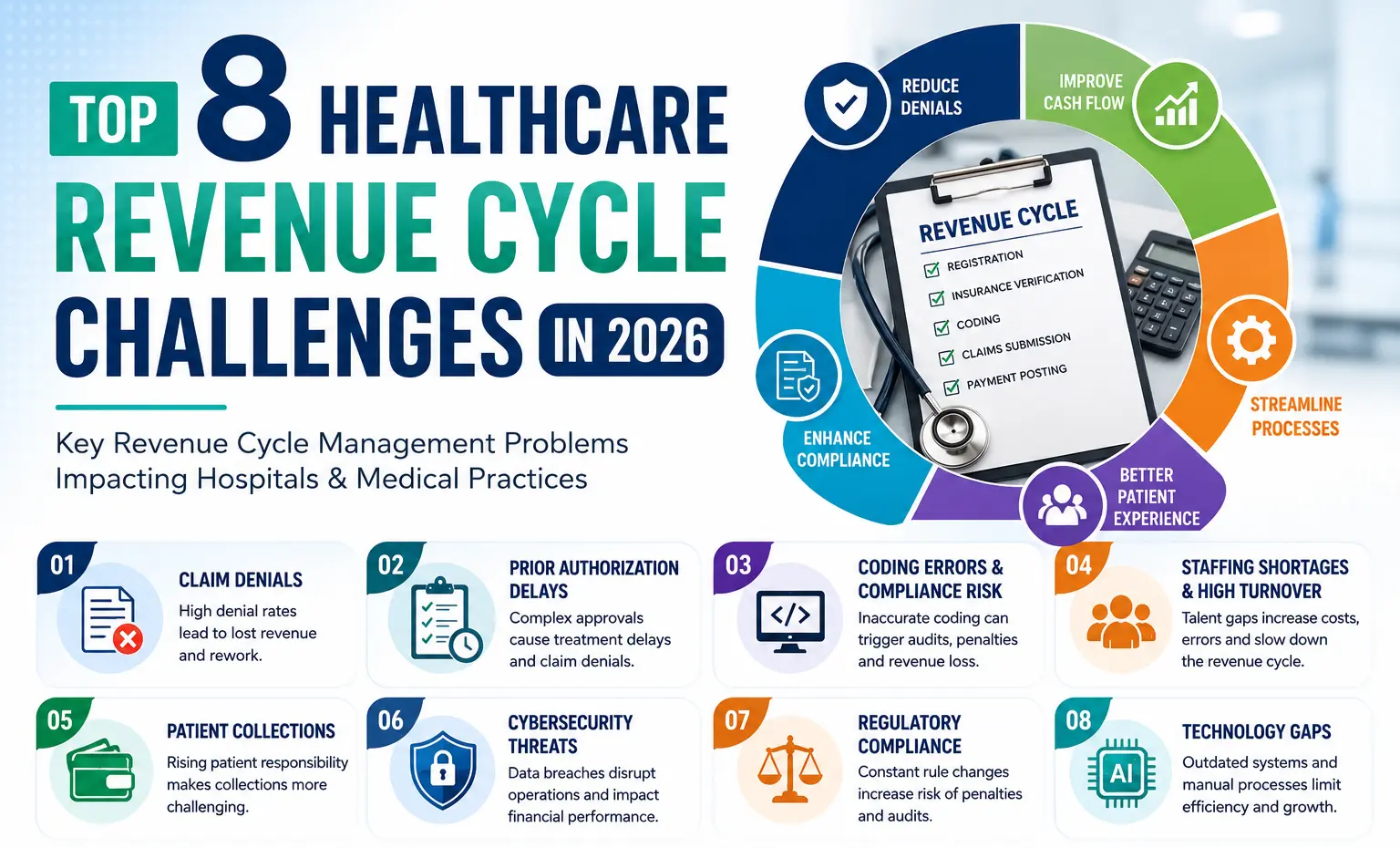
1. Claim Denials and Rising Denial Rates
If there is one revenue cycle challenge that keeps billing directors awake at night more than any other, it is claim denials. In 2024, initial denial rates hit 11.8% across the industry, a figure that represents an enormous amount of rework, write-offs, and wasted labor. MDaudit’s 2026 data paints an even grimmer picture: denied inpatient amounts climbed 12% year over year, while outpatient denied amounts jumped 14%.
These are not rounding errors. They are structural trends driven by payer behavior that shows no sign of reversing. Hospitals collectively spent $25.7 billion in 2023 just fighting denials, a number that reflects not only the cost of rework but the downstream impact on cash flow, staffing, and operational capacity.
What makes the denial problem so insidious is that it compounds invisibly. A denial that sits unworked for 30 days becomes exponentially harder to overturn. A pattern of denials rooted in coding errors or missing documentation gets repeated across thousands of claims before anyone identifies the root cause. And payers are not passive actors here. They have invested heavily in AI-driven pre-payment review tools that flag claims with remarkable precision, which means the days of approving borderline claims are largely over.
The actionable response is not simply to hire more denial management staff. It is to build a denial prevention infrastructure, which means tracking denial codes at a granular level, identifying patterns by payer and by provider, and intervening upstream in the documentation and coding process before claims leave the building. Providers who run weekly denial analytics reviews and share findings directly with clinical documentation improvement teams are seeing materially better denial rates than those who treat denials as a back-end billing problem.
2. Prior Authorization Delays and Complexity
Prior authorization has become one of the most operationally disruptive forces in modern healthcare. According to the 2024 MGMA survey, 89% of providers reported that prior authorization requirements increased compared to the prior year. That number has been climbing for nearly a decade, and there is still no plateau in sight. More troubling than the administrative burden is the clinical consequence: 94% of physicians report that prior authorization delays have directly resulted in patient care being delayed or abandoned. Patients who need an MRI, a biologic infusion, or an elective surgery are waiting not because beds or equipment are unavailable, but because a payer has not yet responded to a form request.
From a revenue cycle perspective, the damage is twofold. When prior auth is not obtained correctly before a service is rendered, the resulting claim denial is almost always unappealable. The service was provided without authorization, full stop. That means the revenue is gone entirely, not deferred. Beyond write-offs, the administrative cost of managing prior auth workflows at scale is significant. Many mid-sized practices have hired dedicated authorization specialists whose entire job is chasing payer portals, faxing documentation, and following up on pending requests. This is not a sustainable model.
The providers gaining ground here are those who have moved from reactive to proactive prior authorization management. Real-time eligibility checks integrated into the scheduling workflow, automated prior auth submission through payer APIs, and clinical decision support tools that flag auth requirements at the point of order are all measurably reducing both denials and delay. If your organization is still managing prior auth through manual fax-and-follow-up workflows, that is your single highest-leverage opportunity for immediate improvement.
3. Medical Coding Errors and Compliance Risk
Medical coding is where clinical documentation becomes financial reality, and the margin for error has never been smaller. The 2026 CPT code updates introduced 270 new codes, with revisions and deletions that require coders to retrain on a significant portion of their working vocabulary every single year.
Add to that the ongoing complexity of ICD-10, where specificity requirements demand that coders not only identify the correct condition but document the anatomical site, laterality, episode of care, and severity with precision, and you have a workforce that is constantly operating at the edge of its knowledge.
The most financially damaging coding errors are not random mistakes. They are systematic ones. Unbundling, which means billing component codes separately when a comprehensive code should be used, and upcoding, which means assigning a higher-acuity code than documentation supports, are the two error patterns that attract the most attention from payers and from the Office of Inspector General. Both can trigger extrapolated overpayment demands that run into the millions of dollars for large health systems, and both are frequently the result of outdated codebooks, undertrained staff, or production pressure that leads coders to default to habit rather than verify.
The actionable response here is systematic. Organizations that run concurrent coding audits, where a sample of charts is reviewed while the patient encounter is still relatively fresh, catch errors before they become patterns. Computer-assisted coding tools that suggest codes based on clinical documentation and flag potential compliance risks are increasingly table stakes, not luxury tools. And coding education should not be an annual event. Monthly feedback loops tied to payer-specific denial data are what separate compliant, high-performing coding departments from those that are one audit away from a significant compliance event.
4. Staffing Shortages and High Turnover
The RCM workforce crisis is real, and it is getting worse. According to Becker’s Healthcare, 60% of providers are currently facing significant hiring challenges in their revenue cycle departments. Turnover rates across RCM roles range from 11% to 40% depending on the position, with front-end registration and patient access roles experiencing the highest churn.
The financial cost of that turnover is staggering. When you factor in recruiting, onboarding, training, and the productivity gap while a new employee ramps up, replacing a single biller or coder can cost anywhere from $10,000 to $30,000. Multiply that across a department of 40 people with 25% annual turnover, and you are looking at a seven-figure operational problem that never appears as a line item in the revenue cycle budget.
The pandemic fundamentally reshaped the labor market for RCM professionals, and the aftershocks are still being felt. Contract labor costs increased 258% post-pandemic, meaning that organizations trying to plug staffing gaps with temporary workers are paying a massive premium while also accepting lower productivity and higher error rates from less-experienced temps who do not know the organization’s specific workflows and payer mix.
What the best-performing organizations have figured out is that retention is a revenue cycle strategy, not just an HR strategy. Career pathing, remote and hybrid flexibility, performance-based compensation tied to clean claim rates and denial recovery, and investment in training technology that makes coders and billers more effective at their jobs are all correlated with lower turnover in the RCM function. The organizations that treat their revenue cycle staff as a commodity will continue to lose them to competitors, to other industries, and to burnout.
5. Patient Payment Collection in High-Deductible Era
The patient is now effectively a third payer, and most revenue cycle operations were not built to handle that reality. Patient financial responsibility increased 11% from 2022 to 2024, driven by the continued proliferation of high-deductible health plans that shift a meaningful portion of the cost of care directly to individuals. For many patients, a single hospitalization or specialist visit now generates an out-of-pocket obligation that runs into the thousands of dollars, and collecting that balance after the fact is substantially harder than collecting from an insurance company.
The fundamental problem is behavioral economics. Patients who feel blindsided by a large bill after a care encounter are significantly less likely to pay than patients who understood their financial obligation before the service was rendered. And the longer the time between service and billing statement, the more that obligation feels abstract and disconnected from a healthcare experience the patient has already moved on from. Bad debt in the patient responsibility category has grown steadily as deductibles have risen, and many providers are writing off 30 to 40 cents of every dollar billed directly to patients.
The organizations that are succeeding in this environment have fundamentally redesigned their patient financial experience around transparency and timing. Real-time benefit checks that produce an accurate out-of-pocket estimate before the appointment, financial counseling conversations that happen at registration rather than after discharge, and payment plan options that are offered proactively rather than after a bill goes unpaid are all meaningfully improving collection rates. Collecting even a partial payment at the point of service dramatically increases the probability of collecting the remainder.
If claim denials, prior auth complexity, or patient collection challenges are hitting your organization harder than they should be, it may be time to get an outside perspective. Downloading a free denial prevention checklist or scheduling a no-obligation revenue cycle assessment can surface specific gaps you might not be seeing from the inside. Many providers are surprised by how quickly targeted changes move the needle.
6. Cybersecurity Threats and Data Breaches
No revenue cycle challenge in recent memory has been as sudden, as severe, or as clarifying as the Change Healthcare cyberattack. The total cost of that breach reached $2.457 billion, and 190 million patients had their protected health information compromised, making it the largest healthcare data breach in U.S. history. For months after the attack, thousands of providers across the country could not submit claims, could not receive remittances, and could not access eligibility data. Small practices with thin cash reserves were unable to make payroll. The revenue cycle, which most organizations had never thought of as infrastructure critical enough to warrant a disaster recovery plan, turned out to be exactly that.
The Change Healthcare breach was not an anomaly. In 2024, 92% of healthcare organizations reported experiencing a cyberattack, yet only 17% felt adequately protected, according to Deloitte research. That gap between exposure and preparedness is where catastrophic financial harm lives. Healthcare remains the most targeted industry for ransomware and data theft because patient data is extraordinarily valuable on the black market, and because healthcare organizations have historically underinvested in cybersecurity relative to the sensitivity of the systems they operate.
From a revenue cycle standpoint, the response requires treating cybersecurity as a revenue protection strategy. This means mapping every third-party vendor and clearinghouse that touches claim data, and building redundant claim submission pathways so that a single vendor outage cannot halt cash flow entirely.
It also means maintaining cash reserve targets that account for the possibility of a multi-week revenue disruption, and investing in cyber insurance policies that are actually sized to the organization’s revenue exposure. The question is not whether another major attack will occur. It is whether your organization will be recoverable when it does.
7. Regulatory Compliance and Payer Policy Changes
The regulatory environment governing healthcare billing has never been more complex or more consequential to get wrong. The No Surprises Act, which took full effect in 2022 and has been refined through ongoing rulemaking, fundamentally changed how providers bill patients for out-of-network services and how disputes with payers are adjudicated. CMS releases annual rule changes for every major program, from the Physician Fee Schedule to the Hospital Outpatient Prospective Payment System, and each update carries reimbursement implications that require revenue cycle teams to retrain and re-code before the effective date.
HIPAA continues to evolve as well, with HHS increasingly focused on enforcement actions related to improper disclosure of health information through tracking technologies embedded in patient-facing web portals. Several large health systems have paid significant settlements related to pixel tracking tools on scheduling pages, a compliance risk that many revenue cycle and marketing teams did not anticipate. Value-based care transitions add another layer of complexity, as the performance measures, attribution methodologies, and payment reconciliation timelines for alternative payment models require entirely different expertise than fee-for-service billing.
The organizations managing this environment most effectively have invested in dedicated regulatory intelligence functions, whether internal or through a trusted advisory relationship, that translate rulemaking into operational changes before deadlines arrive rather than after. They also maintain close communication between the compliance, clinical, and revenue cycle functions, so that when a payer changes a coverage policy mid-year or CMS releases a clarification, the impact on coding and billing practices is assessed and addressed systematically.
8. Technology Gaps and Legacy System Limitations
The technology gap in revenue cycle management is one of the most consequential paradoxes in healthcare administration. Despite widespread recognition that AI and automation can materially improve revenue cycle performance, adoption remains surprisingly low. Sixty-one percent of providers are still using manual claims processing, which is labor-intensive, error-prone, and increasingly noncompetitive. Meanwhile, only 14% of organizations are using AI tools to reduce denials, even though 67 to 70% of providers believe AI can help with that exact problem. The distance between belief and implementation is where hundreds of millions of dollars in avoidable losses accumulate.
Legacy electronic health record and practice management systems are a major contributor to this gap. Many health systems are running revenue cycle technology that was implemented 10 to 15 years ago, long before the current generation of AI-powered coding assistance, predictive denial analytics, and automated prior auth tools existed. Replacing those systems is expensive, disruptive, and politically complicated, so organizations patch them with workarounds and spreadsheets that create new inefficiencies while preventing adoption of better tools.
The actionable path forward does not always require a full system replacement. There is a growing ecosystem of revenue cycle technology that integrates with existing EHR platforms and adds AI-powered capabilities at the point of need: coding assistants that surface documentation gaps before a claim is submitted, denial prediction models that flag high-risk claims for pre-submission review, and patient payment propensity tools that help collectors prioritize their outreach based on likelihood to pay. Starting with one high-impact use case and building the internal competency to evaluate, implement, and manage AI tools is a more achievable path than waiting for a comprehensive system overhaul.
What the Top-Performing Organizations Are Doing Differently
The providers consistently outperforming their peers on revenue cycle metrics are not doing one big thing differently. They are doing a dozen smaller things with more discipline and more integration than their competitors.
They have moved denial management upstream, embedding coding specialists in clinical workflows who catch documentation gaps before a claim is ever generated. They are using near-shore outsourcing partners for specific functions like denial follow-up and payment posting, capturing labor cost savings of 30 to 50% compared to fully domestic staffing without sacrificing quality or compliance.
Their prior authorization workflows are increasingly automated, with systems that submit auth requests electronically through payer APIs and track pending authorizations with real-time status updates rather than phone-based follow-up. And they are using denial analytics platforms that surface root cause trends by payer, by provider, by procedure, and by denial code, so that every denial feeds intelligence back into the prevention side of the cycle rather than just the recovery side.
Strategy and data, working together, is the differentiator.
The Role of AI and Automation in Solving RCM Challenges
Artificial intelligence in revenue cycle management has moved meaningfully beyond pilot programs and proof-of-concept projects. Autonomous coding pilots, where AI assigns codes to clinical documentation with minimal or no human review, are currently underway at more than 30% of U.S. healthcare organizations.
The results are not uniform, but the best implementations are achieving accuracy rates that match or exceed human coders on high-volume, lower-complexity encounter types, freeing experienced coders to focus on complex cases where their expertise is genuinely needed. Mayo Clinic’s use of AI-powered automation in its revenue cycle operations has been widely cited as a benchmark, with reported savings of $700,000 attributed to AI bots handling repetitive, rules-based tasks that previously required dedicated staff time.
The honest assessment of AI in RCM is that it works best when it is narrowly targeted and well-implemented, not when it is bought as a platform and deployed broadly without clinical and operational integration. Denial prediction models, eligibility verification automation, and coding assistance tools have the strongest evidence base and the fastest return on investment. Natural language processing applied to clinical notes for coding and documentation improvement is maturing rapidly and offers significant upside for organizations willing to invest in the change management required to integrate it into clinical workflows. The 14% of providers currently using AI for denial management are not smarter than the other 86%. They simply got started.
If what you have read here resonates and you want to understand where your organization specifically stands, a free billing audit with an experienced RCM consultant can provide an objective baseline and a prioritized action plan. Most organizations discover two or three high-impact opportunities within the first conversation. The cost of not looking is always higher than the cost of finding out.
Conclusion
The revenue cycle challenges facing healthcare providers in 2026 are significant, but they are not insurmountable. The organizations navigating them most successfully share a common characteristic: they have stopped treating the revenue cycle as a back-office billing function and started treating it as a strategic asset that requires the same level of executive attention, data infrastructure, and continuous improvement discipline as clinical operations.
The stakes are quantifiable. Sixteen-point-three billion dollars in lost revenue from RCM inefficiencies is not a statistic to be absorbed passively. It is a call to action.
The single most actionable takeaway from two decades of working in this field is this: measure what you manage, and manage what matters. Start with your denial rate by payer, your clean claim rate, your days in accounts receivable, and your point-of-service collection rate. Those four metrics will tell you where your revenue cycle is losing, and they will point you toward the interventions that will actually move the needle. Everything else follows from that clarity.