

Snoring ICD-10 Code: When It’s More Than Just a Noise
According to the American Academy of Otolaryngology-Head and Neck Surgery, 45% of normal adults snore occasionally, and 25% are habitual snorers. Although snoring may seem benign, in clinical practice, it is often a red flag for underlying sleep-related pathology. Chronic snoring can be an early indicator of obstructive sleep apnea (OSA), upper airway resistance syndrome (UARS), or other conditions that compromise upper airway function and disrupt normal respiratory patterns during sleep.
Properly coding snoring-related symptoms is more than administrative, it’s a clinical and revenue-critical step. The ICD-10 code for snoring (R06.83) helps justify diagnostic testing, supports payer compliance, and bridges documentation to clean claim submission.
What You’ll Learn
In this blog, you’ll learn how to:
- Use the ICD-10 code for snoring (R06.83) accurately in clinical documentation and claim submission
- Differentiate between primary snoring and OSA using clinical and diagnostic indicators
- Link symptom coding with diagnostic testing such as PSG and HSAT
- Apply sleep disorder coding principles for both adult and pediatric patients
- Improve claim approval rates through precise documentation and correct code sequencing
What Is Snoring?
Snoring is the coarse or harsh sound produced by vibration of the upper airway tissues due to partial airway obstruction during sleep. It typically occurs when airflow is disrupted at the level of the soft palate, uvula, tongue base, or nasopharyngeal walls.
While occasional snoring may be benign, chronic or loud snoring is clinically significant and may indicate:
- Obstructive sleep apnea (OSA)
- Upper airway resistance syndrome (UARS)
- Enlarged tonsils or adenoids (especially in children)
- Nasal septum deviation, congestion, or polyps
- Obesity-induced pharyngeal narrowing
The presence of snoring, particularly when associated with symptoms like daytime fatigue, witnessed apneas, or nocturnal choking, warrants a comprehensive diagnostic evaluation. In such cases, ICD-10 code for snoring (R06.83) is assigned to support the medical necessity of sleep studies and specialist referrals.
What Is the ICD-10 Code for Snoring?
The ICD-10 code for snoring is R06.83 – Snoring, found under:
Chapter 18: Symptoms, signs and abnormal clinical and laboratory findings, not elsewhere classified (R00–R99).
This code is a symptom code, meaning it is not a definitive diagnosis but reflects a patient-reported or observed clinical sign that prompts further evaluation.
Use case:
When snoring is the primary complaint without an established diagnosis like OSA, R06.83 is used as a standalone or supporting code to document the condition and justify diagnostic procedures such as:
- Polysomnography (PSG)
- ENT referral
- Home sleep apnea testing (HSAT)
When to Use ICD-10 Code for Snoring (R06.83)
The ICD-10 code for snoring (R06.83) should be applied in the following contexts:
- Primary snoring (benign): The patient reports loud snoring without accompanying signs of sleep-disordered breathing or daytime fatigue.
- Initial workup phase: The patient is undergoing evaluation and diagnostic testing before confirming a condition like OSA.
- Chief complaint: Snoring is the main reason for the medical visit, especially relevant in pediatric cases where structural anomalies are common.
Note: Do not use R06.83 in cases where OSA (G47.33) has already been confirmed. It should not be used solely to document an incidental symptom.
Snoring vs. Obstructive Sleep Apnea: Coding Implications
Distinguishing primary snoring from OSA has direct implications on ICD-10 code selection:
| Criteria | Primary Snoring (R06.83) |
Obstructive Sleep Apnea (G47.33) |
|---|---|---|
| ICD-10 Code | R06.83 | G47.33 |
| Symptom severity | Mild to moderate | Moderate to severe with comorbidities |
| Associated symptoms | Absent | Present (e.g., fatigue, choking) |
| Diagnostic requirement | None required | PSG or HSAT mandatory |
| Typical management | ENT consult, lifestyle | CPAP, BiPAP, oral device |
| Risk profile | Low | High (cardiovascular/metabolic risk) |
Linking ICD-10 Code Snoring to Diagnostic Testing
Assigning R06.83 supports medical necessity for diagnostic services such as:
Polysomnography (PSG) – for full sleep analysis
HSAT (Home Sleep Apnea Test) – often payer-preferred for mild/moderate cases
ENT evaluation – to assess airway obstructions
CPAP titration or oral appliance trial – if clinically indicated
Example:
HPI: Patient reports loud nightly snoring noted by spouse. No witnessed apneas or excessive daytime sleepiness. BMI within normal range. Nasal turbinate hypertrophy observed.
Assessment: Likely primary snoring.
Plan: ENT referral + PSG ordered.
ICD-10 Code: R06.83
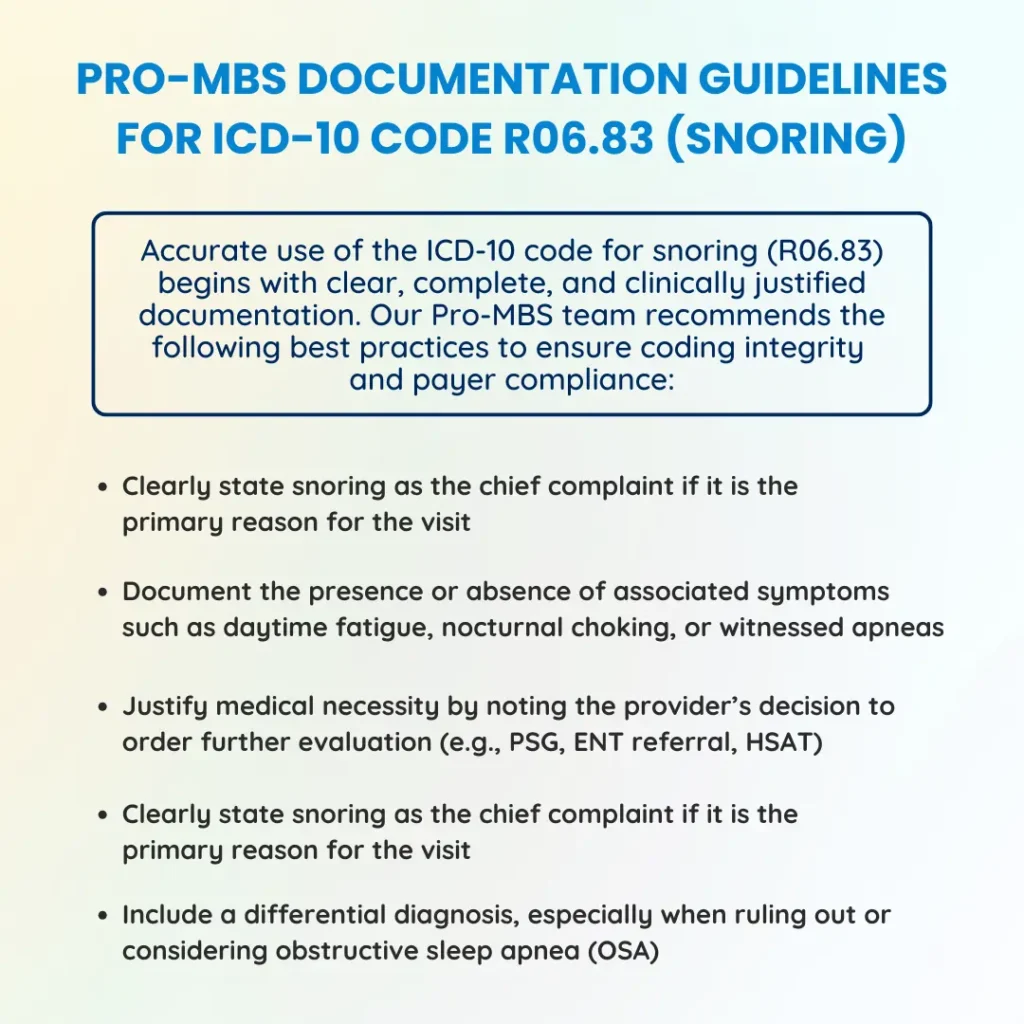
Pro-MBS Documentation Guidelines for ICD-10 Code R06.83 (Snoring)
Snoring in Pediatric Patients: Special Considerations
In children, ICD-10 code R06.83 is often part of an evaluation for:
- Enlarged adenoids/tonsils (e.g., J35.3)
- Nasal obstruction from allergies or structural issues
- Behavioral disorders potentially linked to poor sleep quality
Pediatric snoring is frequently associated with learning difficulties, delayed development, and attention disorders making early coding and referral critical. If OSA is later diagnosed via PSG, the code should be updated to G47.33 accordingly.
ICD-10 Code for Snoring in the Context of Sleep Disorder Coding
R06.83 fits into the early-phase diagnostic pathway of sleep disorder coding and is often paired with:
- Z13.89 – Encounter for screening for other disorder
- Z01.89 – Other special investigations
Use R06.83 in the Problem List, Assessment/Plan section, and as a supporting diagnosis code for testing authorization or payer justification.
Can R06.83 Be a Primary Diagnosis?
Yes. R06.83 can be used as a primary diagnosis code when:
- Snoring is the chief complaint
- There is no confirmed diagnosis of OSA or another sleep disorder
- The provider documents that snoring is the focus of the encounter
Avoid using it as the primary code if the visit is a follow-up for known sleep apnea or if snoring is a secondary concern.
How Pro-MBS Supports Accurate ICD-10 Sleep Disorder Coding
Our Pro-MBS team specializes in optimizing medical coding workflows for sleep-related conditions, including multi-symptom presentations like primary snoring and suspected obstructive sleep apnea (OSA). With advanced knowledge of payer-specific guidelines, ICD-10-CM coding policy, and EHR documentation standards, we help providers and billing teams ensure:
- Accurate application of ICD-10 code R06.83 based on clinical context
- Consistent and compliant documentation of snoring and sleep-disordered breathing
- Proper linkage between diagnostic codes, CPT procedures, and supporting documentation
- Fewer claim denials and a higher percentage of first-pass claim approvals