

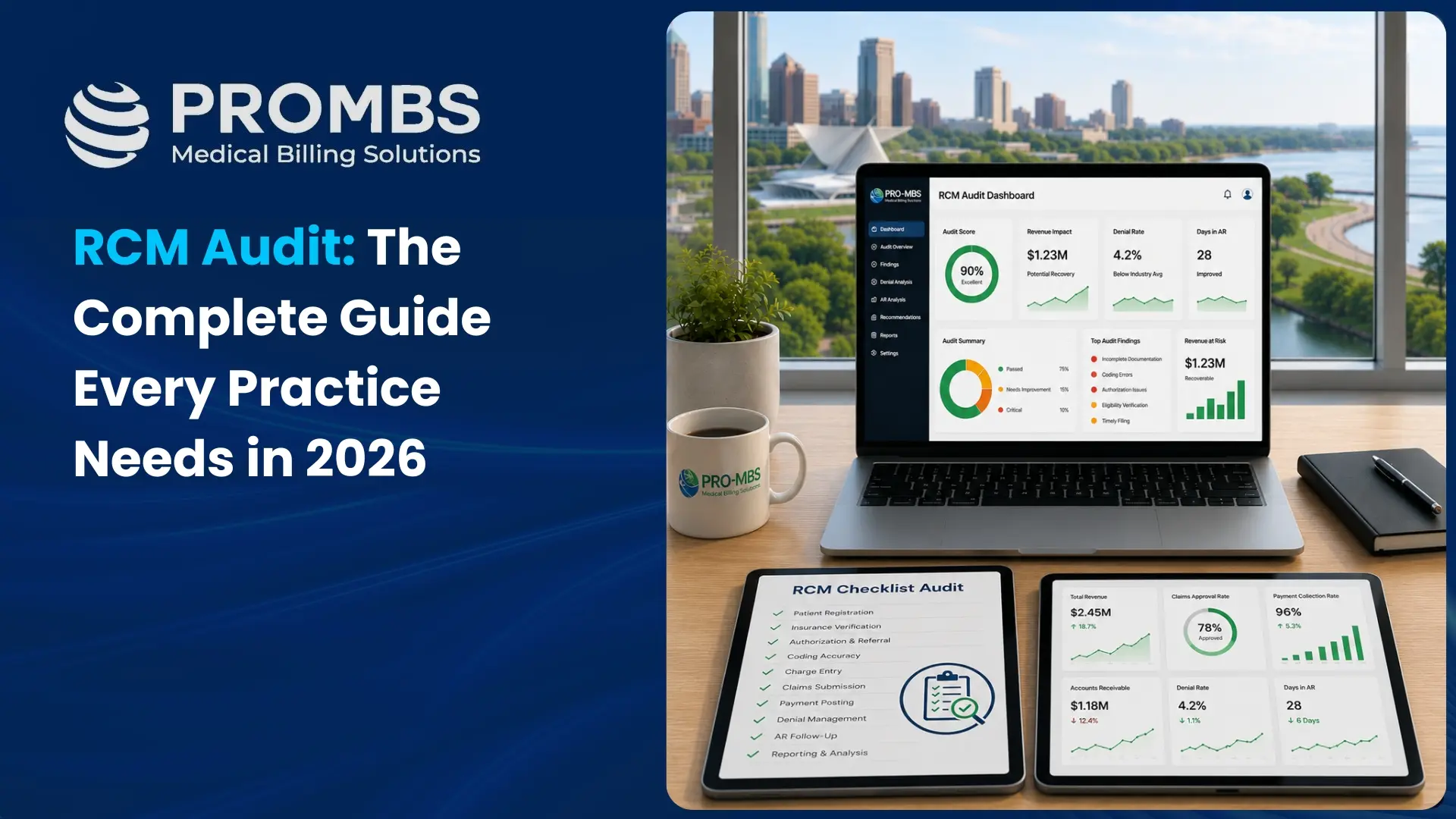
RCM Audit: The Complete Guide Every Practice Needs in 2026

RCM Audit The Complete Guide Every Practice Needs in 2026

An RCM audit, or revenue cycle management audit, is a structured review of a healthcare organization's billing, coding, claims submission, and collections processes to identify errors, compliance gaps, and revenue leakage. It examines every step from patient registration to final payment, benchmarking performance against payer rules and regulatory standards. The goal is simple: make sure the money you earned actually reaches your bank account.

If you run or manage a medical practice, a home health agency, or a multi-specialty group, this guide will walk you through everything, from what a thorough healthcare revenue cycle audit actually looks like to what you do after the findings come in.

Why RCM Audits Exist and What They Actually Catch

Most practices think their billing is running fine until an audit proves otherwise. The reality is that revenue cycle breakdowns are quiet. Denials accumulate. Underpayments go unnoticed. Coding patterns drift over time and nobody catches it until the numbers stop adding up.

A revenue cycle management audit exists to surface what the daily grind hides. It catches duplicate billing, missing charge capture, miscoded procedures, authorization failures, and payer underpayments that look routine but are actually eroding margin.

The Medical Group Management Association (MGMA) has consistently reported that physician practices lose between 5% and 10% of net revenue annually to billing inefficiencies. For a practice bringing in $3 million per year, that is between $150,000 and $300,000 walking out the door unnoticed.

The Real Cost of Skipping a Healthcare Billing Audit

Skipping an RCM audit is not a neutral decision. It is an active choice to leave problems in place.

According to the American Medical Association, claim denial rates average around 5% to 10% industry-wide, but practices without regular audits often see denial rates climbing above 15%. Every denied claim that is not worked costs roughly $25 in rework expenses, according to Healthcare Financial Management Association (HFMA) data. Scale that across thousands of claims per month and you start to see the damage.

Beyond revenue, there is compliance exposure. Upcoding, unbundling, and incorrect modifier use can trigger OIG investigations and False Claims Act liability. A missed HIPAA compliance gap in your billing workflow is not just a financial problem; it is a legal one.

The cost of an RCM audit is almost always less than a single month of undetected revenue leakage.

What a Complete RCM Audit Actually Covers

A thorough RCM audit does not just spot-check a few claims. It examines the entire revenue cycle from front to back, touching every handoff point where money can slip through.

Patient Access and Registration Review

This is where most denials begin. Auditors review whether eligibility verification is happening before every visit, whether prior authorization workflows are documented, and whether demographic data is being captured correctly at registration.

Common failures here include missing or expired insurance information, incomplete referral documentation, and authorization gaps for high-cost services. These front-end errors become back-end denials, sometimes 60 to 90 days later.

Charge Capture and Coding Accuracy

Charge capture audits compare what was documented in the clinical note to what was actually billed. Undercoding is just as much a problem as overcoding. A physician documenting a Level 4 visit who gets billed at Level 2 repeatedly is losing legitimate revenue.

Coding accuracy review includes CPT and ICD-10 code selection, modifier usage, bundling compliance, and alignment with CMS guidelines. This is where HIPAA compliance intersects directly with billing because improper code selection in certain contexts can constitute fraudulent billing.

Claims Submission and Denial Management

Auditors pull clean claim rates, first-pass resolution rates, and denial reason code distributions. A healthy clean claim rate sits above 95%. Practices operating below 90% have a systemic problem somewhere upstream.

Denial management review looks at whether denials are being appealed on time, whether appeal win rates are being tracked, and whether denial root causes are being addressed or just reactively managed claim by claim.

Accounts Receivable and Payer Compliance

Accounts receivable analysis looks at aging buckets. Days in A/R above 50 is a warning sign. Balances sitting in the 90-plus day bucket beyond 15% to 20% of total A/R indicate a collection problem that needs immediate attention.

Payer compliance review checks whether contracts are being followed, whether fee schedule rates match what is being collected, and whether underpayments from commercial payers are being identified and appealed.

Internal vs. External RCM Audit: Which One Do You Need?

This is one of the most practical decisions a practice faces and one that most guides skip over entirely.

Both approaches have real merit and real limitations. The right choice depends on your practice size, your tolerance for disruption, your compliance risk profile, and whether you have the internal expertise to self-evaluate honestly.

Factor Internal RCM Audit External RCM Audit
Cost Lower direct cost Higher upfront investment
Objectivity Risk of blind spots and bias Independent, unbiased findings
Speed Can start immediately Requires onboarding time
Depth of expertise Limited to internal team knowledge Specialized billing and compliance expertise
Staff disruption High, pulls team from daily work Lower, external team leads the process
Regulatory defensibility Weaker if challenged by payer or OIG Stronger documentation and legal standing
Follow-through Depends on internal accountability Typically includes formal report and action plan
Best for Routine monitoring, smaller practices Complex compliance issues, large groups, pre-OIG audit prep

The honest truth is that internal audits work well as regular checkpoints but often miss the subtler systemic problems. External RCM audits, done by a qualified firm, provide the kind of credible, documented findings that protect you if a payer or regulator ever comes calling.

Red Flags That Signal You Need an RCM Audit Right Now

You do not always need to wait for a scheduled review. Some situations demand immediate attention.

If your denial rate has jumped more than 3 percentage points in a 90-day period, something changed in your billing workflow and you need to find it fast. If you have recently gone through a physician departure, a practice management system migration, or an EHR upgrade, your billing processes need to be re-validated from scratch.

Other urgent red flags include:

  • A payer audit or RAC audit request has arrived
  • Your A/R days have increased 10 or more days over the past two quarters
  • You have seen a spike in write-offs that your team cannot explain
  • A new coder or billing vendor has been onboarded in the last six months
  • Patient complaints about billing accuracy or double charges are increasing
  • You are seeing unusual patterns in a specific payer's payment behavior
  • A departing billing employee handled collections solo with limited oversight

Any one of these signals warrants a targeted RCM audit. More than two at the same time calls for a comprehensive one.

How Payer-Specific Rules Shape Your Audit Strategy

One of the most overlooked elements in RCM audit planning is that payers do not play by the same rules. Medicare, Medicaid, and commercial insurers each have distinct documentation requirements, coding edits, and payment policies that affect what you audit and how.

Auditing for Medicare Compliance

Medicare audits demand a deep look at medical necessity documentation, LCD and NCD compliance, and proper use of advance beneficiary notices. Recovery Audit Contractors (RACs) and Targeted Probe and Educate (TPE) reviews are active programs, and practices without strong internal documentation controls are at higher risk. CMS publishes its audit focus areas annually, and aligning your internal audit strategy with those priorities is smart risk management. You can review current CMS audit priorities directly at CMS.gov.

Medicaid and State-Specific Requirements

Medicaid audits vary by state, which complicates things significantly for practices operating across state lines or serving diverse patient populations. Managed Medicaid plans add another layer because each plan may have different authorization and coding requirements layered on top of base state Medicaid rules.

Commercial Payer Audits and Contract Compliance

Commercial payers conduct their own audits and can request refunds for claims they retroactively determine were paid incorrectly. Reviewing your top five commercial payer contracts as part of an RCM audit, comparing contracted rates to what was actually paid, frequently uncovers underpayments ranging from 2% to 8% of collections from those payers.

Technology and AI in Modern RCM Audits

The way RCM audits get done has changed significantly in the past two years. Manual claim-by-claim review is being replaced or supplemented by AI-powered analytics platforms that can process millions of claims in the time it would take a human team to review hundreds.

Modern RCM audit technology does several things that were not possible even five years ago. It identifies statistical anomalies in coding patterns across entire physician panels. It flags claims that have a high probability of denial before submission based on payer-specific rules. It can compare your coding distribution against national benchmarks by specialty and flag outliers automatically.

Natural language processing tools can now read clinical notes and compare documentation to billing codes, identifying gaps in medical necessity support without requiring a coder to manually pull each chart.

For 2025 and 2026, AI-assisted RCM audits are not a luxury for large health systems. Platforms built for independent practices and mid-size groups have made this technology accessible at price points that make sense even for smaller organizations.

That said, technology does not replace judgment. AI tools are excellent at finding what to look at. Human expertise is still required to interpret findings, determine root cause, and build a remediation plan that actually sticks.

If you are evaluating billing partners who use these tools, the team at ProMBS works with AI-assisted audit technology as part of a comprehensive revenue cycle review process designed for practices of all sizes.

RCM Audit Checklist: What to Include in Your Review

A structured audit needs a structured checklist. Use this as your baseline and customize it based on your specialty, payer mix, and risk profile.

Front-End Checklist

  1. Verify that insurance eligibility is checked for 100% of scheduled patients at least 48 hours before the appointment
  2. Confirm that prior authorization workflows are documented and tracked in your PM system
  3. Review patient demographic capture accuracy by pulling a sample of 50 to 100 registration records and checking for errors
  4. Assess whether copay and deductible collection is happening at time of service consistently
  5. Evaluate whether referral documentation is complete and attached to the claim before submission

Mid-Cycle Checklist

  1. Pull a random sample of 30 to 50 claims per provider and compare documentation to billed codes
  2. Review charge capture lag time; anything beyond 48 hours from service to charge entry increases denial risk
  3. Check modifier usage across your top 20 CPT codes for appropriateness
  4. Confirm that your coding staff is working with current-year CPT and ICD-10 code sets
  5. Review any payer-specific coding edits or LCD requirements for your top diagnoses

Back-End Checklist

  1. Calculate and document your clean claim rate, first-pass resolution rate, and denial rate by payer
  2. Review denial reason code distribution and identify the top three root causes
  3. Check A/R aging; flag any balance over 90 days and review for collectibility or write-off appropriateness
  4. Confirm that all denied claims within appeal timelines are being actively worked
  5. Review underpayment identification process and verify it is catching contractual variances
  6. Audit your HIPAA compliance controls around billing data transmission and access permissions

How Often Should You Conduct an RCM Audit?

Audit frequency is not one-size-fits-all. It should reflect your practice's size, risk level, and operational complexity.

Small practices with one to three providers doing stable volume with a consistent payer mix: a full RCM audit annually with quarterly spot-checks on denial rates and A/R aging is usually sufficient.

Mid-size practices with four to ten providers or multiple locations: semi-annual audits are more appropriate, especially if you have had any staff turnover in billing, a payer contract renegotiation, or a coding change in your specialty.

Large groups and health systems: quarterly audits focused on different segments of the revenue cycle, plus continuous monitoring through analytics dashboards, is the industry standard. Anything less leaves too much runway for problems to compound before detection.

Any practice that bills Medicare or Medicaid at high volume should treat audit frequency as a compliance requirement, not just a best practice. The OIG's Compliance Program Guidance specifically recommends regular self-audits as a foundational element of any effective compliance program.

Common RCM Audit Mistakes That Undermine Results

Even well-intentioned audits fail when certain mistakes creep in. Knowing these in advance saves time and frustration.

The most common mistake is sampling too small. Reviewing 10 to 15 claims per provider and drawing sweeping conclusions is dangerous. Industry guidance generally recommends a minimum of 30 claims per provider for any finding to be statistically meaningful.

Another frequent mistake is auditing in isolation. RCM is a connected process, and looking at coding accuracy without also reviewing documentation quality, payer rules, and billing workflow produces findings that are technically accurate but practically incomplete.

Practices also tend to audit what is easy rather than what is risky. They review their highest-volume CPT codes but ignore the modifier-heavy services, the outlier diagnosis combinations, and the payer-specific billing rules that are actually generating denials.

Finally, doing an audit without a structured remediation plan is arguably worse than not doing one. Findings that sit in a spreadsheet without assigned ownership, deadlines, and follow-up verification are a liability, not an asset.

Ready for a Real
RCM Audit?

Get a no-obligation practice assessment and find out where your revenue cycle stands today at prombs.com.

Get Started Now

Post-Audit Action Plan: What to Do After Findings Come In

Step 1: Categorize findings by severity and financial impact. Not everything in an audit report needs immediate attention. Prioritize findings that represent compliance risk, high-dollar revenue recovery opportunity, or systemic process failures.

Step 2: Assign ownership. Every finding needs a named person responsible for remediation, not a department. Diffuse ownership is where action plans go to die.

Step 3: Set realistic timelines. Some fixes, like correcting a registration workflow, can happen in days. Others, like retraining a coder or renegotiating a payer contract, take weeks or months. Build a timeline that is aggressive but achievable.

Step 4: Implement corrective action and document it. Documentation matters here. If a payer or regulator asks later what you did in response to a finding, you need proof that you acted.

Step 5: Re-audit the specific areas flagged. A targeted re-audit 90 days after implementation verifies whether the fix actually worked. This step is skipped constantly and it is how practices end up with the same findings year after year.

Step 6: Update your policies and procedures. If the audit revealed a gap in your written billing policies, fix the policy, train the team on it, and document the training.

Post-Audit Action Plan: What to Do After Findings Come In

An audit without post-audit measurement is just an expensive exercise. These are the metrics that tell you whether your remediation is working.

  • Clean claim rate: Track monthly. Target above 95%. Any regression from your baseline after a process change needs immediate investigation.
  • First-pass resolution rate: Should be above 90% for a healthy revenue cycle. This measures how many claims are paid on the first submission without rework.
  • Denial rate by payer: Segment this. A 12% denial rate from Medicaid means something different than a 12% denial rate from your largest commercial payer.
  • Days in A/R: Track by payer and overall. Post-audit, you should see this trending downward within 60 to 90 days if front-end fixes are working.
  • Accounts receivable over 90 days as a percentage of total A/R: A healthy benchmark is under 15% to 20%.
  • Appeal win rate: If your team is appealing denials but winning less than 50% of those appeals, the issue may be documentation quality, not payer behavior.
  • Net collection rate: This is your ultimate efficiency metric. Net collection rate measures what you actually collected against what you were contractually allowed to collect. A healthy net collection rate is above 96%.

Track these monthly for at least six months post-audit. Give your changes time to work, but do not give them so much time that a backslide goes unaddressed.

For practices looking to benchmark their performance against national standards, HFMA publishes industry benchmarks on key revenue cycle metrics that are worth reviewing annually.

HIPAA Compliance and Regulatory Considerations in Every Audit

HIPAA is not just a data security framework. Its requirements touch billing workflows directly, and a thorough RCM audit must address them explicitly.

Billing data flows through more systems than most practice managers realize: EHR platforms, practice management systems, clearinghouses, patient portals, third-party billing vendors, and payment processors. Each connection is a potential compliance gap.

Your RCM audit should verify that your Business Associate Agreements (BAAs) are current with every vendor who touches Protected Health Information (PHI) in the billing process. It should review access controls for your billing staff and confirm that permissions are appropriately scoped. Billing employees should only have access to the data they need to do their specific job.

It should also look at your minimum necessary standard compliance in claims submission and confirm that data transmission between systems meets current HIPAA Security Rule technical safeguard requirements.

These are not checkbox items. They are the kind of gaps that become expensive problems when a breach or an audit focuses attention on your billing operations.

Medical Billing Compliance & Revenue Protection

If your last audit turned up HIPAA concerns or revenue gaps, PROMB specialists can help build a sustainable program.

Explore Our Audit Services

Building an RCM Audit Program That Lasts

A one-time audit has value. An ongoing audit program has transformational value.

The practices that consistently achieve net collection rates above 97%, maintain denial rates below 5%, and pass payer audits without scrambling all have one thing in common: they treat RCM oversight as an operational discipline, not an emergency response.

Building a sustainable program means scheduling audits in advance and protecting the time, assigning someone internally with ownership of revenue cycle performance, using technology to monitor the metrics between audits, and building a culture where billing accuracy is treated as a clinical-quality issue, not an administrative one.

The return on that investment is not abstract. It shows up in the revenue that stops leaking, the compliance problems that get caught before they escalate, and the practice finances that give you the stability to focus on what you actually trained to do.

FAQ

Q: What is an RCM audit?

An RCM audit, or revenue cycle management audit, is a comprehensive review of a healthcare organization's billing, coding, claims submission, and collections processes. It identifies revenue leakage, compliance gaps, coding errors, and process inefficiencies. The goal is to ensure that every eligible dollar is billed correctly, collected promptly, and that the practice remains compliant with payer and regulatory requirements.

Q: How often should an RCM audit be done?

Small practices with one to three providers should conduct a full audit annually with quarterly spot-checks. Mid-size practices with four to ten providers benefit from semi-annual audits. Large groups and health systems should audit quarterly and use continuous monitoring dashboards in between. Practices billing Medicare or Medicaid at high volume should treat regular self-audits as a compliance program requirement.

Q: What does an RCM audit include?

A complete RCM audit covers patient registration and eligibility verification, prior authorization workflows, charge capture accuracy, coding and documentation compliance, claims submission and clean claim rates, denial management processes, accounts receivable aging, payer underpayment identification, and HIPAA compliance controls across billing workflows. The scope should be customized based on payer mix and specialty.

Q: How long does an RCM audit take?

A targeted audit focused on one segment of the revenue cycle can take one to two weeks. A comprehensive revenue cycle management audit covering the full billing process typically takes three to six weeks depending on practice size, data volume, and whether internal staff or external auditors are leading the review. Post-audit remediation planning adds additional time.

Q: What is the difference between an internal and external RCM audit?

An internal RCM audit is conducted by your own billing staff or management team. It costs less but carries risk of blind spots and bias. An external RCM audit is conducted by an independent billing and compliance specialist. It provides greater objectivity, specialized expertise, and produces documentation that carries more weight with payers and regulators. External audits are typically recommended for compliance-sensitive situations, large practices, or when preparing for a payer audit.

Q: What happens after an RCM audit?

After an RCM audit, findings should be categorized by severity and financial impact, assigned to named owners, and addressed according to a documented remediation plan with deadlines. Corrective actions should be implemented and documented. A targeted re-audit 90 days later should verify that fixes are holding. Post-audit KPIs including clean claim rate, denial rate, days in A/R, and net collection rate should be tracked monthly for at least six months to measure improvement.

× Billing Audit

Get a Free Billing & Coding Audit Now