

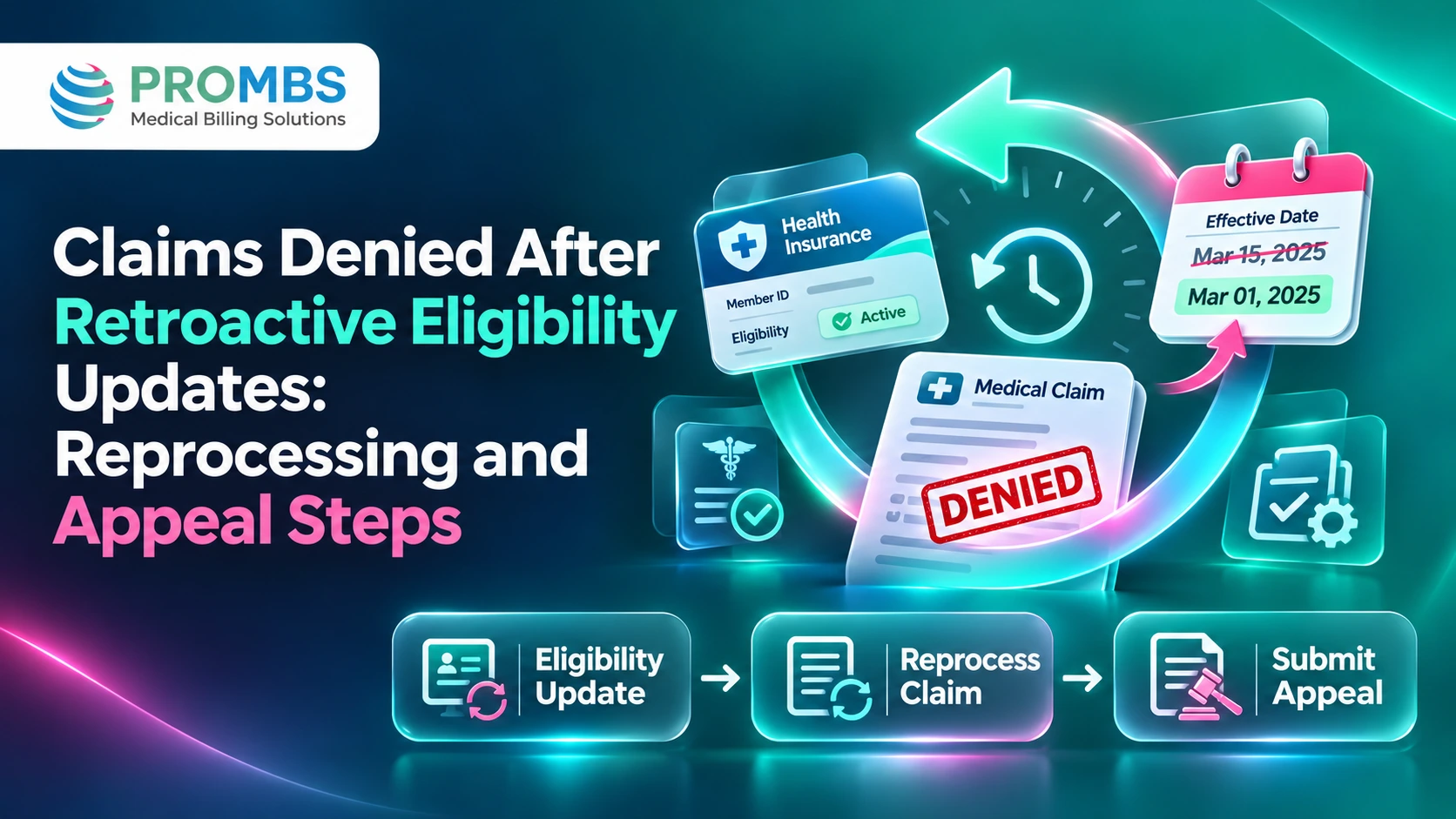
A medical claim can pass eligibility verification on the date of service and still be denied weeks later. The patient appeared to have active insurance, the provider delivered covered services, and the billing team submitted the claim using the available information. Then the payer updated its eligibility records, leaving the claim denied, adjusted, or even reversed after payment.
Retroactive eligibility denials occur when a payer’s revised coverage information affects a claim for a previous date of service. These changes may involve delayed Medicaid enrollment, corrected coverage dates, retroactive policy termination, or coordination of benefits (COB) updates.
For medical billing teams, the difficulty is determining whether the payer’s revised records justify the denial or whether the claim should be reviewed again.
The appropriate response is to verify coverage for the original date of service, identify the reason for the eligibility change, review the claim’s adjudication history, and determine whether reprocessing, correction, reconsideration, or an appeal is appropriate.
Resubmitting a claim without identifying the underlying problem can produce another denial, create a duplicate submission, or complicate an existing payment adjustment.
What Are Retroactive Eligibility Denials?
Retroactive eligibility denials are medical claim denials or payment adjustments caused by changes to a patient’s insurance eligibility records that apply to an earlier period.
Unlike a straightforward eligibility denial, where the payer indicates that coverage was inactive when the claim was first processed, a retroactive denial involves information that has changed or become available after the relevant service date.
Consider an outpatient visit on March 12. The practice verifies the patient’s insurance before treatment, receives an active coverage response, and submits a $1,250 claim.
On April 20, the insurer updates the member’s termination date to February 28. When the claim is adjudicated or subsequently reviewed, the payer may determine that coverage was not active on March 12.
The billing team must now investigate whether the revised termination date is accurate, whether another policy covers the service, and whether a dispute is appropriate.
How Retroactive Eligibility Changes Affect Medical Claims
A retroactive update can affect several stages of the revenue cycle.
If the update occurs before adjudication, the claim may be denied based on the newly recorded eligibility period. If the update occurs after payment, the payer may adjust or reverse the original determination and initiate recovery of an alleged overpayment.
The financial consequences can extend beyond the denied claim amount. A practice may need to reconcile previous payment postings, investigate contractual adjustments, communicate with another insurer, or suspend patient billing while the coverage dispute is evaluated.
However, an updated eligibility record does not automatically establish that a payer’s denial or recoupment is valid. The billing team must evaluate applicable coverage provisions, payer contracts, program requirements, and available supporting evidence.
Retroactive Coverage Approval vs. Retroactive Coverage Termination
Two distinct situations frequently create confusion.
Retroactive coverage approval occurs when a payer or government program establishes eligibility for an earlier period. For example, a patient may receive Medicaid approval after obtaining treatment, with an effective coverage date that includes the date of service.
In this situation, a claim previously denied for inactive coverage may become eligible for submission or reprocessing, subject to applicable requirements.
Retroactive coverage termination occurs when an insurer revises its records to show that coverage ended before the date of service. A claim that initially appeared payable may then be denied or adjusted.
These situations require different investigations. Retroactive approval generally involves proving that coverage applies to the service date. Retroactive termination requires examining the validity of the revised end date, possible alternative coverage, and any restrictions on claim reversals.
Initial Eligibility Denials vs. Reversals of Previously Paid Claims
An initial denial and a payment reversal should not be handled as identical billing events.
With an initial denial, the payer has adjudicated the claim without issuing the expected payment. The team must establish why the claim was not payable under the information used during adjudication.
A payment reversal involves an earlier adjudication that the payer subsequently changes. The provider may receive an adjustment notice, an overpayment demand, or a deduction from a future payment.
For previously paid claims, the investigation must include the original payment, subsequent adjustment transactions, and the payer’s stated basis for recovery.
The distinction is important because claim reprocessing and payment recoupment can involve different contractual, regulatory, and procedural requirements.
Why Do Claims Get Denied After Retroactive Eligibility Updates?
Several administrative and coverage-related events can change the eligibility information used to adjudicate a medical claim. Identifying the precise event is essential before selecting the next billing action.
Coverage Effective Dates Are Corrected After Treatment
Insurance enrollment records sometimes contain incorrect or incomplete effective dates.
An employer may submit enrollment information late, an insurer may correct a data-entry error, or an eligibility file may not reflect a recently approved coverage change.
For example, a patient’s new insurance policy should have become effective April 1, but the payer’s system initially lists May 1. The practice provides treatment on April 15 and receives a denial indicating that expenses occurred before coverage began.
If the insurer later corrects the effective date to April 1, the billing team may have grounds to request reconsideration or reprocessing using the corrected eligibility information.
The key evidence is the authoritative coverage record showing eligibility for the date of service, not simply the patient’s insurance card or verbal statement.
Retroactive Medicaid Approval Changes the Original Eligibility Record
Retroactive Medicaid eligibility is an important consideration for hospitals, physician practices, and providers treating patients who are awaiting coverage determinations.
A patient may receive medical services before Medicaid approval and subsequently qualify for coverage for an earlier period.
Under Medicaid rules applicable in November 2026, retroactive coverage may extend up to three months before the application month when eligibility requirements are satisfied, subject to applicable state provisions and exceptions.
A significant federal change takes effect for applications made on or after January 1, 2027. Under Section 71112 of Public Law 119-21, the retroactive period is reduced to one month for the Medicaid adult expansion group and two months for other Medicaid eligibility groups.
These changes make accurate application dates, eligibility periods, and state-specific guidance particularly important.
Source: Centers for Medicare & Medicaid Services, Medicaid eligibility policy and CMS guidance on the 2027 Medicaid changes.
A retroactive Medicaid approval does not mean every previously denied claim becomes payable automatically. The provider still needs to verify the applicable delivery system, billing requirements, covered services, authorization provisions, and claim filing limits.
Insurance Termination or Enrollment Corrections Affect Past Services
Commercial insurance eligibility may change when an insurer receives corrected employment, enrollment, premium, or administrative information.
Suppose a patient receives treatment on June 18, when the practice’s eligibility response indicates active coverage. In July, the payer changes the policy termination date to May 31.
The claim may be denied or adjusted because the updated record places the service outside the coverage period.
Before accepting that decision, the practice should investigate whether the termination was processed correctly and whether the original eligibility response, coverage notices, or plan documents support a different conclusion.
A prior eligibility confirmation is useful evidence of what the practice was told, but it is not necessarily a guarantee of payment.
Coordination of Benefits Changes the Responsible Payer
Another common source of eligibility-related denials is a retroactive change in the patient’s primary or secondary coverage.
For example, a claim may originally be submitted to a commercial insurer listed as primary. Later, the payer identifies another policy that may have been primary for the date of service.
The original insurer may then deny or adjust the claim based on coordination of benefits.
The billing team should verify:
- The coverage periods of all potentially responsible payers.
- The applicable primary and secondary payer order.
- Whether the original payer processed or reversed the claim.
- Whether the responsible payer requires the previous insurer’s explanation of benefits.
A COB update is not necessarily proof that the original coverage was inactive. It may mean that another insurer should adjudicate the claim first.
This distinction helps prevent unnecessary eligibility appeals when the underlying issue is payer sequencing.
Missing Authorization or Filing Deadlines Create Secondary Denials
A retroactive coverage correction may resolve the original eligibility issue while exposing another claim-processing problem.
For example, a payer may recognize that the patient was covered on the service date but still deny payment because the claim lacks required authorization.
Similarly, a billing team may learn about approved retroactive eligibility after the ordinary claim filing period has passed.
These situations require separate investigation. Coverage validity, authorization requirements, and timely filing compliance are distinct considerations.
Some programs and plans provide specific processes for claims affected by delayed eligibility determinations, but those provisions are not universal. Retroactive coverage does not automatically waive authorization or timely filing requirements.
How to Identify a Retroactive Eligibility Denial
The first step in managing these denials is establishing exactly what changed between the date of service and the payer’s adjudication decision.
Medical billing teams should avoid relying on a single eligibility screen or denial code. A reliable investigation compares historical coverage information, claim records, and payer communications.
Review the Original and Updated Eligibility Responses
Start with the eligibility verification performed before treatment or before the original claim submission.
Under HIPAA electronic transaction standards, the 270 transaction is used to request eligibility and benefits information, while the 271 response communicates the payer’s available eligibility and coverage information.
These transactions provide useful documentation of the information available during the billing process.
CMS explains these standards in its Health Plan Eligibility Benefit Inquiry and Response guidance.
Compare the original response with the current payer record. Look for changes in the member identification number, effective dates, coverage status, plan assignment, and benefit information.
If a payer representative confirms an eligibility correction, document the representative’s name or identifier, the conversation date, the reference number, and the specific coverage period discussed.
An eligibility response retrieved today may not reveal what the payer’s system displayed when the original service was provided. Preserving historical verification records is therefore valuable.
Compare Service Dates, Enrollment Dates, and Termination Dates
Eligibility discrepancies often become clear when the billing team places the relevant dates in chronological order.
Consider this example:
Claim investigation example
- Date of service: August 14, 2026
- Original eligibility response: Active
- Original claim submission: August 19, 2026
- Updated termination date: July 31, 2026
- Denial received: September 8, 2026
The revised termination date indicates that coverage may not have been active when the service occurred.
However, the investigation is incomplete until the team establishes why the date changed and whether the updated record is correct.
A useful approach is to maintain both the service timeline and the eligibility-change timeline. The former shows when treatment and billing occurred. The latter shows when enrollment information was entered, corrected, or communicated.
This separation helps identify whether the discrepancy originated with the provider, the payer, an employer, a government eligibility agency, or another administrative source.
Interpret ERA and EOB Adjustment Codes
The electronic remittance advice (ERA) and explanation of benefits (EOB) can help identify how the payer classified the problem.
Claim Adjustment Reason Codes (CARCs) explain why a payer adjusted payment, while Remittance Advice Remark Codes (RARCs) may supply additional detail.
Common CARCs relevant to these investigations include:
| CARC | Official meaning, summarized | Initial investigation |
|---|---|---|
| 26 | Expenses incurred before coverage began | Verify the effective date |
| 27 | Expenses incurred after coverage terminated | Review termination history |
| 22 | Another payer may be responsible under COB | Confirm payer priority |
| 29 | The claim filing time limit expired | Review filing evidence and exceptions |
| 197 | Required authorization or notification was absent | Review authorization requirements |
Source: X12 Claim Adjustment Reason Codes.
These codes are diagnostic starting points, not complete explanations of why the patient’s eligibility changed.
For example, CARC 27 identifies a coverage termination problem but does not establish whether the termination date was validly applied or whether an appeal is available.
Billing teams should also review the associated claim adjustment group code. CO generally indicates a contractual obligation, while PR identifies patient responsibility. Other group codes may indicate different types of adjustments.
Importantly, the assignment of a remittance code should not be used as the sole basis for transferring a disputed balance to the patient. Applicable program rules, payer contracts, and patient billing protections must also be considered.
Determine Whether the Claim Was Denied, Rejected, Adjusted, or Recouped
The claim’s processing status determines which records must be investigated.
A rejected claim has encountered a submission or processing problem and may not have entered final adjudication. A denied claim has generally undergone adjudication, resulting in a determination not to pay some or all billed services.
An adjusted claim involves a change to an earlier adjudication. A recoupment involves recovery of a payment that the payer considers excessive or improper.
For electronic claims, a 277CA acknowledgment can help establish whether the payer accepted the claim for processing. The 835 remittance transaction provides adjudication and payment-adjustment information.
A previously paid claim that is later reversed requires a different accounting review from a claim rejected before processing.
Before attempting another submission, confirm whether the original claim is already in the payer’s system and whether a pending adjustment or recovery transaction exists.
What Documentation Should Be Collected Before Reprocessing?
A successful investigation depends on having records that connect the patient’s coverage history to the original claim and the payer’s subsequent decision.
An organized documentation package also allows another billing specialist or appeals representative to understand the case without repeating the entire investigation.
Original Eligibility Verification and Payer Reference Numbers
Preserve the eligibility response obtained before treatment, including the verification date, member information, coverage dates, and any available transaction or reference numbers.
When available, retain the actual eligibility response or an archived report rather than only a note stating that insurance was active.
If eligibility was verified by telephone, preserve the representative’s identification, reference number, and summary of the information provided.
These records can help establish the sequence of events even when they do not independently establish a contractual obligation to pay.
Coverage Change Notices and Eligibility Determination Records
When a payer retroactively modifies coverage, request or locate documentation supporting the updated eligibility period.
Depending on the situation, relevant evidence may include an insurer’s enrollment correction, a Medicaid eligibility determination, a coverage termination notice, or information supplied by an employer or plan administrator.
The objective is to identify the authoritative record that governs coverage for the date of service.
For Medicaid claims, verify the eligibility period through the appropriate state system and determine whether the patient was enrolled in fee-for-service Medicaid or a managed care arrangement for that period.
Original Claim, Remittance Advice, and Submission Acknowledgment
Keep the original claim data together with the clearinghouse acknowledgment, payer acceptance information, and any remittance or denial notices.
The claim package should establish what was billed, when the payer received it, and how the payer processed it.
The original payer claim control number is especially useful when requesting review of a previously adjudicated claim. If the payer adjusted the claim more than once, retain the adjustment history rather than replacing the earlier remittance records.
For paid claims that were later reversed, preserve the payment posting information so that any subsequent financial reconciliation can be completed accurately.
Authorization Records and Proof of Timely Filing
Eligibility changes can create disputes involving authorization or submission deadlines, making these records essential.
Retain applicable authorization approvals, authorization request dates, medical necessity documentation, and communication concerning retrospective review.
Proof of timely filing may include an accepted electronic submission acknowledgment, a payer claim receipt, or another form of documentation recognized under the applicable payer rules.
A clearinghouse submission timestamp alone may not satisfy every payer’s definition of timely filing. The documentation must establish the receipt or acceptance event required by the particular program or contract.
Before moving the claim to reprocessing, the billing team should be able to answer four questions:
- Was the patient eligible for the disputed date of service under the applicable coverage record?
- Why did the payer’s eligibility information change?
- What exactly happened to the original claim during adjudication?
- Which documentation supports the next requested action?
If one of these answers remains uncertain, further investigation may be more appropriate than immediate resubmission.
Establishing the Correct Next Step
Retroactive eligibility denials should not be worked as routine eligibility errors until the underlying coverage change has been confirmed.
A corrected effective date may support reprocessing. An inaccurate claim submission may require correction. A disputed termination or adverse adjudication may require reconsideration or an appeal, depending on the payer’s procedures.
For practices managing large volumes of eligibility-related denials, consistent documentation and clear account notes are essential to effective revenue cycle management.
lish whether the patient has coverage today. The billing team must determine whether the applicable coverage was active for the specific date when services were performed.
Verify the member ID, coverage effective date, termination date, benefit plan, and applicable coverage category.
For a claim involving services from multiple dates, review the eligibility period for each service date. A policy change occurring during a treatment episode may affect individual claim lines differently.
If the payer’s online portal continues to show inconsistent information, contact provider services and request confirmation of the historical coverage period.
For instance, a patient may have received treatment on May 10 while the payer initially listed coverage beginning June 1. Following an enrollment correction, the effective date changes to May 1.
The revised record now supports further review of the May 10 claim.
Record when the correction became visible, the source of the information, and any payer reference number. These details help establish the basis for requesting another adjudication.
Step 2: Confirm the Correct Payer and Coordination of Benefits
A retroactive eligibility update does not always mean the original insurer should pay.
Sometimes the revised information indicates that another insurance policy was primary on the date of service. This can happen when employer-sponsored coverage, Medicare eligibility, Medicaid enrollment, or other health insurance information changes.
Before requesting reprocessing, determine which payer was responsible under the applicable coordination of benefits rules.
For example, a patient may have two commercial policies, with the first originally treated as primary. A later COB correction could establish that the second policy should have processed the claim first.
In that situation, asking the original insurer to reconsider the claim without correcting the payer sequence may not resolve the denial.
Billing teams should confirm the correct payer order, whether another insurer has already adjudicated the services, and whether a primary payer EOB is required for secondary submission.
When Medicare is involved, apply the appropriate Medicare Secondary Payer rules rather than assuming Medicare is always primary.
The goal is to establish responsibility for adjudication before choosing where to send the claim.
Step 3: Review the Original Denial and Claim Adjudication History
Once eligibility and payer responsibility are confirmed, examine the claim’s existing processing history.
Review the original submission, payer claim control number, denial reason, remittance advice, and any subsequent adjustment transactions.
An eligibility-related denial may appear straightforward, but another issue could prevent payment even after the coverage record is corrected.
For example, the original remittance might show CARC 27, indicating expenses incurred after coverage terminated. A later review could establish that the termination date was inaccurate.
However, the claim may also contain a separate coding, authorization, or benefit limitation issue that must be addressed.
If the payer has already initiated an adjustment, determine whether that transaction is pending or finalized before creating another submission.
Contact the payer when the claim history is unclear and ask whether the existing claim can be reopened or reprocessed.
Document the representative’s explanation, claim reference number, and any instructions provided.
This step prevents a common billing mistake: treating every retroactive eligibility denial as a reason to submit a brand-new claim.
Step 4: Check Filing Limits and Retroactive Eligibility Provisions
Timely filing is one of the most important considerations when reprocessing claims affected by retroactive eligibility changes.
A payer may recognize corrected coverage but still require the provider to satisfy an original filing deadline, corrected claim deadline, reconsideration period, or formal appeal deadline.
These timeframes are not interchangeable.
For commercial insurance, consult the applicable provider agreement, payer manual, and plan-specific dispute requirements.
For Medicaid, review the relevant state program and managed care requirements.
Texas Medicaid provides a useful example. Under the November 2026 Texas Medicaid Provider Procedures Manual, claims involving retroactive eligibility generally must meet a 95-day period measured from the date eligibility was added to the state’s file, along with the applicable 365-day date-of-service requirement. Specific provisions allow consideration of claims supported by evidence of an earlier timely submission.
This does not create a universal 95-day rule for other Medicaid programs.
Source: Texas Medicaid Provider Procedures Manual, Claims Filing.
Medicare fee-for-service generally requires claims to be filed within one calendar year after the date of service. Certain exceptions under 42 CFR § 424.44 include qualifying retroactive Medicare entitlement situations.
These exceptions have specific conditions and do not apply automatically whenever another insurer changes eligibility information.
Source: Medicaid.gov, Medicare Timely Filing Exceptions.
When a filing deadline is approaching, the billing team should determine the appropriate submission or dispute method promptly rather than waiting for an informal payer inquiry to be resolved.
Step 5: Resolve Authorization and Missing-Documentation Issues
After confirming that coverage applies to the service date, evaluate whether authorization or other documentation requirements remain outstanding.
Retroactive eligibility may create a situation in which the provider could not obtain ordinary advance authorization because the patient was not yet enrolled or the payer had not updated its records.
Some Medicaid programs establish procedures for retrospective authorization in these circumstances.
However, retrospective approval is not universally available, and it does not necessarily eliminate medical necessity review.
For services requiring authorization, verify whether the payer permits retrospective review, what documentation must accompany the request, and whether authorization must be resolved before claim submission.
The supporting clinical records should accurately establish the services performed, their dates, and the medical necessity information required by the payer.
Do not modify service dates or clinical documentation to make a claim fit an authorization period.
If the payer confirms that authorization is unnecessary for the particular service and coverage arrangement, preserve that determination in the account notes.
A complete review helps prevent the initial eligibility denial from being replaced by an avoidable authorization denial.
Step 6: Request Reprocessing or Submit the Appropriate Claim Correction
With the eligibility information and filing requirements confirmed, choose the payer’s approved resolution method.
When the original claim was accurate but adjudicated using an outdated eligibility record, ask the payer whether it can reprocess the existing claim.
Provide the original claim control number, date of service, corrected coverage period, and supporting eligibility reference.
If the payer agrees to reopen the claim, record the request number and expected next action.
When claim data was incorrect, the payer may instead require a corrected claim.
For electronic professional and institutional claims, claim frequency code 7 commonly identifies a replacement claim, while code 8 identifies a void or cancellation. Replacement claims generally require the original payer claim control number in the appropriate field.
For example, University of Utah Health Plans instructs providers submitting electronic corrected claims to use the appropriate CLM05-3 frequency code and the original claim number in REF*F8.
Source: University of Utah Health Plans, Corrected Claim Instructions.
These electronic standards do not mean every payer accepts the same correction workflow for every denial type.
A replacement claim should not be used merely because a payer needs to reconsider its own eligibility record.
Similarly, submitting another original claim while the first is still active can generate duplicate claim denials.
Confirm the payer’s required method before submitting the transaction.
Step 7: Track the Claim Through Adjudication and Payment Posting
Submitting the reprocessing request does not complete the claim resolution process.
The account should remain in an active follow-up status until the payer issues a determination and the billing team verifies the resulting transactions.
Track the request date, payer reference number, current processing status, next follow-up date, and any additional documentation requested.
When the payer processes the claim, compare the new remittance against the original adjudication.
Confirm that the eligibility denial was addressed, review any new adjustment reasons, and verify the allowed amount and applicable payment.
If the payer previously recovered a payment, confirm whether the subsequent adjustment restores that amount or produces a different final balance.
For partially paid claims, reconcile the new payment with previously posted adjustments rather than treating the full amount as additional revenue.
If reprocessing results in another denial, evaluate the reason and determine whether the claim must move into the formal dispute process.
A claim should be considered resolved only when its adjudication and financial records accurately reflect the final determination.
When Should You Reprocess, Correct, or Appeal a Claim?
Medical billing teams often use the terms reprocessing, corrected claim, reconsideration, and appeal interchangeably. In practice, they represent different actions.
Choosing the wrong pathway can create unnecessary delays or cause a provider to miss a formal dispute deadline.
| Claim situation | Appropriate action to evaluate | Essential evidence |
|---|---|---|
| Payer corrected the patient’s coverage effective date | Request reprocessing of the existing claim | Updated eligibility record and original claim number |
| Original claim contained an incorrect member ID or other billing data | Submit a corrected claim or payer-directed correction | Accurate claim information and prior submission details |
| Payer maintains an incorrect administrative or reimbursement decision | Request reconsideration where applicable | Denial notice, eligibility proof, and supporting claim records |
| Payer upholds the disputed denial or requires direct appeal | Submit a formal appeal through the designated process | Written dispute, relevant evidence, and filing documentation |
| Another payer is determined to be primary | Follow the appropriate COB and claim submission process | Verified coverage order and prior payer adjudication |
This matrix is a starting point. The controlling process remains the one established by the applicable payer, program, and contract.
Reprocessing When the Payer’s Eligibility System Was Outdated
Reprocessing is often the most appropriate initial request when the claim was submitted correctly, but the payer used eligibility information that has since been corrected.
For example, if the payer now confirms that coverage began before the service date, it may be able to reevaluate the original claim using the updated information.
This approach generally avoids changing otherwise accurate claim data.
Corrected Claims When the Submitted Information Was Inaccurate
A corrected claim is more appropriate when the provider needs to change information on a previously accepted claim, such as a billing identifier, diagnosis, or service-related data element.
The specific correction method depends on the payer’s instructions and the nature of the error.
An error in the payer’s eligibility system is not automatically a claim correction issue.
If a claim was sent to the wrong insurer altogether, it may require an original submission to the correct payer rather than a replacement transaction directed to the wrong one.
Reconsideration When the Adjudication Decision Needs Another Review
A reconsideration allows a payer to review a previous decision under its administrative dispute procedures.
Aetna, for instance, describes reconsideration as a formal review covering certain reimbursement decisions, coding decisions, and claims needing reprocessing.
Its published process also identifies claim categories that proceed directly to appeal rather than reconsideration.
Source: Aetna Provider Disputes and Appeals.
This illustrates why practices should not assume that every payer uses the same terminology or sequence of dispute steps.
Formal Appeal When a Denial Remains Disputed
A formal appeal may be necessary when the payer refuses to change an eligibility-related denial, maintains that coverage was terminated, or upholds another disputed determination.
Some payer policies permit direct appeals for specified claim categories, while others require an earlier administrative review.
The billing team should establish the correct appeal channel and applicable deadline as soon as the dispute becomes apparent.
A reprocessing request should not be assumed to suspend or extend the appeal deadline unless the controlling policy expressly provides for that result.
How Retroactive Medicaid Eligibility Changes Claim Submission
Retroactive Medicaid eligibility requires particular attention because the administrative processes can differ substantially between states and between fee-for-service and managed care arrangements.
Medicaid Fee-for-Service vs. Managed Care Requirements
The first question is which Medicaid coverage arrangement applied to the patient for the service date.
A patient may be eligible for Medicaid but enrolled in a managed care organization for the relevant period. Another patient may have fee-for-service coverage or services administered outside the managed care benefit.
These arrangements may have different claim destinations, authorization rules, and dispute procedures.
For example, Texas Medicaid directs claims for managed care benefits to the responsible managed care organization, while the state claims administrator handles fee-for-service and certain excluded services.
Source: Texas Medicaid Claims Filing Guidance.
Before submitting a retroactive Medicaid claim, verify the patient’s coverage arrangement for the actual date of service rather than assuming that the current plan enrollment also applied historically.
The Relationship Between Eligibility Add Dates and Timely Filing
A Medicaid eligibility effective date and an eligibility determination or system add date serve different purposes.
The effective date identifies when coverage applies. The determination or add date may establish when the program formally approved or entered that eligibility.
Certain state rules use these later administrative dates when measuring specific claim filing periods.
For a billing team, both dates may therefore matter.
For example, consider a patient whose Medicaid coverage becomes effective February 1, but whose eligibility is added to the state system on April 22.
The February date helps establish whether a March service falls within the coverage period. The April date may affect an applicable filing calculation under that state’s program.
The provider must still verify any separate outer filing deadline and exceptions.
Retrospective Authorization and Medical Necessity Review
Some state Medicaid programs allow authorization requests after eligibility has been established retroactively.
Virginia Medicaid issued guidance effective August 24, 2026, requiring retrospective service authorization requests for applicable services within 90 calendar days of the individual’s Medicaid eligibility determination date. The required authorization must be obtained before billing under the bulletin’s instructions.
Source: Virginia Medicaid, Retrospective Service Authorization Bulletin.
Texas Medicaid has different requirements for fee-for-service authorization during a retroactive eligibility period, including a 95-day period measured from the eligibility add date for applicable services.
These are separate state-specific rules, not interchangeable national deadlines.
Medical billing teams should verify whether the particular service requires authorization, which organization reviews the request, and which clinical documentation supports approval.
When Medicare or Another Payer May Be Responsible
A retroactive Medicaid eligibility determination can also reveal that Medicare or commercial insurance was responsible for all or part of the services.
Medicaid is generally the payer of last resort when another legally liable third party is responsible, subject to applicable exceptions.
If the patient is enrolled in both Medicare and Medicaid, the billing team must determine the correct payer order and whether a Medicare claim or adjudication record is required before Medicaid can process its portion.
For retroactive Medicare entitlement, certain timely filing exceptions may apply under federal regulations.
However, a late Medicaid approval does not independently establish eligibility for a Medicare filing exception.
The appropriate action depends on the actual coverage history, coordination rules, and the circumstances of the delayed submission.
Practical Claim Reprocessing Example
Consider an outpatient practice that provides a covered procedure to a commercially insured patient on June 16, 2026.
The payer’s system initially shows that the patient’s policy began July 1, causing the claim to be denied for services performed before coverage became effective.
The practice subsequently receives confirmation that the patient’s actual effective date was June 1.
Original Claim and Eligibility Correction
The claim contains the following hypothetical financial information:
- Total billed charges: $1,800
- Contractual allowed amount: $900
- Original denial: Coverage not effective on the date of service
- Corrected coverage effective date: June 1, 2026
- Actual service date: June 16, 2026
The billing team verifies the revised coverage, confirms that the original claim was accurate, and contacts the payer to request reprocessing using the existing claim number.
Assume the payer agrees to review the claim and, after reprocessing, determines that the service is covered under the patient’s benefits.
Calculating the Potential Adjudicated Amount
For this example only, assume the patient has $100 in applicable deductible remaining and a 20% coinsurance obligation after the deductible.
Step 1: Determine the contractual adjustment.
$1,800 billed charges − $900 allowed amount = $900 contractual adjustment
Step 2: Apply the deductible.
$900 allowed amount − $100 deductible = $800 remaining allowed amount
Step 3: Calculate coinsurance.
$800 × 20% = $160 coinsurance
Step 4: Calculate the payer payment.
$800 − $160 = $640 payer payment
The resulting hypothetical adjudication would be:
| Financial component | Amount |
|---|---|
| Original billed charges | $1,800 |
| Contractual adjustment | $900 |
| Patient deductible | $100 |
| Patient coinsurance | $160 |
| Payer payment | $640 |
| Total allowed amount | $900 |
The patient’s calculated responsibility would be $260, comprising the deductible and coinsurance.
This outcome assumes the stated plan benefits apply, the service is covered, no other adjustments are required, and the payer’s final adjudication supports those amounts.
A corrected eligibility date makes the claim eligible for review. It does not establish the final payment or patient responsibility by itself.
What the Billing Team Should Verify After Reprocessing
After receiving the new remittance, the billing specialist should confirm that the payer processed the claim using the corrected eligibility period and that the payment, contractual adjustment, and patient responsibility match the actual adjudication.
If the original denial remains, the specialist should identify whether the payer failed to apply the eligibility correction or whether another claim issue now prevents payment.
The final determination should be documented before any disputed patient balance is released for collection.
For practices experiencing repeated eligibility-related denials, a consistent reprocessing workflow helps organize follow-up activity, preserve filing evidence, and prevent avoidable duplicate claims.
How to Appeal Retroactive Eligibility Denials
When a payer refuses to reprocess a claim despite evidence of valid coverage, a formal appeal may be necessary. An effective appeal for retroactive eligibility denials should identify the disputed coverage determination, establish the correct eligibility period, and explain why the original claim deserves another review.
A successful appeal strategy depends on the applicable payer’s procedures, the strength of the supporting records, and compliance with submission deadlines.
Determine Whether Reconsideration or a Formal Appeal Is Required
Before preparing an appeal, verify which dispute process applies to the claim.
Commercial insurers may distinguish administrative reconsiderations from formal appeals. Some require reconsideration first, while others permit direct appeals for particular denial categories.
For example, Aetna generally allows 180 calendar days from the initial claim decision to file a reconsideration. Its standard appeal process generally allows 60 calendar days following a reconsideration decision, although direct appeal rules and state-specific exceptions may apply.
Original Medicare follows a different process. Its first-level appeal, called a redetermination, generally must be requested within 120 days of receiving the initial claim determination notice.
Sources: Aetna Provider Disputes and Appeals and CMS Medicare Redetermination Guidance.
Billing teams should never assume that an informal reprocessing inquiry extends the deadline for submitting a formal appeal.
Prepare an Appeal Letter Supported by Eligibility Evidence
The appeal letter should clearly establish the relationship between the disputed denial and the corrected eligibility information.
Include the patient and claim identifiers, date of service, original denial reason, updated eligibility period, and specific action requested from the payer.
For example, if a payer denied a July 15 claim because coverage supposedly terminated June 30, but a corrected enrollment record confirms coverage through July 31, the appeal should focus on that discrepancy.
The central explanation could state:
The claim was denied based on a coverage termination date that has since been corrected. The updated eligibility record confirms coverage for the disputed date of service. We request review of the original adjudication using the corrected eligibility information and the supporting documentation provided.
Supporting evidence may include historical eligibility responses, updated enrollment records, remittance advice, payer correspondence, and relevant authorization documents.
Avoid lengthy appeals filled with unrelated medical records when the dispute concerns only an administrative eligibility correction. However, include clinical evidence when medical necessity or authorization is also disputed.
Document Original Submission Dates and Timely Filing Compliance
When appealing an eligibility denial, establish when the payer originally received the claim.
This becomes especially important if the payer later raises a timely filing objection.
Preserve accepted claim acknowledgments, transaction reference numbers, original remittance records, and documentation of the retroactive eligibility determination.
If an exception to the filing deadline applies, identify the precise payer provision or program rule supporting it.
For instance, evidence that a claim was transmitted before the filing deadline may be insufficient if the payer requires proof of acceptance or receipt.
The appeal should distinguish between the original claim filing deadline and the deadline for appealing the denial.
Submit Through the Correct Payer Appeal Channel
Use the payer’s designated submission method, which may involve a provider portal, secure electronic appeal, approved form, or another authorized channel.
The appeal must reach the appropriate department. Sending an eligibility appeal to a general claims submission address can delay review and potentially jeopardize filing compliance.
Before submission, confirm that the appeal package includes:
- The disputed claim number and relevant service dates.
- A clear explanation of the requested correction.
- The denial notice and updated coverage evidence.
- Required claim filing and authorization documentation.
- Any payer-specific appeal form or provider authorization.
Retain proof of submission and the payer’s acknowledgment.
Follow Up, Escalate, and Document the Final Decision
An appeal should remain in the billing workqueue until the payer communicates its determination and the account is reconciled.
Monitor appeal acknowledgments, requests for additional information, decision deadlines, and the availability of further review.
If the payer upholds the denial, examine the written explanation before deciding whether another appeal level, contractual dispute process, or appropriate regulatory complaint is available.
Original Medicare provides multiple administrative appeal levels, while commercial plans and Medicaid programs follow their respective procedures.
Maintain a complete record of the dispute, including the final decision, payment adjustments, and any remaining balance.
The objective is not simply to submit an appeal. It is to obtain a documented resolution and ensure that the account accurately reflects the outcome.
What Happens When a Payer Retroactively Recoups a Paid Claim?
A retroactive eligibility change may result in an insurer seeking to recover payment already issued to the provider.
This process, commonly called claim recoupment, can occur when the payer determines that the original payment was improper based on corrected coverage information.
However, the payer’s ability to recover funds may depend on contractual terms, federal program requirements, and applicable state insurance laws.
Understanding Payment Reversals and Recoupment Notices
A payer may issue an adjustment reversing an earlier payment or send a notice identifying an alleged overpayment.
The notice should be reviewed to determine the claim involved, the amount being recovered, the stated reason, and any available dispute rights.
For example, a payer may have paid $850 for a procedure before receiving information that the patient’s policy had terminated before the service date.
The payer subsequently reverses the $850 payment and applies the amount to an overpayment balance.
Before accepting the adjustment, the billing team should verify the termination date and examine whether the applicable rules permit the reversal.
A payment reversal is not necessarily the final determination of the provider’s rights.
Reconciliation of Adjusted Claims and Offset Payments
Some insurers recover overpayments by deducting funds from future payments owed to the provider.
These offsets require careful accounting because the recovery may appear on a different remittance from the original claim.
Consider an $850 payment that the payer later reverses. If the insurer deducts $250 from a subsequent payment, the remaining alleged recovery balance would be $600, assuming no other transactions.
The practice should reconcile the original $850 payment, the reversal, the $250 offset, and the outstanding recovery amount.
If the appeal later results in restoration of the original payment, subsequent adjustments must also be reconciled to prevent duplicate payment posting.
The billing team should distinguish an actual refund, a payment offset, and an accounting adjustment.
State-Specific Recoupment Limits and Exceptions
Recoupment rules can vary significantly by jurisdiction.
Maryland provides a useful example. Under Section 15-1008 of the Maryland Insurance Article, carriers generally have six months from payment to retroactively deny reimbursement of an already paid claim.
The state identifies exceptions, including claims involving fraud or miscoding, for which the specified time restriction does not apply. Coordination of benefits disputes generally have an 18-month period under the provision.
Source: Maryland Insurance Administration, Retroactive Denial of Claims and Recoupment.
These restrictions are specific to the applicable Maryland law and should not be treated as nationwide standards.
Medicare also has separate overpayment recovery protections. Under 42 CFR § 405.379, certain valid and timely redetermination or reconsideration requests can limit Medicare recoupment while the applicable review is pending.
The rule does not suspend every collection action or apply to every type of overpayment.
Source: 42 CFR § 405.379, Limitation on Recoupment.
Determining Whether Any Patient Balance Is Legally Collectible
A payer’s retroactive denial does not automatically authorize a practice to transfer the disputed amount to the patient.
Patient financial responsibility depends on coverage provisions, provider participation agreements, applicable laws, and the circumstances of the denial.
Medicaid is particularly important. Under 42 CFR § 447.15, participating providers generally must accept Medicaid payment plus permitted patient cost sharing as payment in full for covered services.
Additional state rules may restrict when providers can bill Medicaid beneficiaries, including situations involving delayed or retroactive eligibility.
Source: 42 CFR § 447.15, Acceptance of State Payment as Payment in Full.
For commercial insurance, contractual obligations and applicable patient protections must be evaluated before collecting a disputed balance.
A practical safeguard is to hold the disputed amount from routine patient collections while the practice determines responsibility, where appropriate and consistent with applicable rules.
How to Prevent Repeat Retroactive Eligibility Denials
Not every retroactive coverage change can be prevented. Employers, insurers, and government agencies may update eligibility records after services have been provided.
However, medical practices can strengthen their procedures for identifying these changes, resolving affected claims, and reducing repeated administrative errors.
Strengthen Eligibility Verification and Documentation
Verify eligibility before scheduled services and repeat verification when circumstances indicate that coverage may have changed.
Maintain historical 271 eligibility responses and relevant payer reference numbers in the practice management system.
When patients report a recent employment change, Medicaid application, new insurance policy, or coverage termination, document the information and follow the appropriate verification process.
For recurring treatments, verification procedures should account for coverage changes occurring during the treatment period.
Pro Medical Billing Solutions provides verification and prior authorization services that practices can incorporate into broader front-end revenue cycle workflows.
Monitor Retroactive Enrollment and Termination Changes
Eligibility verification at registration is useful, but it does not capture every later enrollment correction.
Develop a process for reviewing claims affected by newly approved Medicaid eligibility, corrected insurance effective dates, and retroactive termination notices.
When a payer identifies a coverage change affecting several claims, investigate whether other service dates or accounts are involved.
A single administrative correction may affect multiple visits for the same patient.
Identifying related claims early helps reduce repeated research and inconsistent account handling.
Build an Eligibility Denial Workqueue
A dedicated workqueue allows billing specialists to distinguish retroactive eligibility cases from ordinary registration errors.
Each account should identify the denial reason, payer, service date, disputed amount, current eligibility status, applicable deadline, assigned specialist, and next action.
Useful workqueue categories include retroactive approval, retroactive termination, COB correction, reprocessing pending, appeal pending, and recoupment dispute.
Prioritize claims according to filing deadlines, available evidence, financial exposure, and operational complexity.
Automated reminders can support follow-up, but payer determinations and appeal documentation should still receive appropriate human review.
Track Reprocessing Outcomes and Recurring Payer Errors
Healthcare revenue cycle teams should evaluate both individual claim outcomes and patterns across the denial inventory.
The Healthcare Financial Management Association (HFMA) recommends standardized denial metrics, including resolution time and overturned denials, to support meaningful performance analysis.
Source: HFMA, Standardizing Denial Metrics for Revenue Cycle Benchmarking.
Useful internal measures include:
| Performance measure | What it reveals |
|---|---|
| Retroactive eligibility denial volume | Frequency of coverage-related claim problems |
| Average denial resolution days | Time between initial denial and final account resolution |
| Appeal overturn rate | Percentage of completed appeals resulting in favorable decisions |
| Outstanding disputed dollars | Financial exposure across unresolved eligibility cases |
For example, if a practice completes 40 eligibility denial appeals during a reporting period and 26 receive favorable determinations, the appeal overturn rate is:
26 ÷ 40 × 100 = 65%
This is an illustrative calculation, not an industry benchmark or expected outcome.
Tracking results by payer and root cause can reveal recurring enrollment discrepancies, missing documentation, or weaknesses in internal claim handling.
Frequently Asked Questions About Retroactive Eligibility Denials
1. Can a claim be reprocessed if the patient becomes eligible after the date of service?
Yes, provided the patient’s newly established coverage applies to the date of service and the claim satisfies the payer’s requirements. For example, retroactive Medicaid approval may establish coverage for treatment received before the application was approved. The provider must still verify the correct payer, filing deadline, authorization requirements, and covered benefits.
2. Does retroactive Medicaid approval automatically waive timely filing requirements?
No. Retroactive Medicaid eligibility does not automatically eliminate claim filing limits. Some states establish special filing provisions based on eligibility determination or system enrollment dates. Providers should consult the applicable state Medicaid manual and managed care requirements to determine whether an extension or exception applies.
3. Can a payer reverse a claim that was already paid?
Yes, a payer may reverse or adjust a previously paid claim when it identifies an alleged overpayment, including one involving revised eligibility. However, the payer must comply with applicable contractual and regulatory requirements. State recoupment limits, dispute rights, and federal program protections may affect whether recovery is permitted.
4. Does an earlier eligibility confirmation prove that the payer must pay the claim?
Not necessarily. Eligibility verification provides evidence of the coverage information available when the inquiry occurred, but it is generally not an unconditional payment guarantee. Payment can also depend on covered benefits, authorization, medical necessity, billing accuracy, and applicable plan provisions. Historical verification records can nevertheless support an appeal involving conflicting coverage information.
5. What happens if the original payer is no longer responsible for the date of service?
The practice should verify the correct payer order and determine whether the responsible insurer accepts the claim under applicable coordination of benefits and filing provisions. The original payer’s denial or reversal may be needed as documentation. Billing teams should avoid submitting duplicate claims without establishing the proper submission process.
6. Can a claim be appealed if retrospective authorization was unavailable when care was provided?
Potentially. The provider should determine whether the payer permits an exception, retrospective authorization, or an administrative appeal based on delayed enrollment. The fact that coverage was established retroactively does not guarantee authorization approval. Relevant eligibility documentation, service records, and payer policies should support the request.
7. Should the practice bill the patient while an eligibility dispute remains unresolved?
A practice should determine the patient’s actual legal and contractual responsibility before issuing a bill for disputed charges. Medicaid billing restrictions, commercial payer agreements, and applicable patient protections may limit collection. A temporary billing hold can help prevent inappropriate statements while the coverage dispute is investigated.
Final Takeaways for Medical Billing and RCM Teams
Resolving retroactive eligibility denials requires more than confirming that a patient’s insurance record has changed. Billing teams must determine whether coverage applied to the original service date, identify the correct payer, review the initial adjudication, and select the appropriate correction, reprocessing, or appeal process.
When previously paid claims are reversed, the investigation must also address recoupment rights, financial reconciliation, and patient billing restrictions.
Maintaining reliable eligibility records, preserving timely filing evidence, and tracking payer disputes can help practices make more informed claim-resolution decisions.
For healthcare providers managing complex eligibility corrections and recurring insurance denials, Pro Medical Billing Solutions offers denial management and revenue cycle support focused on claim investigation, documentation, appeals, and follow-up.
A well-managed eligibility denial process cannot prevent every payer coverage change, but it can help practices respond consistently, protect their appeal rights, and maintain more accurate financial records.