

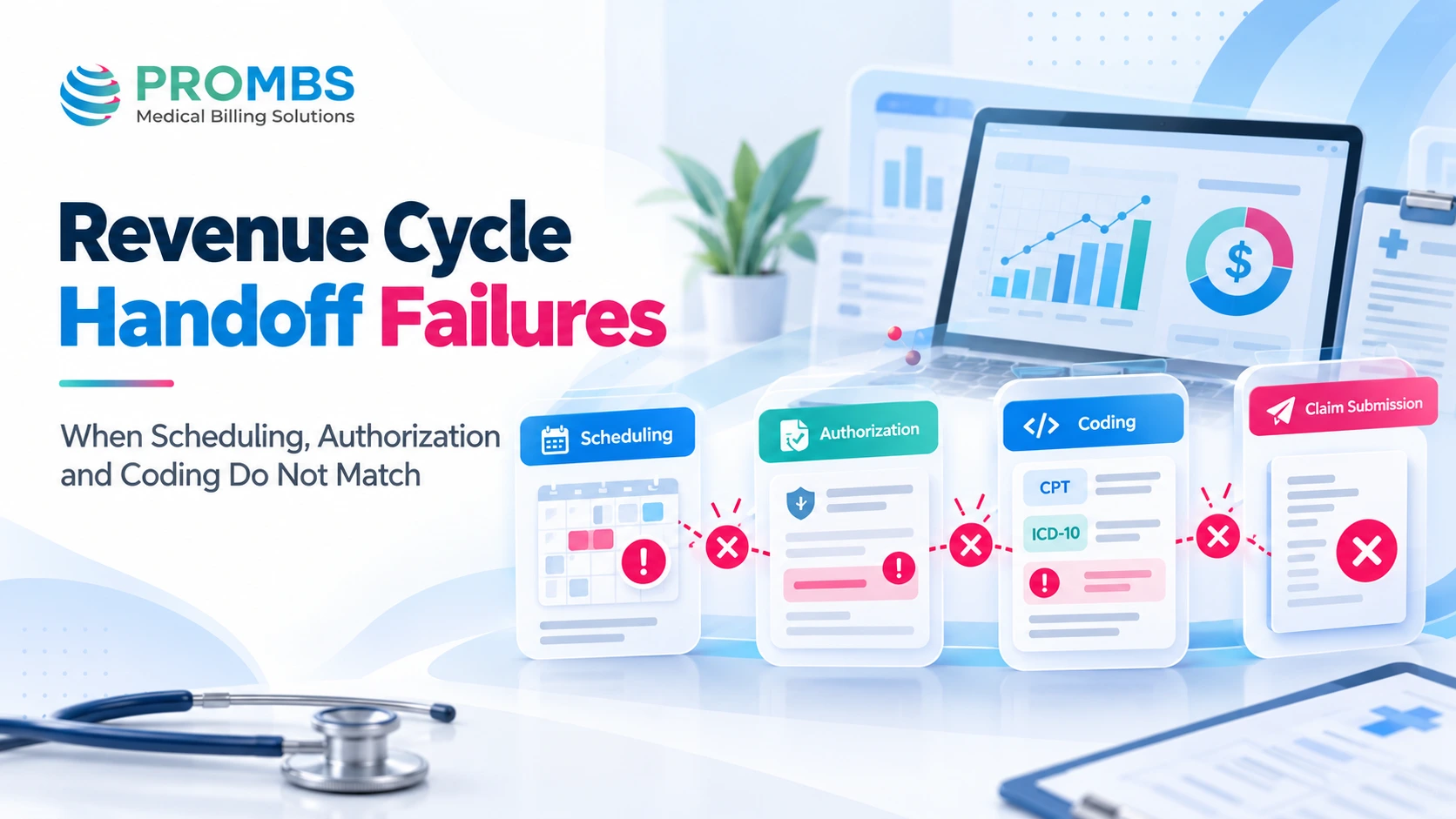
A patient schedules a procedure, the authorization team obtains insurance approval, and the coding department prepares the claim after treatment.
Each department completes its assigned task. Yet the claim is delayed or denied because the information recorded at one stage no longer matches what happened at another.
Perhaps the procedure was moved to a different facility. The physician changed the treatment plan, but the authorization was never reviewed. Or the coding team received an outdated procedure description.
These are common examples of revenue cycle workflow errors, where information fails to move correctly between departments.
The problem is not always incorrect coding or missing authorization. Sometimes, the information was accurate when it was entered but became outdated as the patient’s treatment changed.
For medical practices, these gaps can create claim holds, delayed submissions, repeated administrative work, and preventable denials.
Understanding where information stops matching is the first step toward preventing revenue cycle problems before claims reach insurance payers.
What Are Revenue Cycle Workflow Errors?
Revenue cycle workflow errors are mistakes, missing updates, or communication failures that occur as patient and billing information moves between scheduling, insurance verification, prior authorization, clinical documentation, coding, and claim submission.
These problems often develop during handoffs between departments.
For example, a scheduling employee changes a patient’s procedure date in the practice management system. The authorization department is not notified, so its records still reflect the original appointment.
The service is completed on the new date, and the coding team prepares an accurate claim.
However, the billing department discovers that the authorization may not apply to the actual service date.
The claim cannot be released without further investigation, even though the coding itself may be correct.
This illustrates an important distinction: a billing problem can begin before anyone creates the claim.
A connected revenue cycle should ensure that significant changes are communicated, reviewed, and documented before they affect reimbursement.
Through its revenue cycle management services, Pro Medical Billing Solutions (PROMBS) supports healthcare practices with eligibility verification, prior authorization, medical coding, claim processing, and billing follow-up.
Coordinating these activities helps practices identify inconsistencies earlier rather than waiting for the payer to discover them.
Why Revenue Cycle Handoffs Fail Between Departments
A revenue cycle handoff occurs whenever one department passes information or responsibility to another.
The scheduling team may provide patient and appointment information to the authorization specialist. The authorization team communicates approval details, while the clinical department documents the service performed.
The coding team then translates that documentation into the appropriate codes, and billing prepares the claim.
Problems develop when one department works with information that another department has already changed.
Different Departments Work With Different Records
Many practices use separate systems or work queues for scheduling, authorizations, clinical documentation, and billing.
For example, a procedure change may appear in the EHR but not in the authorization tracking system.
The scheduling team may see the revised appointment, while the authorization specialist continues working from the original request.
Without a process for identifying these differences, each department may believe its information is accurate.
The issue becomes visible only when the coding team, billing staff, or insurance payer identifies the mismatch.
Changes Are Made Without Notifying the Next Department
Not every appointment follows the original treatment plan.
A patient may reschedule, a physician may change, or clinical findings may require a different procedure.
These changes are part of normal healthcare operations. They become billing problems when the relevant departments are not informed.
For example, changing the procedure location may require the authorization specialist to confirm whether the existing approval remains applicable.
If that review never occurs, the claim may be delayed even when the patient received appropriate care.
No One Owns the Final Handoff
Another common problem is unclear responsibility.
The scheduling department may assume authorization staff will notice a change. The authorization department may assume the billing team will verify everything before submission.
Meanwhile, coders focus on accurately reporting the services documented in the medical record.
Each team has completed its immediate responsibility, but nobody has confirmed that the final information matches across systems.
A reliable workflow needs a designated person or team responsible for reviewing unresolved differences and confirming that a claim is ready for submission.
Common Scheduling, Authorization and Coding Mismatches
The most significant revenue cycle handoff failures often involve differences between what was scheduled, what the payer authorized, and what the clinician actually performed.
Understanding these scenarios helps practices identify where a breakdown begins.
Scheduling Changes That Never Reach the Authorization Team
Consider a patient scheduled for an outpatient procedure at a specific facility.
The practice obtains authorization based on the scheduled treatment information.
A few days before the appointment, the procedure is moved to another location because of equipment availability.
The scheduling team updates the appointment, but the authorization specialist does not receive the change.
The procedure is completed, and the billing team prepares the claim using the correct service location.
However, the authorization still identifies the original facility.
Depending on the payer’s requirements, the practice may need to resolve this discrepancy before submitting the claim.
The problem began with a scheduling change that was never communicated to the department responsible for verifying approval.
Practical prevention: Changes to procedures, facilities, rendering providers, or relevant service dates should trigger an authorization review when required by the payer.
PROMBS’s prior authorization services support practices with approval tracking, eligibility checks, and authorization-related follow-up.
Approved CPT Codes That Differ From Performed Services
A CPT mismatch can develop when the treatment provided differs from the procedure originally scheduled and authorized.
For example, a physician initially plans a diagnostic procedure and obtains the required approval.
After reviewing additional clinical findings, the physician determines that a different procedure is appropriate.
The clinical team performs the revised service, and the coding department selects the CPT code supported by the medical record.
However, the authorization team was never informed that the planned procedure changed.
The correct claim code may therefore differ from the code associated with the original approval.
This does not automatically mean the coding department made a mistake.
The claim must accurately represent the treatment performed. Staff should not change the CPT code simply to match an outdated authorization.
Instead, the practice should determine whether the revised procedure requires an authorization amendment, a new request, or another payer-specific action.
These details are particularly important for surgical practices, imaging centers, and specialty providers where clinical treatment plans may change.
Provider, Facility and Service-Date Changes
Information mismatches are not limited to procedures.
A claim may also contain provider or location details that differ from the original authorization.
For example, a physician may be unavailable on the scheduled date, requiring another provider to perform the service.
The replacement provider is correctly documented in the medical record, but the authorization remains associated with the original physician.
Depending on the insurer and authorization type, that difference may require review.
Similarly, moving a procedure between healthcare settings can affect billing information.
The CMS Place of Service Code Set distinguishes settings such as physician offices, hospital outpatient departments, and ambulatory surgical centers.
For example, POS 22 identifies an on-campus outpatient hospital, while POS 24 identifies an ambulatory surgical center.
The billing team must report the actual service location accurately while confirming that any applicable authorization requirements have been satisfied.
Practices should not assume that an approval for one facility automatically applies to another.
Coding Completed Without Updated Authorization Information
Medical coders depend on the clinical record to identify the services performed and select appropriate codes.
However, coders may not always have access to the latest authorization records or scheduling changes.
For example, a coding specialist reviews the completed procedure note and assigns the appropriate CPT code.
The claim moves to billing, but the authorization information attached to the encounter reflects an earlier treatment plan.
The coding work may be accurate, yet the claim remains at risk because the authorization has not been reconciled with the final service.
The solution is not to make coders responsible for obtaining every authorization.
Instead, the billing workflow should include a checkpoint confirming that the final coded service and relevant authorization information have been reviewed together.
PROMBS provides medical coding services that support accurate CPT, HCPCS, ICD-10, and modifier reporting based on clinical documentation.
Combining accurate coding with appropriate authorization verification helps practices recognize discrepancies before claim submission.
How Workflow Errors Cause Denials, Charge Delays and Revenue Leakage
Revenue cycle handoff failures can affect practice finances even before a claim is submitted.
When billing teams discover inconsistent information, they may need to contact scheduling staff, verify authorization details, request documentation, or investigate changes to the service.
While those issues remain unresolved, the claim may sit in a pending work queue.
Claim Submission Delays
Suppose a practice performs 30 procedures during a week.
Five encounters remain on hold because the final procedure details do not match the information recorded during authorization.
Even if those five claims are eventually paid, the practice has experienced additional billing delays.
The financial impact depends on the claim amounts, how long the issues remain unresolved, and whether the claims can be submitted within applicable payer deadlines.
Repeated delays can also increase staff workload as billing employees revisit encounters that should have been resolved earlier.
Avoidable Claim Denials
Some mismatches are not discovered until the insurance payer processes the claim.
For example, a payer may determine that the billed procedure or treatment location falls outside the applicable authorization.
The billing team must then investigate the denial, retrieve the original approval, and determine which resolution process is available.
That requires additional time and does not guarantee reimbursement.
Our related guide, Authorization Approved but Claim Denied, explains how practices can investigate these denials after they occur.
However, preventing the original handoff failure is often more efficient than resolving the problem after payment has already been refused.
Missing Charges and Revenue Leakage
Workflow problems can also prevent certain services from reaching billing.
For example, a procedure may be documented in the EHR but remain outside the charge entry process because the encounter was never released from a pending work queue.
If the issue remains unnoticed, the practice could overlook a legitimate billing opportunity or approach a filing deadline without a completed claim.
Not every held encounter represents recoverable revenue, but each requires an appropriate billing outcome.
A structured medical billing and coding audit can help practices identify missing charges, unresolved claim holds, and recurring process errors.
Why These Problems Require More Than Denial Management
Denial management is essential when a payer has already refused payment.
However, revenue cycle workflow errors need attention before that stage.
Practices should be able to identify when scheduling information changes, determine whether an authorization review is required, and confirm that final coding matches the documented service.
These checks help prevent unresolved differences from reaching the payer.
PROMBS supports healthcare practices through connected revenue cycle services, including verification, authorization management, coding, charge capture, claim processing, and reporting.
The objective is to create clearer communication between billing activities so that inaccurate or outdated information can be identified before it creates additional work.
How to Identify Where a Revenue Cycle Handoff Failed
The most effective way to identify a revenue cycle handoff failure is to compare the original scheduling information, authorization records, completed clinical documentation, and final billing details to find where the information stopped matching.
A medical claim may contain accurate CPT codes and provider information but still encounter problems because another department was working with outdated records.
For example, the scheduling department may have updated a procedure date while the authorization specialist continued using the original appointment information.
The billing team might not discover the discrepancy until the claim is ready for submission.
Instead of reviewing only the final claim, practices should trace the information backward through each stage.
Start With the First Point of Mismatch
When an encounter remains on hold because of inconsistent information, billing teams should identify the earliest point where the records differ.
Begin with the original appointment and compare it with subsequent changes.
Review whether the patient’s insurance plan, scheduled procedure, provider, service date, or treatment location changed.
Next, examine the authorization record to determine whether those changes were communicated and reviewed.
Finally, compare both records with the service documented by the clinician and the codes prepared for billing.
This process helps determine whether the problem began during scheduling, authorization, clinical documentation, coding, or claim preparation.
For example, if the scheduling team correctly documented a facility change but the authorization system still displays the original location, the handoff failure likely occurred between scheduling and authorization.
Identifying the actual breakdown helps practices correct the workflow instead of repeatedly asking the billing team to fix the resulting claims.
Review Changes Rather Than Only Final Records
Looking at the latest information in each system may not reveal why a mismatch occurred.
Practices should also review when changes were made, which department received the update, and whether the information was acknowledged.
A useful investigation may reveal that:
- The procedure was changed after authorization approval.
- The scheduling system recorded the change correctly.
- No notification reached the authorization specialist.
- The final claim reflected the actual service performed.
- The authorization still contained the original procedure details.
In this situation, the coding may be accurate. The missing communication created the billing risk.
This is why preventing revenue cycle workflow errors requires visibility across departments, not simply more claim edits.
Pro Medical Billing Solutions (PROMBS) supports healthcare practices through coordinated eligibility verification, authorization management, medical coding, and claim processing services that help identify inconsistent information before it creates reimbursement problems.
How to Reconcile Scheduling, Authorization and Coding Records
Encounter reconciliation means confirming that the information used throughout the revenue cycle accurately reflects the patient’s coverage, the service performed, and the requirements for submitting the claim.
The goal is not to make every record look identical. It is to ensure that each record is accurate and that any differences have been reviewed under the applicable payer requirements.
For example, the procedure originally scheduled may legitimately differ from the treatment ultimately performed.
The coding team must report the actual documented service, while the authorization department determines whether the existing approval covers that service.
A practical reconciliation process should follow three steps.
Verify Patient, Payer and Scheduled Service Details
Start by checking the original appointment and current patient information.
Confirm the patient’s identity, insurance coverage, responsible payer, scheduled service, and relevant referral or authorization requirements.
If the patient changed insurance plans after scheduling, the practice should determine whether eligibility and authorization requirements need to be reviewed again.
Similarly, if the appointment date or provider changed, the scheduling record should reflect that update.
The important question is whether the team responsible for the next step received accurate information.
Practices can reduce these problems by connecting appointment changes with their insurance verification and prior authorization process.
Compare Authorization With the Actual Treatment
The authorization specialist should review the approved service against the procedure documented after treatment.
This includes checking the relevant CPT or HCPCS codes, approved dates, authorized units, and any provider or facility restrictions.
For example, a physician may determine during treatment that a different procedure is clinically appropriate.
The final clinical documentation should accurately describe what was performed.
If the authorization covers only the original procedure, the specialist should investigate whether the revised service falls within the approval or requires another action under the payer’s rules.
Not every procedure change requires a new authorization. Requirements vary by insurer, service, and approval terms.
An existing authorization also does not automatically guarantee payment.
The CMS Prior Authorization and Pre-Claim Review Initiatives explain that advance reviews help identify certain claim issues earlier but do not eliminate applicable medical necessity and documentation requirements.
Confirm CPT Codes, Provider NPI, Facility and POS
Once the clinical documentation is complete, the coding team should verify that the assigned codes accurately reflect the services performed.
The billing team should then compare the final claim information with applicable authorization requirements.
Important fields include the procedure codes, relevant modifiers, rendering provider NPI, service date, facility, and place-of-service code.
For example, the CMS Place of Service Code Set identifies POS 22 as an on-campus outpatient hospital and POS 24 as an ambulatory surgical center.
These codes describe different treatment settings.
However, reporting the correct POS code does not automatically establish that a service was authorized at that location.
The team must separately confirm whether the applicable authorization covers the facility where treatment occurred.
PROMBS’s medical coding services support accurate coding based on clinical documentation, while its broader RCM services help connect that information with the claim submission process.
Who Is Responsible for Each Revenue Cycle Handoff?
One of the most effective ways to prevent billing communication failures is to establish clear responsibility for each stage of the revenue cycle.
A department should know what information it must verify, who receives the information next, and which changes require additional review.
Without this ownership, important updates may remain in individual emails, appointment notes, or disconnected work queues.
The following framework can help practices assign responsibility.
| Workflow stage | Responsible team | Required handoff |
|---|---|---|
| Scheduling | Front desk or scheduling staff | Current patient, payer, procedure, provider, date and location |
| Authorization | Authorization specialist | Approval status, approved services, dates, units and relevant restrictions |
| Clinical documentation | Treating provider or clinical team | Accurate record of the service performed and clinical changes |
| Medical coding | Qualified coding staff | Supported CPT, HCPCS, ICD-10 and modifier information |
| Claim preparation | Billing team | Final reconciliation, resolution of applicable exceptions and claim validation |
These responsibilities can vary according to practice size and staffing arrangements.
For smaller practices, one employee may perform several administrative functions.
The important requirement is that responsibility remains clear even when roles overlap.
Assign Ownership to Unresolved Exceptions
Not every encounter will pass through reconciliation without questions.
Some claims may require clarification about the procedure performed. Others may involve an authorization that does not appear to match the final treatment.
When this happens, the encounter should move into a designated exception queue.
Each unresolved case should identify:
- The information that does not match.
- The department responsible for investigating it.
- The action required.
- The date the issue was identified.
- The next review or escalation deadline.
For example, an encounter should not remain indefinitely under the status “Authorization pending” when the actual issue is that the procedure changed after approval.
A clearer status would be “Procedure code changed; authorization specialist reviewing payer requirements.”
This makes the problem easier to understand and reduces unnecessary follow-up between departments.
How to Build a Pre-Submission Handoff Checklist
A pre-submission checklist helps practices identify revenue cycle workflow errors before a claim is transmitted to the insurance company.
The review should confirm that the final claim accurately reflects the completed service and that any relevant authorization changes have been addressed.
Practical Revenue Cycle Handoff Checklist
Before releasing a claim, verify the following:
-
Patient identity and insurance information are accurate for the date of service.
-
The completed service and clinical documentation have been reviewed.
-
CPT, HCPCS, diagnosis codes, and applicable modifiers accurately describe the documented service.
-
The rendering provider and billing entity are correctly identified.
-
The actual treatment location and applicable POS code are accurate.
-
Required authorization information has been verified against the performed service.
-
Procedure, provider, facility, date, or unit changes have been reviewed when relevant.
-
Documentation or authorization exceptions are resolved or appropriately escalated.
-
The claim has passed applicable billing and clearinghouse validation checks.
-
The claim’s submission status and subsequent payer acknowledgment will be monitored.
Not every encounter requires the same level of authorization review.
Practices should apply payer-specific requirements rather than delaying services or claims for approvals that are not required.
What Happens When a Mismatch Is Found?
The billing team should avoid releasing a claim with unresolved errors that could affect its accuracy or compliance.
However, placing an encounter on hold should not mean leaving it unattended.
The responsible department should investigate the discrepancy and determine whether clarification, correction, or payer communication is necessary.
If the original authorization no longer appears applicable, the authorization specialist should confirm the permitted resolution process.
When the clinical record and scheduling information differ, the appropriate clinical or administrative team should verify the facts.
If a claim is approaching a filing deadline, the issue should be escalated promptly rather than allowed to remain in a routine work queue.
A successful pre-submission review produces one of two outcomes: the claim is ready for accurate submission, or the unresolved issue has a clearly assigned next action.
Practical Example: A Procedure Change That Creates a Denial
Consider an outpatient specialty practice that schedules a patient for a procedure requiring prior authorization.
The following example is illustrative.
The Original Scheduling and Authorization Process
The patient is scheduled for Procedure A.
The scheduling department records the appointment, rendering provider, and treatment location.
The authorization team obtains approval for Procedure A, and the payer records the approved service information.
At this point, the records are consistent.
The Clinical Treatment Plan Changes
Before treatment, the physician determines that Procedure B is more appropriate based on updated clinical findings.
The scheduling department updates the appointment description.
However, the authorization specialist is not notified that the planned procedure has changed.
The physician performs Procedure B and accurately documents the treatment.
The coding team reviews the medical record and assigns the correct code for Procedure B.
The Handoff Failure Reaches Billing
The billing team receives the final coded encounter and submits the claim.
However, the authorization record still identifies Procedure A.
If the payer’s approval does not cover Procedure B and the applicable rules require authorization for that service, the claim may be denied.
The problem did not originate with the final coding.
It began when the updated treatment information failed to reach the authorization team.
How the Practice Could Have Prevented the Denial
A better process would require a change to an authorization-relevant procedure to trigger a review.
Before the service, the authorization team could determine whether the existing approval remained valid or whether another payer action was required.
After treatment, the claim preparation team could compare the final codes with the authorization record.
If the mismatch remained unresolved, the billing team could escalate it before submission.
When a denial has already occurred, practices may need to follow the payer’s applicable correction or appeal process. Our separate article, Authorization Approved but Claim Denied, explains that post-denial investigation in more detail.
The important lesson is that a single missed update can affect several downstream processes.
Preventing the communication failure is generally more efficient than correcting its consequences after the payer has processed the claim.
How to Prevent Communication Gaps Between RCM Teams
Improving revenue cycle communication does not necessarily require replacing the practice’s existing EHR or billing software.
Many problems can be addressed by establishing clearer responsibilities, consistent documentation, and a reliable process for communicating important changes.
Create Standard Change Notifications
Practices should identify which changes require communication between scheduling, authorization, clinical, coding, and billing teams.
These may include procedure changes, rendering provider substitutions, facility transfers, insurance updates, and authorization-relevant date changes.
When a significant change occurs, the relevant team should receive an update through an approved system or work queue.
The notification should explain what changed and whether another review is required.
This is more reliable than expecting employees to discover updated information by manually checking multiple systems.
Use Shared Status Tracking
Each encounter should have a clear status that reflects its progress through the revenue cycle.
For example, an encounter might be marked as scheduled, authorization review required, approved, service completed, coding complete, or claim ready.
When information changes, the status should reflect the new requirement.
A shared view helps reduce situations where one department believes work is complete while another is still waiting for information.
These records should be maintained in systems with appropriate access controls to protect patient information.
Review Recurring Handoff Problems
Management should examine whether the same types of communication failures continue to occur.
For example, recurring site-of-service mismatches may indicate that facility changes are not triggering authorization reviews.
Repeated coding holds may suggest that clinical documentation is not reaching coders promptly.
These patterns can reveal which handoffs require better procedures, staff training, or system configuration.
Through its revenue cycle management services, PROMBS supports healthcare practices with verification, authorization management, coding, claim submission, denial management, and reporting.
Our approach helps practices connect the information needed at each billing stage, identify unresolved discrepancies, and improve communication between revenue cycle activities.
The objective is not to add unnecessary administrative steps. It is to make sure important information reaches the right team before it affects reimbursement.
Reducing revenue cycle workflow errors requires a process in which every significant change is recorded, reviewed, and communicated to the department responsible for the next action.
How to Prevent Revenue Cycle Workflow Errors Before Claim Submission
Preventing revenue cycle handoff failures starts with making sure scheduling, authorization, clinical documentation, and coding teams are working with accurate information about the same patient encounter.
A practice may have experienced employees and reliable billing software but still encounter payment problems when important updates do not reach the next department.
The most effective prevention strategy is to establish clear handoff responsibilities, communicate changes promptly, and verify critical information before releasing claims.
Establish Clear Handoff Checkpoints
Every revenue cycle department should know when its responsibility begins and when information must be passed to the next team.
For example, scheduling staff should communicate changes to procedures, providers, service dates, or facilities when those changes may affect authorization.
The authorization team should verify applicable payer requirements and communicate approval details to the billing department.
Clinical staff must accurately document the treatment performed, while coders should assign codes supported by that documentation.
Before submission, billing staff should confirm that relevant discrepancies have been reviewed.
These checkpoints help prevent unresolved issues from moving unnoticed through the billing process.
Use Automated Alerts for Important Changes
EHR and practice management systems can help identify changes that require additional review.
For example, a procedure modification could trigger a notification to the authorization team when the new service may require payer approval.
Similarly, an encounter with incomplete documentation could be flagged before charge release.
Automation reduces reliance on manual communication, but it does not replace professional judgment.
Staff must still determine whether an authorization update is necessary and whether the claim accurately represents the service performed.
Through its revenue cycle management services, Pro Medical Billing Solutions (PROMBS) supports claim validation, prior authorization coordination, coding accuracy, and billing follow-up to help practices identify problems earlier.
What Should a Revenue Cycle Handoff Audit Include?
A revenue cycle handoff audit examines whether information moves correctly between departments and identifies where communication failures contribute to delayed claims or denials.
Unlike a traditional coding audit, this review looks at the entire process, from the original appointment to claim submission.
A practical audit should answer three questions:
- Was the correct information available to each department?
- Were important changes communicated and reviewed?
- Did unresolved discrepancies affect submission or reimbursement?
Review Scheduling and Authorization Records
Start with completed encounters that experienced billing holds or authorization-related denials.
Compare the original appointment details with subsequent scheduling changes and authorization records.
Look for changes involving procedure codes, rendering providers, treatment locations, insurance coverage, and service dates.
The objective is to identify whether the information was inaccurate from the beginning or became outdated during treatment planning.
Examine Clinical Documentation and Coding Handoffs
Next, review whether the coding department received complete and accurate clinical documentation.
Determine whether the final coded services matched the treatment actually performed and whether relevant authorization details were available before billing.
A coding error and an authorization mismatch are not necessarily the same problem. The audit should identify which process actually failed.
Identify Repeated Workflow Problems
The audit should group findings by department, payer, provider, and error category.
For example, repeated facility mismatches may indicate that scheduling changes are not reaching authorization staff.
Frequent claim holds involving incomplete procedure documentation may suggest that clinical records are not reaching the coding team promptly.
A structured medical billing and coding audit can help practices identify these patterns and develop corrective actions.
The final report should explain the root cause, affected claims, potential financial exposure, responsible department, and recommended improvement.
Key KPIs for Monitoring Handoff Failures and Denials
Medical practices should measure whether workflow changes actually reduce billing delays and claim problems.
Tracking only the overall denial rate may not reveal where a handoff failure began.
The following metrics provide a useful starting point.
| KPI | What it measures |
|---|---|
| Handoff exception rate | Percentage of reviewed encounters with unresolved cross-department discrepancies |
| Authorization mismatch rate | Percentage of applicable reviewed encounters with authorization-related discrepancies |
| Charge lag | Time between service delivery and charge entry |
| Claim submission lag | Time between charge entry and claim submission |
| Handoff-related denial rate | Percentage of adjudicated claims denied for reasons traced to handoff failures |
These are operational measurements, not universal industry benchmarks. Practices should define their reporting populations and calculate each metric consistently.
Track Problems by Their Actual Cause
Suppose a practice identifies 200 encounters requiring authorization verification during a month.
Of those, 16 have unresolved authorization-related discrepancies before claim submission.
The authorization mismatch rate for the reviewed group is 8%.
This is an illustrative example.
The practice should investigate where those discrepancies originated and whether a particular department or workflow accounts for most of them.
After implementing a change-notification process, management can compare subsequent results using the same definition.
The goal is to determine whether fewer encounters require corrective work and whether related denials are declining.
Monitor Financial Impact Alongside Error Rates
Not every workflow discrepancy causes a denial, and not every denial represents permanently lost revenue.
Practices should also track the value of claims delayed by unresolved handoffs, the time required for resolution, and the amounts eventually collected.
PROMBS supports healthcare practices through revenue cycle reporting, denial trend analysis, payer performance monitoring, and accounts receivable follow-up.
These measurements help practice owners understand whether operational improvements are producing meaningful financial results.
How to Recover Revenue From Claims Affected by Workflow Errors
Some revenue cycle handoff failures are discovered only after a claim has been submitted or denied.
In those cases, the practice must determine whether the claim can be corrected, whether the payer’s decision should be challenged, or whether additional information is required.
Recovery begins with identifying the actual cause of nonpayment, not automatically resubmitting the claim.
Identify the Original Handoff Failure
Suppose a claim is denied because the billed procedure does not match the authorization.
The billing team should compare the original approval with the clinical documentation and claim information.
If the code accurately reflects the service performed, staff should not change it simply to match the authorization.
Instead, the team should determine whether the payer permits an authorization amendment, administrative review, or appeal.
If the original claim contains an actual billing error, an appropriate correction may be necessary.
The selected resolution must follow the payer’s rules and accurately reflect the service provided.
Review Filing and Appeal Deadlines
Unresolved handoff problems can become more serious when they delay claim submission or recovery action.
For Original Medicare, claims generally must be filed within one calendar year after the date of service, subject to limited exceptions.
The official Medicare filing guidance explains this requirement.
Commercial payers and Medicaid programs may have different original filing, correction, and appeal deadlines.
These deadlines should not be treated as interchangeable.
If a claim has already been adjudicated, the billing team should review the applicable correction or appeal process rather than assuming that the original filing deadline determines every remaining recovery option.
Track the Claim Until Financial Resolution
Once a correction or appeal has been submitted, the account should remain in an active follow-up queue.
Staff should verify receipt, monitor payer responses, and reconcile the final payment or adjustment.
For example, consider six claims delayed by authorization handoff problems, each with an estimated collectible balance of $900.
The practice has $5,400 in potential reimbursement requiring investigation.
That amount is not guaranteed recovery. Actual reimbursement depends on coverage, documentation, payer requirements, and the available resolution process.
Through its denial management services, PROMBS helps practices investigate payer denials, coordinate necessary corrections, pursue appropriate appeals, and monitor outstanding balances.
The longer-term objective is to prevent similar claims from developing the same problem.
How Pro Medical Billing Solutions Connects Revenue Cycle Teams
Medical practices often experience billing delays because important information is spread across separate departments and systems.
Scheduling employees may have updated appointment information, while authorization specialists are working from an earlier treatment plan. Coders may accurately report the completed service without knowing that the original approval needs review.
Pro Medical Billing Solutions helps healthcare practices address these gaps through coordinated medical billing and revenue cycle management support.
Our services cover important stages of the revenue cycle, helping practices manage information more consistently from patient access through claim submission and payment.
Eligibility Verification and Authorization Support
PROMBS provides verification and prior authorization services that help practices review insurance requirements, manage authorization information, and follow up on approvals.
This support is particularly important when procedure details or treatment arrangements change.
Coordinating authorization review with scheduling and billing helps identify discrepancies before they become claim denials.
Medical Coding and Claim Validation
Accurate coding must reflect the actual clinical service, not simply the procedure originally scheduled.
PROMBS supports CPT, HCPCS, ICD-10, and modifier accuracy through documentation-based coding services.
Our claim scrubbing and billing workflows also help identify missing information and potential submission errors.
Together, these activities support accurate claim preparation while reducing unnecessary rework.
Denial Management and A/R Follow-Up
When a claim has already been denied, identifying the original workflow failure can help prevent the same issue from occurring again.
PROMBS supports denial investigation, payer communication, appropriate corrections, appeals, and accounts receivable follow-up.
Our reporting also helps practices identify recurring problems involving authorization, documentation, and coding.
This allows billing performance reviews to focus on root causes rather than individual claim problems alone.
Revenue Cycle Reporting and Billing Audits
A successful revenue cycle workflow errors prevention strategy requires visibility into what happens between departments.
PROMBS provides billing reports, payer performance monitoring, denial analysis, and coding audits to help healthcare practices identify recurring process gaps.
Our goal is to support a more reliable revenue cycle in which important changes are reviewed, billing issues have clear ownership, and outstanding claims receive appropriate follow-up.
Frequently Asked Questions About Revenue Cycle Workflow Errors
What are the most common revenue cycle workflow errors?
Common errors include missing scheduling updates, outdated authorization details, incomplete clinical documentation, incorrect coding handoffs, and mismatches involving providers or treatment locations.
These problems often occur when departments work with different information about the same patient encounter.
How do scheduling errors cause medical claim denials?
Scheduling changes can affect authorization requirements when procedures, providers, facilities, or relevant service dates change.
If those changes are not reviewed, the final claim may contain information that differs from the applicable payer approval.
Whether a denial occurs depends on the payer’s requirements and the circumstances of the service.
Can a claim be denied even when the CPT coding is correct?
Yes. Accurate coding does not guarantee payment.
A claim may still be denied because of authorization conditions, coverage restrictions, provider enrollment, or other payer requirements.
The billing team should investigate the actual reason rather than assuming that every denial indicates a coding error.
Who should be responsible for revenue cycle handoffs?
Each department should own the accuracy of the information it produces and communicate changes affecting downstream work.
Scheduling staff manage appointment updates, authorization specialists review approval requirements, clinicians document services, coders assign supported codes, and billing staff perform applicable pre-submission checks.
A designated employee or team should manage unresolved exceptions.
How can medical practices reduce revenue cycle communication gaps?
Practices can establish standard change notifications, shared encounter statuses, clearly assigned responsibilities, and pre-submission reconciliation checks.
Regular audits and KPI reviews can help identify whether those processes are reducing claim holds and repeated denials.
Can revenue cycle handoff errors cause revenue leakage?
Yes. Missing charges, delayed claim submissions, and unresolved denials can put legitimate reimbursement at risk.
However, every outstanding balance should be reviewed individually. Not all claim holds represent lost revenue, and not every denied claim is recoverable.
How can PROMBS help prevent revenue cycle workflow errors?
PROMBS supports medical practices with eligibility verification, prior authorization, medical coding, claim validation, denial management, A/R follow-up, and billing audits.
These connected services help practices identify information gaps, address billing problems, and improve revenue cycle coordination.
Identify Revenue Cycle Gaps With a Free PROMBS Billing Audit
Revenue cycle problems do not always begin with an incorrect claim.
Sometimes, the original scheduling information was accurate, the authorization was properly obtained, and the coding was correct. The problem developed because an important change was never communicated between departments.
These handoff failures can delay claims, increase administrative work, and contribute to preventable denials.
Reducing revenue cycle workflow errors requires practices to look beyond individual claim mistakes and examine how information moves through scheduling, authorization, clinical documentation, and billing.
With clear responsibilities, timely updates, and consistent reconciliation, practices can identify problems before they affect reimbursement.