

A patient schedules an appointment with an orthopedic specialist after receiving a referral from their primary care physician. The specialist’s office collects the referral letter, verifies the patient’s active insurance coverage, and confirms the appointment.
The visit takes place as scheduled.
Several weeks later, the insurance company denies the claim because the patient’s health plan required an electronic referral from the primary care provider, and no valid referral was recorded in the payer’s system.
The practice has a physician’s referral letter, but the insurer does not recognize it as satisfying the plan’s referral requirement.
Now consider a different situation.
A patient visits a cardiologist after obtaining a valid specialist referral. During the evaluation, the cardiologist recommends an advanced diagnostic procedure. The billing team assumes the existing referral is sufficient and schedules the service without checking whether the procedure requires separate prior authorization.
The payer subsequently denies the procedure claim because the required authorization was not obtained.
These situations illustrate two distinct medical billing problems. In the first, the practice failed to verify the payer’s referral requirements. In the second, it confused a valid referral with authorization for a separately regulated service.
A referral and a prior authorization are not interchangeable, and one does not automatically satisfy the requirements of the other.
Healthcare practices must verify both requirements independently, even when the patient’s insurance coverage is active and the treating provider has already received documentation from another physician.
For practices managing specialist appointments, diagnostic services, procedures, and ongoing treatment, understanding the distinction is essential for preventing avoidable claim denials.
This article explains how referrals and prior authorizations differ, when health plans may require one or both, and why verification errors frequently arise before the date of service.
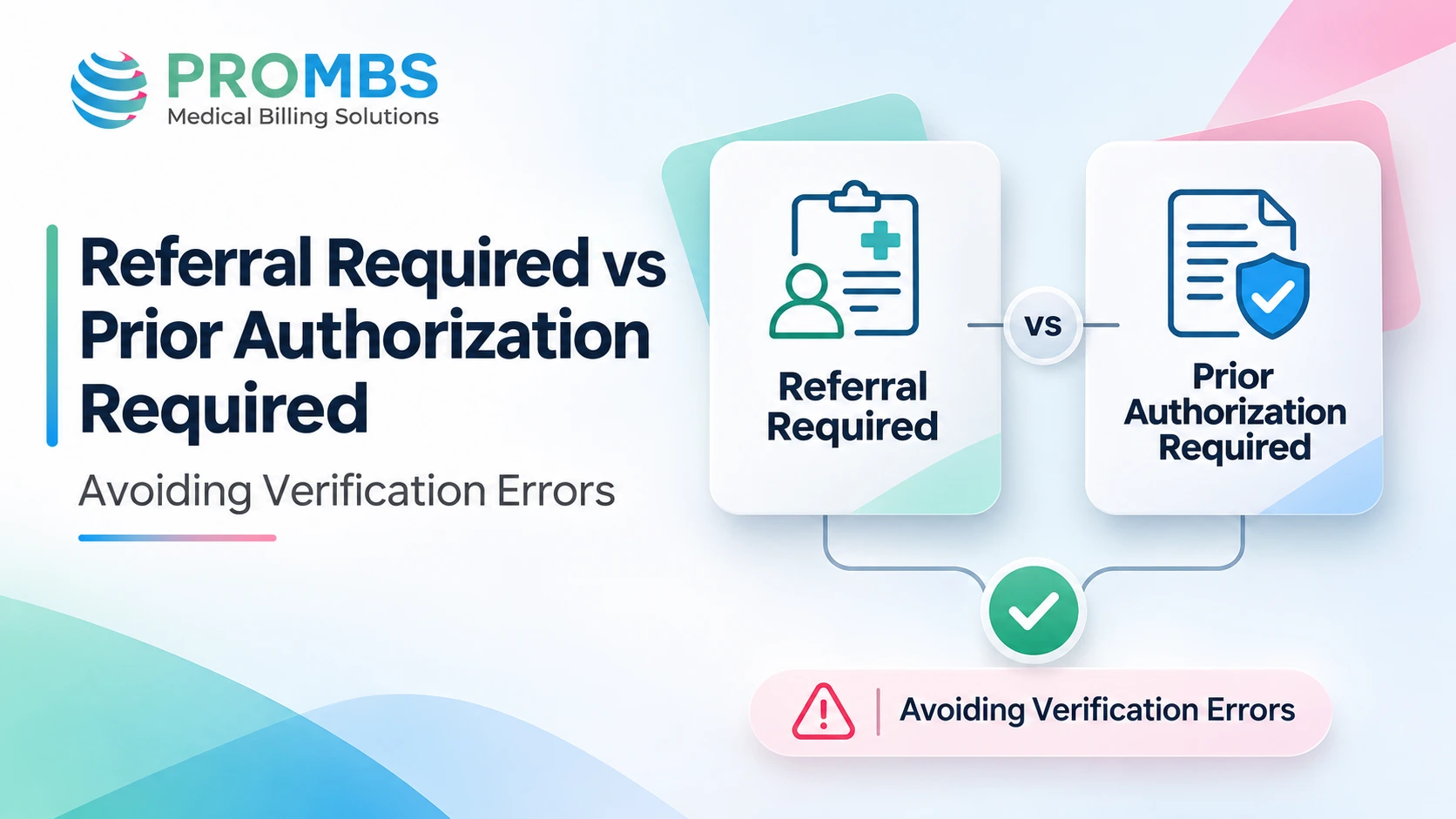
What Is the Difference Between Referral and Prior Authorization?
The primary difference is the purpose of each requirement.
A referral generally involves a physician or other authorized healthcare professional directing a patient to another provider, often a specialist, for evaluation or treatment. Depending on the patient’s health plan, the referral may also need to be submitted or registered through the insurer’s administrative process.
A prior authorization is a health plan’s advance review or approval process for specified healthcare services, treatments, medications, or procedures. The insurer or its authorized reviewer evaluates the request according to applicable coverage and clinical criteria.
A referral typically establishes the appropriate pathway for accessing specialty care. Prior authorization addresses whether a particular service requires advance review under the patient’s coverage.
For example, an HMO member may need a primary care physician’s referral before visiting a neurologist.
If the neurologist subsequently orders an advanced imaging study, the patient’s insurer may require separate authorization for that study.
The referral supports access to the specialist. The authorization addresses the imaging service.
The patient may need both, and each requirement may have its own identification number, effective dates, provider information, and limitations.
Why the Difference Matters in Medical Billing
Medical billing teams frequently receive referral documents and authorization information through similar administrative workflows.
Both may be handled before the patient’s appointment. Both can involve communication with physicians, insurance companies, and scheduling teams.
As a result, employees may incorrectly assume that confirming one requirement means the patient has satisfied all necessary pre-service conditions.
The problem often becomes apparent only after the insurance company processes the claim.
A payer may recognize that the service was medically necessary but deny reimbursement because the required administrative referral was missing.
Alternatively, the patient may have an appropriate referral, but the payer may determine that the separately billed procedure required prior authorization.
The correct approach is to verify each requirement separately for the patient’s specific insurance product and the service being provided.
What Does Referral Required Mean in Medical Billing?
When a health plan indicates that a referral is required, it generally means the patient must obtain an appropriate referral before receiving certain services, commonly specialist care.
The referring provider is often the patient’s designated primary care physician, although the rules depend on the plan.
For example, a patient enrolled in an HMO may need their assigned primary care physician to refer them to an orthopedic specialist.
The insurer may require the referral to identify the specialist, specialty, effective period, or other relevant information.
Some plans require referrals to be entered into the payer’s electronic system. Others may recognize different referral arrangements or exempt certain services.
The practice must verify the actual requirements rather than assume a physician’s recommendation is sufficient.
Who Is Responsible for Issuing a Specialist Referral?
Under many referral-based managed care arrangements, the patient’s primary care provider initiates the referral.
The PCP may determine that specialized evaluation is clinically appropriate and direct the patient to another healthcare professional.
Where the plan requires administrative referral submission, the PCP office or another authorized party may be responsible for entering the referral into the payer’s system.
The receiving specialist’s office should confirm that the applicable requirement has been satisfied.
However, responsibility for obtaining or submitting a referral varies among payers and health plan products.
Practices should establish the correct process with the insurer instead of assuming that patients or referring physicians will always complete every administrative step.
What Information May Be Included in a Referral?
Depending on the plan, a referral record may contain:
- Patient and referring provider information.
- The receiving specialist or medical group.
- The specialty or type of care authorized for referral.
- A referral reference or tracking number.
- Effective and expiration dates.
- An approved number of specialist visits, when applicable.
- Other limitations established by the patient’s plan.
These details help the receiving provider verify whether the planned visit is covered by the referral.
For example, a referral may have been issued for a cardiology evaluation but may not satisfy a separate referral requirement for another specialty.
Similarly, a referral may have expired before a scheduled follow-up appointment.
A valid referral must be evaluated against the actual encounter rather than treated as an unrestricted approval for all future services.
What Does Prior Authorization Required Mean?
When a healthcare service requires prior authorization, the health plan generally expects the applicable approval process to be completed before the service is performed.
The requirement may apply to particular procedures, diagnostic studies, therapies, specialty treatments, or other covered services.
The treating or requesting provider commonly submits information supporting the requested care, although responsibility varies by payer and service.
The insurer or its authorized reviewer evaluates the request according to the applicable coverage rules and clinical criteria.
For example, a patient may be referred to an orthopedic specialist for evaluation of persistent knee pain.
The specialist recommends an advanced imaging study after reviewing the patient’s condition and treatment history.
Even if the specialist referral is valid, the imaging study may require a separate prior authorization request.
The authorization process may involve reviewing the requested study, diagnosis, clinical findings, previous treatment, and other relevant information.
What Information Is Associated With Prior Authorization?
An authorization may identify the approved service and the conditions under which the payer has granted approval.
Depending on the insurer and service, relevant information can include the authorization number, approved procedure, provider, facility, service dates, units, or number of treatments.
These details are particularly important when a patient’s treatment plan changes after the initial authorization.
For example, an authorization for a particular imaging procedure should not automatically be treated as approval for a different study.
Likewise, an approval associated with one facility or provider may not cover a service performed elsewhere if the payer applies provider or location restrictions.
The authorization team must confirm that the actual planned service falls within the approval’s scope.
Does Prior Authorization Guarantee Insurance Payment?
No. Prior authorization does not automatically guarantee payment.
Even when the insurer approves a service in advance, the final claim may still be subject to eligibility, coverage, coding, medical necessity, provider participation, and other applicable payment requirements.
A claim may also be denied if the service submitted does not match the conditions of the authorization.
For example, the payer may have approved a procedure at one location, while the claim identifies another facility.
The authorization may have expired, or the reported service may differ from the approved procedure.
These issues require separate investigation.
For a detailed explanation of the approval process itself, see PROMBS’s guide on what prior authorization means.
Clinical Referral vs. Payer-Required Administrative Referral
One of the most overlooked verification errors occurs when practices confuse a clinical referral with a referral that must be registered under the patient’s insurance plan.
Although the terms sound similar, they may represent different requirements.
A Clinical Referral Documents the Physician’s Recommendation
A clinical referral generally records that a physician recommends evaluation or treatment by another provider.
For example, a primary care physician may create an electronic health record referral directing a patient to an endocrinologist.
The document may explain the medical reason for the referral and identify the specialist.
This information supports continuity of care and communication between healthcare professionals.
However, a clinical referral does not necessarily establish that the insurer has received or accepted an administrative referral required under the patient’s plan.
A Payer Referral Satisfies the Plan’s Administrative Process
Certain health plans require a referral to be entered into their administrative system before covered specialist services are provided.
The PCP office may need to select the appropriate specialist, enter the referral details, and complete the insurer’s required submission process.
A referral number or confirmation may then be generated.
If the specialist’s office receives a clinical referral letter but fails to confirm the payer-required referral, the appointment may proceed without the administrative requirement being satisfied.
UnitedHealthcare’s Medicare Advantage referral guidance illustrates how payer-specific rules may require PCP referral submission for certain specialist encounters.
These requirements must be evaluated for the patient’s actual plan and the rules applicable on the date of service.
Why the EHR Referral Status May Not Be Enough
An electronic health record may show that a referral was created, transmitted, or accepted internally.
However, that status may describe the clinical referral workflow rather than the insurer’s administrative referral process.
For example, the specialist’s office may see a referral marked as completed in the EHR, while the insurance portal shows no valid referral for the scheduled encounter.
The billing team should understand which system is being used to confirm referral compliance.
When the plan requires a payer referral, the practice should verify the appropriate payer record rather than rely exclusively on the internal clinical referral status.
Referral vs Prior Authorization: Key Differences for Healthcare Practices
The following comparison summarizes the operational differences between referrals and prior authorizations.
| Verification area | Referral | Prior authorization |
|---|---|---|
| Primary purpose | Directs the patient to a specialist or designated care pathway | Obtains advance payer review for a specified service |
| Typical initiating party | PCP or another authorized referring clinician | Treating or requesting provider, depending on payer requirements |
| Common use | Specialist visits and managed care access | Procedures, imaging, treatments, and other services requiring advance review |
| Payer record | May require an administrative referral entry | Usually requires an authorization decision or reference when applicable |
| Key details | Referred provider, specialty, effective dates, visit limits | Approved service, codes, units, provider, location, and dates as applicable |
| Medical necessity review | Not necessarily a separate utilization review | Commonly includes coverage and clinical review |
| Can expire? | Yes, depending on the plan | Yes, depending on the approval |
| Guarantees payment? | No | No |
| Can both be necessary? | Yes | Yes |
The precise requirements vary by health plan and service.
For example, an insurer may not require a PCP referral for a specialist visit but may require prior authorization for a procedure ordered during that visit.
Another plan may require both the referral and procedure authorization.
A third plan may require neither for the specified encounter.
The practice should not make the decision using the procedure type or insurer name alone.
When a Patient Needs Both a Referral and Prior Authorization
Some healthcare encounters involve more than one administrative requirement.
Consider a patient enrolled in a referral-based HMO who is experiencing persistent lower back pain.
The primary care physician determines that a specialist evaluation is appropriate and refers the patient to a pain management physician.
The health plan requires a PCP referral for specialist visits, so the appropriate referral must be established before the consultation.
During the visit, the specialist evaluates the patient and recommends a procedure.
The insurer may require prior authorization for that procedure.
The patient now has two separate requirements associated with the overall course of care.
The specialist referral supports the patient’s access to the pain management provider.
The prior authorization addresses the planned procedure.
The existence of one does not eliminate the other.
The Referral May Cover the Consultation but Not the Procedure
A specialist referral may establish that the patient can receive an authorized number of visits during a specified period.
That does not automatically mean every service performed by the specialist has received the necessary advance approval.
For example, a referral to an orthopedic physician may support a consultation, while a subsequent procedure requires separate authorization.
The receiving practice should verify the requirements for the actual services planned.
The Authorization May Be Approved While the Referral Is Missing
A payer may approve a specific procedure through its utilization management process even when the patient’s plan also requires an administrative referral for the specialist encounter.
If the practice checks only the procedure authorization, it may miss the separate referral requirement.
This can create billing problems even though the authorization itself is valid.
The safest operational approach is to maintain separate verification results for referral requirements and prior authorization requirements.
Neither Approval Replaces Eligibility Verification
A valid referral and an approved authorization do not establish that every other coverage condition has been satisfied.
The patient may have changed insurance products, lost active coverage, or received services outside the applicable plan terms.
The practice should therefore maintain appropriate eligibility and benefits verification alongside the referral and authorization processes.
PROMBS’s article on eligibility active but claim denied explains why active insurance alone does not guarantee coverage or reimbursement for a particular service.
HMO vs. PPO Referral and Authorization Requirements
Health maintenance organizations and preferred provider organizations commonly use different approaches to specialist access.
However, practices should avoid assuming that every plan within one category follows identical rules.
Coverage requirements can vary by insurer, employer arrangement, Medicare Advantage product, and other plan-specific conditions.
HMO Referral Requirements
Many HMO plans coordinate specialist care through a designated primary care provider.
Under these arrangements, patients may need a referral before receiving certain nonemergency specialist services.
The referral may need to be submitted to the payer or medical group according to the plan’s administrative rules.
However, not every HMO applies the same referral requirements, and exceptions may exist for particular services.
The practice should verify whether a referral is required for the specific specialist and encounter.
PPO Referral Requirements
PPO plans commonly provide more flexibility when patients seek specialist care.
Many PPO products do not require a PCP referral for covered specialist visits.
However, this does not mean that all services are exempt from prior authorization.
A PPO member may be able to schedule a specialist consultation directly while still needing advance approval for certain imaging studies or procedures.
Additionally, plan-specific referral or other administrative requirements may apply in particular circumstances.
Billing teams should verify the patient’s actual plan rather than assume that the PPO designation automatically resolves every question.
Why the Insurance Company Name Is Not Enough
A practice may participate with an insurance company that offers multiple products.
For example, the insurer may administer HMO, PPO, Medicare Advantage, and other arrangements with different provider access and authorization requirements.
A patient presenting an insurance card from a familiar payer does not establish which referral rules apply.
The billing team needs to identify the exact product and relevant network or benefit arrangement.
Using the requirements of one plan for a different product can result in incorrect verification.
Original Medicare vs. Medicare Advantage Referral Requirements
Medicare coverage arrangements require particular attention because Original Medicare and Medicare Advantage do not necessarily apply the same rules.
A practice should identify which Medicare arrangement the patient has before determining whether a referral is required.
Original Medicare
Under Original Medicare, patients generally do not need a primary care physician’s referral to see a Medicare-participating specialist.
However, this does not mean every service is automatically covered.
Certain services may have specific coverage, documentation, medical necessity, or other administrative requirements.
The practice should distinguish the general absence of a specialist referral requirement from the separate rules governing particular services.
Medicare Advantage
Medicare Advantage plans are administered by private insurers under the Medicare Advantage program.
Depending on the plan structure, patients may be required to obtain referrals before visiting certain specialists.
Medicare Advantage HMO products may use PCP referral rules, while other products may provide different specialist access arrangements.
Prior authorization requirements may also apply to selected services.
These requirements should be evaluated using the particular Medicare Advantage plan, not Original Medicare assumptions.
Medicare.gov provides an official comparison of Original Medicare and Medicare Advantage coverage arrangements.
A Current Payer Example
UnitedHealthcare’s Medicare Advantage referral requirements illustrate why health plan policies need ongoing verification.
Its guidance addresses PCP referrals for certain specialist services under applicable Medicare Advantage HMO and HMO-POS arrangements.
The guidance also makes clear that a referral does not replace any separate prior authorization or advance notification requirement.
The important lesson is not that every Medicare Advantage plan follows UnitedHealthcare’s policy.
It is that practices must verify the requirements of the actual insurance product and use the rules applicable on the date of service.
Why Active Insurance Does Not Confirm Referral or Authorization Requirements
Eligibility verification is an essential part of the revenue cycle, but confirming that a patient’s policy is active does not resolve every pre-service requirement.
A patient’s eligibility response may identify active enrollment and basic benefits without establishing that the practice has satisfied an applicable referral or prior authorization requirement.
For example, an HMO patient may have active coverage and a specialist benefit, but the plan may still require a valid PCP referral.
Similarly, a patient may have active PPO coverage for outpatient imaging while the requested study requires prior authorization.
The coverage status and administrative approval requirements must be evaluated separately.
Benefit Coverage Is Not the Same as Approval
A service may be included in the patient’s benefit structure but still be subject to advance review.
For example, diagnostic imaging may be a covered benefit under the plan.
However, the specific imaging procedure may require prior authorization before it is performed.
A verification response showing that imaging benefits exist should not be treated as confirmation that no authorization is necessary.
The practice should determine whether the specific service requires a separate pre-service action.
Network Participation Does Not Eliminate Other Requirements
A specialist may participate in the patient’s network, but network status alone does not establish that a required referral has been obtained.
Likewise, an in-network facility may perform a service that requires separate prior authorization.
Network participation, eligibility, referral status, and prior authorization should be evaluated as distinct elements of verification.
Accurate pre-service checks are particularly important when these requirements affect whether the insurer will process the claim under the expected coverage terms.
Common Verification Errors Before Specialist Visits
Several recurring administrative mistakes can cause medical practices to confuse referrals with prior authorizations.
These errors often begin during scheduling and become visible only after the insurer processes the claim.
Assuming a Referral Letter Satisfies the Payer
The referring physician sends a clinical referral letter, and the specialist’s office schedules the patient.
However, the plan requires a separate administrative referral, and the billing team never confirms that it exists.
The practice should identify whether the insurer requires the referral to be registered in its own system.
Treating a Referral Number as an Authorization Number
The practice receives a reference number associated with the specialist referral and records it as the authorization number for a planned procedure.
The payer subsequently determines that the procedure required separate advance approval.
Staff should label referral and authorization references clearly and verify the purpose of each number.
Assuming One Authorization Covers Every Service
A procedure receives prior authorization, but the physician later changes the treatment plan.
The practice assumes the original approval covers the revised service.
Depending on the payer, the changed procedure may require an amended authorization or an entirely new request.
The authorization team should confirm that the actual service remains within the approved scope.
Overlooking Referral Effective Dates or Visit Limits
A patient attends a follow-up appointment after the original referral expires or after the permitted number of visits has been exhausted.
The initial referral may have been valid for earlier encounters but not for the current visit.
Where the payer applies referral dates or visit limits, practices must evaluate the referral against each relevant appointment.
Applying the Wrong Plan’s Requirements
A patient previously had a PPO plan that did not require a specialist referral.
The patient changes to an HMO product with different requirements.
The practice relies on the earlier verification record and schedules the visit without checking the new plan.
Pre-service requirements should be reverified when the insurance product changes.
Assuming Authorization Approval Guarantees Payment
The payer approves the procedure, and the billing team assumes the claim cannot be denied.
However, the actual claim may contain a different procedure code, provider, facility, or date outside the approval’s applicable conditions.
Approval does not eliminate the need for accurate claims and compliance with remaining coverage requirements.
For additional discussion of these situations, see PROMBS’s guide on authorization approved but claim denied.
Establishing Accurate Referral and Authorization Verification
Preventing these errors requires practices to treat referrals and prior authorizations as separate administrative processes.
The front desk may verify the patient’s insurance information and identify whether a specialist referral is required.
The authorization team may evaluate whether planned procedures, imaging, or other services require advance payer approval.
Both teams should document their findings and communicate any unresolved requirements before the date of service.
A status of “verified” should not mean that an employee checked only the patient’s active insurance coverage.
It should accurately reflect the requirements that were investigated, the information obtained, and any outstanding administrative actions.
Verify the Requirement, Not Just the Number
A referral number is useful only when it corresponds to the correct patient, provider, encounter, and applicable plan requirements.
An authorization number is useful only when the approval covers the service that will actually be performed.
The verification process should establish whether each requirement applies and whether the available documentation satisfies it.
This approach reduces the risk of recording a reference number without confirming what it represents.
Maintain Separate Referral and Authorization Statuses
A practice may use different statuses for the two requirements.
For example, the referral may be confirmed while the prior authorization remains pending.
Alternatively, prior authorization may be approved, but the required PCP referral has not yet been submitted.
Keeping these results separate helps the scheduling team understand whether additional action is necessary.
It also makes it easier to investigate billing problems when the insurer later questions the claim.
Coordinate Verification With the Planned Service
Verification must reflect the actual encounter.
A specialist consultation, diagnostic study, and surgical procedure may have different administrative requirements even when they involve the same patient and medical condition.
The practice should reassess relevant requirements when the service, provider, location, or insurance product changes.
When the planned care differs from what was previously verified, the team should not assume that earlier referral or authorization information remains sufficient.
PROMBS helps healthcare practices manage referral vs prior authorization requirements through its verification of benefits and prior authorization services.
These activities support accurate pre-service information gathering and coordination of administrative requirements that may affect claim reimbursement.
The objective is to identify what the patient’s plan requires before care is delivered, rather than discovering a missing referral or authorization after the claim is denied.
How to Verify Referral and Prior Authorization Requirements Before the Date of Service
Preventing referral and prior authorization denials requires healthcare practices to verify more than a patient’s active insurance coverage. The billing team must determine which administrative requirements apply to the planned encounter, who is responsible for completing them, and whether the necessary approvals are valid before services are performed.
A patient may have an active insurance policy, an in-network specialist, and a physician’s referral letter but still lack the administrative referral required by the health plan.
Similarly, a patient may have a valid specialist referral while the diagnostic procedure scheduled during that visit requires separate prior authorization.
These situations occur because eligibility verification, referral verification, and prior authorization verification answer different questions.
The most reliable approach is to evaluate both requirements independently and document the results in the practice management or scheduling system.
A pre-service verification process should establish whether a referral is required, whether authorization is required, and whether any applicable requirement has been satisfied for the specific encounter.
Begin With the Planned Service
Verification should start with an accurate understanding of what the patient is scheduled to receive.
A new specialist consultation may have different requirements from a diagnostic procedure or an ongoing treatment series.
For example, an orthopedic consultation might require a PCP referral under the patient’s plan, while an MRI ordered during the consultation may require separate authorization.
The billing team should identify the scheduled provider, service type, facility, and expected date of service.
Where procedure-specific authorization is relevant, the appropriate procedure codes should be confirmed with the clinical or coding team when available.
Verifying a general specialty benefit without identifying the actual planned service can lead to incomplete decisions.
Verify the Applicable Payer Requirements
Once the service is identified, staff should review the patient’s exact insurance product and applicable payer guidance.
The payer’s online tools, provider resources, and authorized representatives may provide information about referral and authorization requirements.
However, the practice should recognize that publicly available general policies may not address every patient’s specific benefits or plan arrangement.
When requirements are unclear, staff should use the insurer’s designated verification process and document the information received.
The goal is to establish the requirements applicable to the patient’s coverage and scheduled service, not simply obtain a general statement about the payer’s usual practices.
Building a Two-Track Pre-Service Verification Checklist
A two-track verification process treats the referral and prior authorization as separate requirements.
This helps prevent employees from assuming that confirmation of one automatically establishes the other.
| Verification item | Referral verification | Prior authorization verification |
|---|---|---|
| Requirement | Is a referral required for this specialist encounter? | Does the specific service require authorization? |
| Responsible party | Who must issue or submit the referral? | Who must submit the authorization request? |
| Payer status | Is the required referral recorded and valid? | Is authorization approved, pending, denied, or not required? |
| Provider information | Does the referral apply to the receiving specialist or group? | Does the approval apply to the performing provider and facility, where required? |
| Service scope | Does the referral cover the planned specialty or visit? | Does the approval cover the intended procedure or treatment? |
| Dates and limits | Are the referral dates and permitted visits valid? | Are the approved dates, units, or visits sufficient? |
| Documentation | Is the relevant referral confirmation retained? | Is the authorization decision and applicable reference retained? |
Each verification result should be recorded separately.
For example, a practice might document that a specialist referral is confirmed but the procedure authorization remains pending.
That distinction gives scheduling and clinical teams a clear understanding of the outstanding requirement.
A single status labeled “insurance verified” may be insufficient when the encounter involves several different coverage and approval conditions.
Record When a Requirement Does Not Apply
A requirement that does not apply should be documented as carefully as one that does.
For example, an insurer may confirm that no PCP referral is required for a particular PPO specialist visit.
The practice should record the basis for that determination, including the relevant payer source or verification reference when available.
However, confirmation that no referral is required should not be interpreted as confirmation that no prior authorization is required.
Each decision must be supported independently.
Confirming the Correct Insurance Product and PCP Assignment
Many verification errors begin when staff identify the insurance company but fail to confirm the patient’s actual plan.
One insurer may administer multiple products with different specialist access requirements.
An HMO member may need a PCP referral, while a member enrolled in another product from the same insurer may have different rules.
The payer’s name alone is not enough to establish the correct requirements.
Identify the Exact Plan
Staff should verify the patient’s current coverage and relevant plan information using the appropriate eligibility and payer resources.
Depending on the plan, this may involve confirming the product type, network arrangement, member identifiers, and effective dates.
The practice should also determine whether the planned specialist and facility participate under the applicable network arrangement.
An in-network provider under one plan product may not necessarily participate under another.
Accurate identification of the plan should precede referral and authorization checks.
Check the Designated Primary Care Provider
For plans that require PCP coordination, the assigned PCP may be important.
A patient may present a referral letter from a physician who is not the PCP recorded by the insurer.
Depending on the plan, that referral may not satisfy the administrative requirement.
The receiving practice should verify whether the referral must originate from the designated PCP or another authorized provider.
If the patient recently changed primary care physicians, the relevant payer records may need to be updated before the referral can be processed.
The practice should determine whether the plan permits any applicable exceptions rather than assuming that a referral from any treating physician is sufficient.
Confirm Coverage on the Relevant Date
A verification completed several weeks before the appointment may no longer reflect the patient’s coverage on the actual service date.
Patients can change insurance products, lose coverage, or move to another network arrangement.
The practice should establish a reasonable re-verification process, particularly when appointments are rescheduled or the patient reports an insurance change.
A referral or authorization issued under an earlier product should not automatically be treated as valid under the new coverage.
How to Confirm That a Specialist Referral Is on File
A clinical referral document can be useful for coordinating patient care, but it may not satisfy an insurer’s administrative referral requirement.
When the patient’s health plan requires a payer referral, the receiving practice should confirm that the appropriate referral has been submitted through the required process.
Identify the Referral Submission Method
Some insurers require the referring provider to enter a referral through an online portal or other designated system.
Others may recognize referrals through medical group arrangements or different administrative processes.
The receiving practice should determine which procedure applies to the patient’s plan.
For example, UnitedHealthcare’s Medicare Advantage referral guidance describes referral requirements for applicable products and emphasizes that referrals and prior authorizations remain separate processes.
The practice should apply the insurer’s rules only to the relevant plan and effective date.
Verify the Referral Details
When a referral is required, staff should confirm that it applies to the scheduled encounter.
Important details may include the receiving specialist, medical group, specialty, effective dates, and any permitted visit limits.
A referral may be valid for one specialist but not another.
Likewise, a referral might cover an initial consultation without necessarily satisfying the requirements for visits outside its effective period or scope.
The practice should not assume that a referral number alone establishes validity.
Resolve Missing Referrals Before the Encounter
If the insurer requires an administrative referral and none is on file, the receiving practice should identify who is responsible for obtaining it.
The appropriate next step may involve contacting the PCP office or the party authorized to submit the referral.
The billing team should explain what information is missing and what the payer requires.
If the issue remains unresolved, the practice should follow its scheduling and escalation procedures, taking account of clinical urgency and applicable access-to-care requirements.
Staff should not assume that a missing referral can always be entered retroactively or that later submission will guarantee reimbursement.
How to Verify Whether a Procedure Requires Prior Authorization
A valid specialist referral does not automatically establish that all services performed by the specialist are approved.
The authorization team should review the requirements for the actual planned procedure or treatment.
For example, a specialist consultation may be permitted under the patient’s referral, while an advanced imaging study or other planned procedure requires separate authorization.
Verify the Specific Service
The authorization review should consider the intended service, relevant procedure codes when available, payer product, performing provider, and planned location.
These details matter because authorization requirements may vary by procedure and setting.
A general statement that a patient has outpatient benefits does not establish that every outpatient procedure is exempt from authorization.
When a service requires prior authorization, the practice should use the payer’s designated process to obtain the relevant decision.
Review the Approval Scope
An authorization may be limited to specified services, dates, units, providers, or facilities.
Before the appointment, the team should compare the planned care with the approval.
For example, an authorization issued for one imaging procedure may not cover a different study.
Similarly, an approval issued for a particular facility may not automatically apply if the service is moved elsewhere.
When the treatment plan changes, the practice should confirm whether the original authorization remains applicable or whether an amendment or new request is necessary.
Distinguish Pending From Approved
An authorization request that has been submitted is not the same as an approved authorization.
Staff should avoid marking a procedure as cleared simply because the payer acknowledged receipt of the request.
The record should reflect the actual status, such as pending review, approved, denied, or authorization not required.
If the decision is pending near the scheduled service date, the authorization team should follow the appropriate payer escalation and scheduling procedures.
Emergency services and other situations protected by applicable laws or coverage requirements should not be handled through an indiscriminate rule that delays medically necessary urgent care.
Case 1: Specialist Visit Scheduled With a Referral Letter but No Payer Referral
Consider a hypothetical patient enrolled in a Medicare Advantage HMO that requires a PCP referral for a particular specialist consultation.
The patient’s primary care physician recommends an orthopedic evaluation and sends a referral letter to the specialist.
The orthopedic office receives the letter and schedules the appointment.
The front desk verifies active insurance coverage but does not check whether the plan-required administrative referral has been entered.
On the date of service, the specialist evaluates the patient.
The claim is subsequently submitted without a valid referral recorded in the payer’s system.
What Went Wrong?
The practice treated the clinical referral as proof that the insurance requirement had been completed.
The physician’s recommendation may have been medically appropriate, but the payer’s administrative process was separate.
The referring office may have created the EHR referral without submitting the required information to the insurance company.
The specialist’s office did not identify the missing payer referral before the appointment.
How the Practice Should Have Handled It
During pre-service verification, the receiving practice should have determined whether the patient’s plan required a PCP referral.
If a referral was required, staff should have checked the payer’s designated system or verification channel.
When no valid referral was found, the team should have contacted the referring office to coordinate the appropriate submission.
The specialist’s office should have documented the referral status and confirmed whether the requirement was satisfied before the encounter, subject to applicable clinical and access considerations.
The prevention principle is simple: a clinical referral letter and a payer-required referral record are not automatically the same thing.
Case 2: Prior Authorization Approved, but the Required Specialist Referral Is Missing
A patient enrolled in a referral-based managed care plan is scheduled for a procedure with a specialist.
The authorization team submits the procedure information, and the payer approves the requested service.
The practice receives the authorization number and records it in the patient’s account.
However, the patient’s plan also requires a PCP referral for the specialist encounter.
The scheduling team assumes that the procedure authorization satisfies every administrative requirement.
No one confirms whether the specialist referral exists.
Why the Authorization Does Not Solve the Referral Problem
The approved authorization addresses the procedure under review.
The required referral concerns access to the specialist under the patient’s plan.
These may be administered through different payer systems or workflows.
The authorization decision does not necessarily establish that the PCP referral requirement was satisfied.
As a result, the practice may have a valid procedure authorization while another required administrative step remains incomplete.
Corrective Workflow
The verification record should contain two separate results.
The first should document the procedure’s authorization status and relevant approval details.
The second should document the specialist referral requirement and whether the payer recognizes a valid referral.
If the referral remains missing, staff should coordinate with the appropriate referring provider or medical group.
A claim should not be considered fully verified merely because the procedure authorization was approved.
For related claim-processing issues, PROMBS’s article on authorization approved but claim denied explains why approval details must match the actual billed service.
Case 3: Referral on File, but the Ordered MRI Requires Separate Authorization
A patient sees a neurologist under a valid specialist referral.
During the consultation, the neurologist determines that an MRI is clinically appropriate.
The imaging facility schedules the study after receiving the physician’s order.
Because the patient already has a specialist referral, the scheduling team assumes that no additional insurance approval is necessary.
However, the patient’s plan requires prior authorization for the particular MRI.
The imaging study is performed without the required advance approval.
The Verification Error
The practice used the existing specialist referral as evidence that the imaging procedure was also authorized.
However, the referral and MRI authorization address different requirements.
The referral may cover the patient’s consultation with the neurologist.
The authorization requirement applies to the diagnostic study itself.
Even though the MRI was ordered by the referred specialist, it may still require separate payer review.
What the Imaging Facility Should Verify
Before the scheduled study, the imaging facility should confirm the patient’s current insurance product and determine whether the specific MRI requires prior authorization.
When authorization is required, the team should verify the status and relevant approval information.
The approved procedure, performing facility, and effective dates should be checked where applicable.
If the ordered study changes, the authorization should be reassessed.
The facility should also retain the appropriate verification and approval documentation.
A clinical order establishes the physician’s request for the study, but it does not automatically establish that the insurer has completed its authorization process.
Case 4: Referral Visit Limit Exceeded Before a Follow-Up Appointment
A patient receives a valid specialist referral covering three visits within a specified period.
The patient attends the initial consultation and two follow-up appointments.
The specialist recommends another appointment for continued evaluation.
The scheduling team sees the original referral number in the patient’s record and assumes it remains valid.
No one checks whether the permitted visits have been exhausted.
The patient attends the fourth visit, and the payer later determines that the encounter exceeded the referral’s permitted limit.
Why the Referral Number Was Not Enough
The referral reference was valid for the earlier encounters.
However, the authorization of additional specialist visits was subject to the plan’s referral rules.
The practice failed to evaluate the referral against the number of visits already used.
A referral that was previously valid is not necessarily sufficient for every future encounter.
Some plans use visit limits, while others use different referral structures or effective periods.
The practice must verify the actual applicable conditions.
Preventing Visit-Limit Errors
When the plan uses referral visit limits, staff should document the permitted number of visits and maintain an accurate record of encounters applied against that limit.
Before scheduling additional visits, the practice should determine whether further referral approval is needed.
If the existing referral is exhausted, the team should coordinate with the responsible referring provider or payer.
The record should identify the new referral details or any other applicable payer determination.
Practices should avoid relying on a historical referral number without checking whether it still covers the scheduled visit.
Case 5: Patient Changes Insurance Products After Verification
A patient schedules a cardiology appointment several weeks in advance.
At the time of scheduling, the patient has a PPO plan that does not require a referral for the intended consultation.
The scheduling team verifies the requirements and records that no referral is needed.
Before the appointment, the patient changes to a different insurance product.
The new plan requires a PCP referral for the cardiologist.
The practice does not repeat verification because the patient’s account already contains a completed insurance verification record.
The visit takes place without the new plan’s required referral.
Why the Earlier Verification Was No Longer Reliable
The original verification applied to the patient’s previous coverage.
When the insurance product changed, the administrative requirements also changed.
The practice incorrectly relied on historical information rather than the rules applicable on the actual service date.
A referral or authorization associated with one insurance product should not automatically be assumed valid under another.
When Practices Should Reverify Coverage
Healthcare organizations should establish a process for identifying changes that may affect pre-service requirements.
Relevant triggers include a new insurance card, a reported coverage change, a different plan effective date, or a change in provider or facility.
The team should also reassess applicable requirements when a scheduled service is materially changed.
The objective is to ensure that the referral and authorization decisions correspond to the coverage and care actually in effect.
Documenting Referral and Authorization Numbers Correctly
A common operational problem is recording referral and authorization information in one generic field.
When the records are not clearly distinguished, employees may use the wrong reference number during claim submission or payer follow-up.
A referral number should be identified as a referral reference.
An authorization number should be identified as an authorization reference.
The practice should avoid assuming that one type of number can substitute for the other.
Maintain Separate Verification Records
The patient’s account should clearly identify which requirements were checked, what the payer communicated, and whether additional action is necessary.
Where applicable, the record may contain the referral reference, authorization number, relevant provider information, dates, and permitted services or visits.
It should also include the source of the verification, the date of the inquiry, and any available payer confirmation or interaction reference.
This information helps employees understand why a particular requirement was marked as satisfied or not required.
It also provides useful evidence if the payer subsequently questions the claim.
Record “Authorization Not Required” Accurately
An insurer may confirm that a specific service does not require prior authorization.
In that situation, the practice should record that authorization was not required for the verified encounter under the applicable plan.
This is different from recording an approved authorization number.
A determination that authorization is not required should be supported by the relevant payer information and should not automatically be extended to different procedures or future coverage periods.
If the service changes, the practice should reassess the requirement.
Avoid Assuming a Reference Number Guarantees Payment
A payer interaction reference may document that a representative provided information.
However, it does not necessarily establish an authorization decision or guarantee reimbursement.
Similarly, an authorization approval does not eliminate the need to satisfy the remaining claim-processing requirements.
Practices should retain verification evidence without overstating what the information establishes.
What to Recheck When the Specialist, Procedure, or Appointment Changes
Pre-service verification is not always a one-time process.
A patient’s care plan may change between the initial appointment and the actual date of service.
For example, a specialist may order a different procedure, the facility may change, or the patient may reschedule treatment beyond the authorization’s effective dates.
These changes can affect referral or authorization validity.
When the Treating Specialist Changes
A referral may identify a particular specialist, medical group, or specialty.
If the patient begins receiving care from another provider, the practice should determine whether the original referral remains applicable.
Some plans may permit referrals to a medical group, while others apply more specific requirements.
The team should verify the actual payer rules rather than assume that all providers within the same specialty are interchangeable.
When the Procedure Changes
A prior authorization may cover a specific service or set of services.
If the physician changes the planned procedure, staff should determine whether the approval still applies.
A new procedure code, treatment type, or service location may require an updated authorization or a separate request.
The practice should coordinate with the clinical team so authorization verification reflects the treatment actually scheduled.
When the Appointment Is Rescheduled
A changed appointment date may fall outside the relevant referral or authorization period.
The practice should review applicable effective dates and determine whether the existing approval remains valid.
If the plan uses visit or unit limits, those should also be checked.
Rescheduling does not necessarily invalidate an approval, but the validity should be confirmed when the change affects its conditions.
Improving Communication Between Scheduling, PCP Offices, and Authorization Teams
Many referral and authorization problems result from incomplete communication rather than a lack of insurance information.
The scheduling team may believe the PCP office submitted a referral.
The PCP office may believe the receiving specialist is responsible for verification.
The authorization team may have obtained approval for a procedure without knowing that the specialist referral remains outstanding.
Unless responsibilities are clearly assigned, these gaps can continue until the claim is denied.
Define Who Owns Each Requirement
The practice should establish which team verifies referrals, which team coordinates prior authorization, and who reviews unresolved requirements before the date of service.
Responsibility for actually submitting a referral or authorization may depend on payer requirements.
The internal workflow should reflect those requirements.
For example, the specialist’s scheduling team may be responsible for confirming that the PCP submitted the referral, even when the PCP office is the party authorized to enter it.
The authorization team may be responsible for verifying procedure-specific approval.
Each group should document its work so the next department can identify outstanding issues.
Escalate Incomplete Requirements Before Treatment
If a required referral is missing or authorization remains pending, the practice should communicate that status promptly.
The clinical and scheduling teams need accurate information to determine the appropriate next step.
Depending on the circumstances, that may involve contacting the payer, requesting additional information, following an urgent review process, or adjusting the appointment.
However, practices must account for emergency care rules, applicable access protections, and clinical urgency.
Administrative verification policies should not be used indiscriminately to delay emergency evaluation or medically necessary urgent services.
Reduce Handoff Errors Through Shared Status Information
A centralized pre-service workflow can help employees distinguish completed requirements from unresolved tasks.
For example, a patient account might show that insurance eligibility was confirmed, the specialist referral was received and verified, and procedure authorization was approved.
Another account might show that eligibility is active and the referral is valid, but authorization is still pending.
These separate statuses provide clearer operational information than a single generic approval indicator.
PROMBS’s discussion of revenue cycle handoff errors provides additional context for how communication gaps between administrative teams can affect claim processing.
Final Pre-Service Verification Review
Before the planned encounter, the practice should confirm that its verification findings match the actual patient, insurance product, provider, and service.
If a referral is required, verify that the appropriate referral is valid for the encounter.
If prior authorization is required, confirm that the applicable approval covers the planned service under its stated conditions.
If either requirement does not apply, document the basis for that determination.
The team should also determine whether any changes since the original verification require another review.
A completed verification record should make it clear which requirements were checked, which were satisfied, and which remained unresolved.
PROMBS’s verification of benefits and prior authorization services support healthcare practices in coordinating pre-service administrative requirements.
Through its medical billing services, PROMBS also supports claim processing and insurance follow-up, helping practices address issues that emerge after services are billed.
The objective is to identify administrative problems before claims are submitted, while maintaining accurate records for later payer review.
Why Medical Claims Are Denied for Missing Referrals or Prior Authorization
Referral and prior authorization denials often originate from verification errors that occurred before the patient received care. A healthcare practice may have confirmed active insurance coverage, documented the patient’s diagnosis, and submitted an otherwise accurate claim, but the payer may still deny reimbursement because a required referral or authorization was missing.
The challenge is that these denials can appear similar on accounts receivable reports, even though their underlying causes and resolution procedures are different.
A missing referral generally concerns the patient’s access to a specialist or designated provider under the applicable health plan. A missing prior authorization concerns a service that required advance payer review.
Some claims involve both requirements, making accurate investigation especially important.
The first step in resolving a referral or authorization denial is determining which requirement actually failed. Billing teams should not automatically submit a new authorization request, contact the referring physician, or appeal the claim before reviewing the payer’s specific reason for denying payment.
The correct resolution depends on the patient’s insurance product, date of service, relevant policy, original verification records, and applicable payer review procedures.
Common Reasons Referral-Related Claims Are Denied
Referral denials may occur when the payer requires an administrative referral but does not have a valid referral associated with the encounter.
For example, the referring physician may have issued a clinical referral letter without completing the insurer’s required submission process.
Other problems may involve expired referrals, exceeded visit limits, incorrect receiving providers, or changes to the patient’s insurance product.
A referral may also have been entered correctly but not associated with the claim during payer processing.
The billing team should distinguish a genuinely missing referral from an administrative matching problem.
These situations may require different corrective actions.
Common Reasons Authorization-Related Claims Are Denied
Prior authorization denials may involve a required approval that was never requested, a request that was still pending on the date of service, or an approval that did not cover the actual procedure.
Other issues include expired authorization periods, exceeded treatment limits, or mismatches involving the approved provider or facility.
For example, the insurer may have approved a diagnostic procedure at a particular location, while the service was performed at another facility.
The billing team must determine whether the approval applied to the reported service under the payer’s requirements.
The existence of an authorization number alone does not prove that the claim satisfies every approval condition.
Understanding CARC 287 and 288: Referral Exceeded or Missing
Claim Adjustment Reason Codes (CARCs) help explain why a payer reduced or denied payment.
Two particularly relevant codes for referral problems are CARC 287 and CARC 288.
According to the official X12 Claim Adjustment Reason Codes, these codes address different referral-related circumstances.
CARC 288: Referral Absent
CARC 288 indicates that the required referral is absent.
When this code appears, the practice should determine whether the patient’s plan required a referral for the encounter and whether a valid referral was established.
The billing team should retrieve the original pre-service verification information, referral documentation, and any relevant payer confirmation.
If the referral was correctly submitted but not recognized during adjudication, the practice may have grounds to request an administrative review or appropriate reprocessing.
However, if the required referral was never obtained, the available resolution options depend on the payer’s rules and any applicable exceptions.
The practice should not assume that a referral created after the date of service will automatically correct the denial.
CARC 287: Referral Exceeded
CARC 287 indicates that the referral limit has been exceeded.
This can be relevant when a plan imposes restrictions on the number of specialist visits or other referral conditions.
For example, a referral may have covered three specialist encounters, but the claim under review represents an additional visit.
The billing team should review the referral’s applicable limits, previously used visits, and the current date of service.
If the payer incorrectly counted a visit or applied the wrong referral information, the practice should investigate the discrepancy.
If the referral limit was genuinely exhausted, any available correction or appeal depends on the applicable payer requirements.
A previously valid referral should not automatically be treated as unlimited authorization for future visits.
Understanding CARC 197, 198, 284, and 296
Authorization-related denials require a separate investigation because the payer may be questioning whether advance approval was obtained or whether the billed service matched the approval.
The following codes are relevant to these circumstances.
| CARC | General meaning | Primary investigation |
|---|---|---|
| 197 | Required precertification, authorization, notification, or pretreatment step was absent | Was the required advance process completed? |
| 198 | Authorization or notification limits were exceeded | Were approved visits, units, or service limits exceeded? |
| 284 | The authorization reference does not apply to the billed services | Does the approval cover the actual procedure or service? |
| 296 | The authorization reference does not apply to the provider | Does the approval apply to the billing or rendering provider, as required? |
These codes should be interpreted alongside the remittance’s claim adjustment group code, any remark codes, and the payer’s explanation.
The same numerical code does not independently establish the complete reason for a claim’s financial disposition.
CARC 197: Missing Required Authorization
When a claim is denied because a required advance authorization was absent, the billing team should verify whether the service actually required the approval under the patient’s plan.
If authorization was required, determine whether the request was submitted, whether a decision was issued, and whether the approval covered the date of service.
A claim may contain an authorization number that belongs to another procedure or coverage period.
Staff should not submit repeated corrected claims without identifying whether the original requirement was satisfied.
CARC 198: Authorization Limits Exceeded
Some authorizations cover a defined number of visits, units, or treatments.
A claim may be denied when the reported services exceed those limits.
The billing team should compare the authorization with the services previously billed and the units reported on the current claim.
An error in units, authorization tracking, or payer processing may explain the denial.
If the limits were genuinely exceeded, the practice should review the payer’s applicable procedures and determine whether further review is available.
CARC 284 and 296: Authorization Mismatches
An authorization may exist but fail to match the billed service or provider.
CARC 284 can indicate that the authorization reference does not apply to the reported services.
CARC 296 can indicate that the authorization reference does not apply to the relevant provider.
These situations require verification of the approval details against the original claim.
The coding or authorization team may need to compare procedure codes, provider identifiers, facility information, and other applicable conditions.
If the claim was submitted with inaccurate information, a properly supported correction may be appropriate.
If the claim was accurate but the payer applied the wrong authorization record, the practice may need to request review through the insurer’s designated process.
How to Investigate a Referral Denial vs. an Authorization Denial
An effective denial investigation should identify the actual administrative problem before selecting a resolution method.
A referral denial should not automatically be assigned to the prior authorization team, and an authorization denial should not automatically be treated as a missing PCP referral.
The billing specialist should begin with the remittance advice and the payer’s explanation.
Next, retrieve the patient’s eligibility and verification records for the relevant date of service.
Review the referral or authorization information associated with the encounter, including available payer confirmations.
Then determine whether the required administrative process was completed and whether the documentation supports the original claim.
Investigating a Referral Denial
The review should establish whether the patient’s insurance product required a referral and whether the appropriate referring provider submitted it.
If the payer required a referral, determine whether it covered the specialist, date of service, and applicable visit limits.
A clinical referral letter may support the history of the encounter but may not establish that a required administrative referral was entered.
When the payer cannot locate a previously submitted referral, staff should gather the available submission evidence and use the appropriate payer review process.
Investigating an Authorization Denial
For an authorization denial, the team should establish whether the service required advance approval.
If approval was required, review the authorization decision and any relevant restrictions.
Compare the approved procedure, provider, location, dates, and service limits with the submitted claim.
If the records do not match, determine whether the problem originated in authorization processing, scheduling changes, coding, or claim preparation.
The practice should correct the underlying error rather than repeatedly submit the same unsupported information.
When to Request a Claim Correction, Reprocessing, or Appeal
Not every referral or authorization denial requires a formal appeal.
The appropriate response depends on the specific issue, the payer’s rules, and whether the original claim information was correct.
Corrected Claims
A corrected claim may be appropriate when the original submission contains an error that can be properly corrected.
For example, an authorization reference may have been entered incorrectly even though the payer had approved the actual service.
The practice should verify the original approval and use the payer’s accepted correction process.
A corrected claim should not be used to represent an authorization as having existed before service when it did not.
Administrative Reprocessing
Reprocessing may be appropriate when the practice has evidence that a required referral or authorization was valid but the payer did not associate it correctly with the claim.
The team should provide relevant reference numbers, confirmation records, and claim information.
Whether the payer accepts an administrative reprocessing request depends on its procedures and the claim’s status.
Formal Appeals
A formal appeal may be appropriate when the practice has a supported basis to challenge the payer’s determination.
For example, the organization may believe that the payer incorrectly applied a referral requirement or denied a procedure despite a valid authorization covering the billed service.
The appeal should address the actual denial reason and include relevant evidence.
However, an appeal does not guarantee payment, and unsupported claims should not be pursued merely because the practice wants reimbursement.
Are Retroactive Referrals or Authorizations Allowed?
Practices should never assume that a referral or authorization can be obtained retroactively.
Some payer policies or applicable requirements may provide retrospective review procedures in defined circumstances.
Emergency services may also be subject to special protections and different administrative requirements.
However, those situations do not establish a general right to obtain approval after treatment.
The billing team should verify the applicable rules, deadlines, and exceptions.
The practice should also avoid transferring a denied balance to the patient without confirming whether patient billing is permitted under the relevant coverage arrangement and provider agreement.
Creating a Centralized Referral and Authorization Tracking System
Preventing repeated verification errors requires a consistent process for tracking referrals and authorizations from scheduling through claim submission.
The system should clearly distinguish the two requirements.
For each scheduled encounter, the practice should identify whether a referral is required, whether prior authorization is required, and the status of each.
A single field marked “approved” may be misleading when the patient has a confirmed referral but a pending authorization.
Recommended Tracking Information
A centralized verification record should contain the patient’s relevant insurance product, planned service, provider, location, and scheduled date.
Where applicable, it should also record the referral and authorization numbers, effective dates, permitted visits or units, and verification sources.
The record should identify the responsible employee and any outstanding actions.
Sensitive patient information must be maintained through approved systems with appropriate privacy and security safeguards.
Monitor Expiration Dates and Service Limits
Some referrals and authorizations are valid only for specific periods or service quantities.
Practices should establish a process for identifying appointments that may fall outside those conditions.
When a service is rescheduled, the team should check whether the existing approval remains applicable.
When the treatment plan changes, staff should verify whether a new authorization or updated referral is necessary.
Automated reminders can support this process, but the underlying requirements must be accurately recorded.
Assigning Responsibility Between the Front Desk, PCP Office, and Authorization Team
Verification errors often arise when multiple departments assume another team has completed the required action.
A specialist’s office may believe that the PCP submitted the referral.
The PCP office may have issued a clinical referral but not completed the insurer’s administrative process.
Meanwhile, the authorization team may have obtained procedure approval without knowing that the specialist referral remains missing.
Clear responsibility helps prevent these gaps.
Front Desk and Scheduling
Scheduling personnel should identify the patient’s insurance product and capture the planned service information needed for verification.
They should also flag encounters requiring additional referral or authorization review.
Staff should avoid treating active eligibility as proof that every pre-service requirement has been satisfied.
Referring Provider or PCP Office
When the payer requires a referral from the PCP or another designated provider, the responsible office should complete the process according to the plan’s requirements.
The receiving practice should verify the referral status when applicable.
This coordination is particularly important when the patient has changed PCPs or when a referral must identify a specific specialist.
Authorization and Billing Teams
The authorization team should verify procedure-specific requirements and retain relevant approval information.
The billing team should ensure that claim information accurately reflects the services performed and the available administrative records.
Before submission, unresolved discrepancies should be investigated through the appropriate process.
No department should assume that another team completed a requirement without a documented confirmation.
KPIs for Referral and Prior Authorization Verification
Healthcare practices should measure verification accuracy rather than rely exclusively on the number of referrals or authorizations processed.
A team may complete many authorization requests while still overlooking plan-specific referral requirements.
Similarly, a practice may maintain extensive referral records but fail to identify expired approvals or mismatches before claim submission.
The following indicators can help management evaluate performance.
| KPI | Suggested calculation | What it measures |
|---|---|---|
| Referral verification accuracy | Audited encounters with correctly determined and documented referral requirements ÷ audited encounters × 100 | Accuracy of referral verification |
| Prior authorization verification accuracy | Audited services with correctly determined and documented authorization requirements ÷ audited services × 100 | Accuracy of authorization verification |
| Pre-service requirement completion rate | Encounters with all applicable requirements satisfied before service ÷ applicable encounters audited × 100 | Readiness before treatment |
| Referral-related initial denial rate | Initially adjudicated claims denied for referral-related reasons ÷ comparable initially adjudicated claims × 100 | Frequency of referral-related denials |
| Authorization-related initial denial rate | Initially adjudicated claims denied for authorization-related reasons ÷ comparable initially adjudicated claims × 100 | Frequency of authorization-related denials |
| Verification correction rate | Audited verification records requiring correction ÷ verification records audited × 100 | Quality of documentation and administrative handoffs |
These are recommended internal metrics rather than universal industry benchmarks.
The practice should define each reporting population consistently and avoid counting the same claim repeatedly because it has been reprocessed.
Analyze Denials by Root Cause
A referral-related denial should be classified according to the actual problem.
Possible categories include missing administrative referral, expired referral, exceeded visit limit, incorrect provider, or payer processing error.
Authorization-related denials may involve missing approval, expired authorization, service mismatch, unit limit, or provider mismatch.
Separating these causes helps management identify which workflow requires improvement.
A rising referral denial rate may indicate problems with PCP coordination, while increasing authorization mismatches may point to changes between approval and service delivery.
Conducting a Monthly Referral and Authorization Compliance Audit
A recurring audit can identify verification problems before they become widespread reimbursement issues.
The audit should include selected paid claims, denied claims, and encounters involving referrals or prior authorizations.
Reviewing only denied claims may overlook inappropriate practices that have not yet resulted in payment problems.
Review the Original Requirements
For each selected encounter, verify the patient’s insurance product and the requirements applicable on the date of service.
Determine whether the practice correctly identified the need for a referral, authorization, both, or neither.
If a requirement applied, confirm whether the appropriate administrative process was completed.
Verify Documentation Accuracy
Compare the recorded referral and authorization information with the actual payer evidence.
Check relevant service dates, provider information, procedure scope, and applicable limits.
If a record states that authorization was not required, determine whether that conclusion was properly supported.
If an approval number was recorded, verify that it referred to the correct type of approval.
Identify Recurring Errors
Audit findings should distinguish between staff verification mistakes, incomplete PCP coordination, payer processing discrepancies, and changes to scheduled treatment.
These issues require different corrective actions.
For example, repeated missing referrals may justify a clearer process for contacting PCP offices.
Repeated authorization mismatches may require better communication between clinical scheduling and the authorization team.
The following audit should determine whether the corrective actions reduced the problem.
How PROMBS Helps Prevent Referral and Authorization-Related Claim Denials
Referral and prior authorization requirements create administrative challenges when healthcare practices must coordinate multiple payers, providers, and service-specific rules.
A valid clinical referral may not satisfy an insurer’s administrative requirements.
An approved authorization may not cover a changed procedure, provider, or service date.
These problems can lead to avoidable denials, delayed reimbursement, and additional administrative work.
Pro Medical Billing Solutions (PROMBS) provides verification, prior authorization, medical billing, and denial management services that can support healthcare practices in addressing these challenges.
Verification of Benefits and Prior Authorization
PROMBS’s verification of benefits and prior authorization services support the review of applicable insurance requirements before services are performed.
Accurate verification helps practices identify whether a specialist referral or procedure authorization may be necessary.
It also supports coordination of administrative information that may affect claim submission and reimbursement.
Medical Billing and Claim Accuracy
Through its medical billing services, PROMBS supports claim preparation, submission, and insurance follow-up.
Correct referral and authorization information should be maintained alongside the relevant claim details.
When a claim is denied, accurate records can help establish whether the problem involves a missing requirement, an incorrect reference, or another payer processing issue.
Denial Management and Payer Follow-Up
PROMBS’s denial management services support the investigation of denied claims and appropriate payer follow-up.
When the insurer denies a claim because of a missing referral or authorization, the billing team should examine the actual requirements and available evidence before selecting a resolution method.
The objective is to pursue supported reimbursement while identifying recurring administrative errors.
Revenue Cycle Audits and Process Improvement
PROMBS’s medical billing and coding audit services can help healthcare organizations evaluate claim accuracy and recurring denial concerns.
A focused review may identify weaknesses in referral verification, authorization tracking, claim documentation, or communication between departments.
Addressing those weaknesses can help reduce preventable administrative rework and strengthen revenue cycle accuracy.
Frequently Asked Questions About Referral vs Prior Authorization
1. Is a referral the same as prior authorization?
No. A referral generally directs a patient to a specialist or another provider, while prior authorization involves advance payer review for a specific healthcare service. The patient’s plan may require one, both, or neither, depending on the encounter.
2. Can a patient need both a referral and prior authorization?
Yes. A health plan may require a PCP referral for a specialist consultation and separate prior authorization for a procedure recommended by that specialist. Each requirement should be verified independently.
3. Does a specialist referral guarantee insurance payment?
No. A referral does not guarantee reimbursement. The claim must still satisfy applicable coverage, eligibility, coding, billing, and other payment requirements. If prior authorization is separately required, the referral does not automatically replace it.
4. Do all HMO plans require specialist referrals?
No. Many HMO products use PCP referral requirements, but the rules vary by insurer, plan, specialty, and service. Practices should verify the patient’s actual insurance product rather than assume that all HMOs follow identical requirements.
5. Do PPO plans require prior authorization?
Some PPO plans require prior authorization for selected procedures, imaging services, treatments, or other covered care. The absence of a general specialist referral requirement does not mean that every service is exempt from advance payer review.
6. Does Original Medicare require a referral to see a specialist?
Original Medicare generally does not require a PCP referral for specialist visits. However, Medicare Advantage plans may apply different referral requirements depending on the product. Other coverage and service-specific requirements may still apply.
7. What happens if the referral expires before the appointment?
If the plan requires a valid referral and the existing referral expires before the encounter, the practice should determine whether an updated referral is needed. The correct process depends on the insurer’s rules and any applicable exceptions.
8. Can a claim be denied even when prior authorization was approved?
Yes. A claim may be denied when the service performed falls outside the authorization’s conditions or when another applicable payment requirement is not satisfied. The billing team should compare the approval details with the actual claim and review the payer’s reason for denial.
9. Can a missing referral or authorization be obtained after treatment?
Some payer rules or applicable legal requirements may permit retrospective review in specific circumstances, but retrospective approval is not universally available. Practices should verify the payer’s procedures and should not assume that an approval obtained after treatment will guarantee payment.
10. How can healthcare practices prevent referral and authorization denials?
Practices can reduce avoidable denials by verifying the patient’s exact insurance product, checking referral and authorization requirements separately, confirming relevant dates and service limits, documenting payer responses, and reassessing requirements when the provider, procedure, or coverage changes.
Request a Free PROMBS Medical Billing Audit
Referral and prior authorization verification errors can create unnecessary reimbursement delays when healthcare practices confuse two different administrative requirements.
A specialist referral does not automatically approve a procedure, and a procedure authorization does not necessarily satisfy a health plan’s PCP referral requirement.
Accurate verification requires practices to identify the patient’s specific insurance product, review the requirements for the planned encounter, and confirm that each applicable administrative step has been completed.
When referral and authorization records are maintained separately and verified against the actual services performed, billing teams can identify potential problems before claims are submitted.
If your healthcare practice is experiencing missing referral denials, prior authorization mismatches, or recurring insurance verification errors, PROMBS can help evaluate the billing processes contributing to those issues.